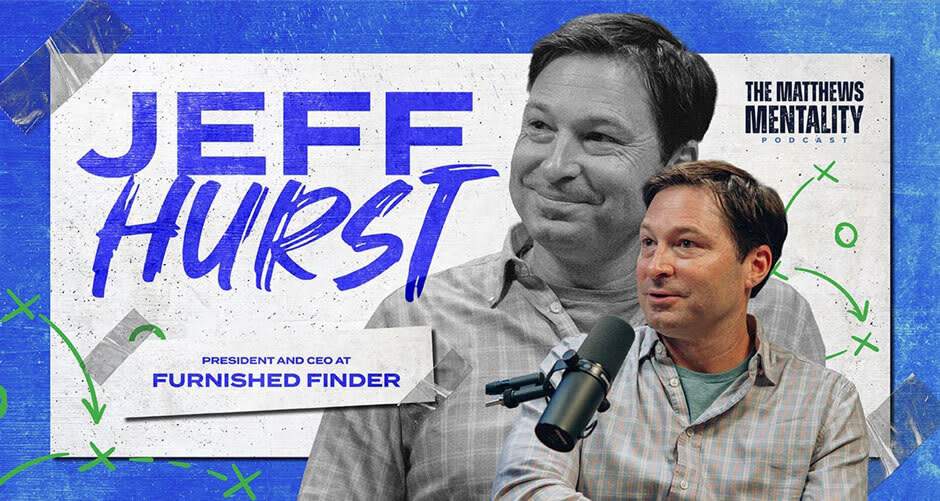
If you know Furnished Finder (opens in new tab), you know it as the leading marketplace for monthly (mid-term) rentals. What many landlords want to understand better is the leadership and mindset behind the platform.
Jeff Hurst, CEO of Furnished Finder, brings decades of experience from the highest levels of travel and real estate technology. Before leading Furnished Finder, Jeff served as Chief Operating Officer of Expedia Brands, President of Vrbo, and Chief Strategy Officer of HomeAway, where he played a key role in the company’s acquisition by Expedia. Few executives have had a front-row seat to the evolution of short-term and midterm rentals.
In a recent episode of the Matthews Mentality podcast (opens in new tab) with Kyle Matthews, Jeff shared not just his professional journey, but the mindset lessons that shaped his career. For Furnished Finder landlords, these lessons apply directly to building a resilient rental business and a sustainable life.
The hard work mindset: measured by seasons of life
Jeff is clear about one thing. Hard work was non-negotiable early in his career.
In his 20s and 30s, Jeff regularly worked 60 to 70 hour weeks. Not because he believed in burnout, but because he believed in seasons. Some seasons require acceleration. Others allow you to take the foot off the pedal and maintain what you’ve built.
Rather than chasing daily work life balance, Jeff focused on long-term trajectory. He viewed hard work as an investment that compounds, much like real estate. This perspective resonates deeply with Furnished Finder landlords who understand that upfront effort in furnishing, pricing, and tenant communication creates long-term stability. The key takeaway is simple: Balance is not measured by a single week. It is measured over seasons of life.
Comparison is the thief of joy: the Vrbo vs Airbnb lesson
One of the most powerful themes Jeff discussed was comparison.
While leading Vrbo, Jeff and his team constantly measured themselves against Airbnb. Despite building a highly successful and profitable business, the comparison created dissatisfaction and distraction. Airbnb was bigger. Airbnb was louder. Airbnb captured headlines.
The lesson came later. Vrbo did not need to win the same game to win for its customers.
Jeff shared that the reset happened when Vrbo stopped obsessing over Airbnb and instead focused on what it did best. Serving complex family vacations and longer vacation stays.
This lesson directly applies to monthly rental owners. Furnished Finder is not Airbnb and monthly furnished rentals are not short-term rentals. And they do not need to be.
Trying to copy short-term rental strategies often leads to higher risk, higher fees, and regulatory headaches. Furnished Finder landlords succeed by focusing on a different customer, a different stay length, and a different value proposition such as business professionals and relocating families that need monthly flexible housing.
Comparison steals clarity. Focus creates momentum.
Learning through missed opportunities
Jeff openly shared some of his biggest career regrets. Not failures, but missed opportunities.
He passed on early chances to co-found or join companies like Bonobos, Trunk Club, and Tecovas. Each went on to sell for hundreds of millions of dollars.
The lesson was not about money. It was about risk tolerance.
Jeff realized that early in his career, he optimized for stability over ownership. In hindsight, he learned that the best time to take big swings is when your personal burn rate is low.
For landlords, this translates into starting sooner, starting smaller, and learning faster. Many successful Furnished Finder hosts began with one unit, a room rental, or a furnished ADU before scaling.
Missed opportunities are only failures if you do not learn from them.
Where Jeff found his discipline
Discipline often comes from unexpected moments.
For Jeff, it started with a childhood experience. His uncle took him to a Houston Rockets game and they sat courtside. At seven years old, Jeff saw a different version of life and asked what it took to get there.
The answer was simple. Hard work over a long period of time.
That moment planted a seed. Discipline became a learned behavior, reinforced by consistency and example. Over time, it shaped how Jeff approached school, career decisions, and leadership.
For landlords, discipline shows up in small actions. Screening tenants carefully. Maintaining properties consistently. Treating rentals as a business, not a hobby.
Success is rarely one big decision. It is thousands of disciplined ones.
Early career principles that shape future success
Jeff and a close friend teach a course at the University of Texas called What you should know your first five years out. The advice applies just as well to new investors and career switchers.
Jeff’s core guidance includes:
Keep your burn rate low
If you spend everything you earn, you remove your ability to take smart risks later.
Relationships compound faster than resumes
Work hard early, even in roles you may not love. The people you impress today often create opportunities years later.
Take swings early
Take swings early, they are easier to absorb and often clarify what actually matters. As commitments grow, the cost of indecision rises.
Jeff’s perspective on conflict and direct communication
One of the more practical lessons Jeff shared was his view on conflict. Not as something to avoid, but as a necessary part of progress.
Jeff explained that early in his career, he softened feedback in an effort to be kind. Over time, he realized that avoiding direct conversations often did more harm than good. When people are shielded from hard truths, they lose the chance to improve.
What changed for Jeff was intent. Conflict, when handled well, is not about winning or being harsh. It is about helping someone understand impact, learn faster, and move forward with clarity.
He emphasized that direct feedback works best when it is grounded in trust. When people know you are invested in their success, honesty feels supportive rather than personal. The goal is not comfort. The goal is growth.
For Furnished Finder landlords, this lesson shows up in everyday situations. Clear expectations with tenants. Direct conversations with partners. Honest assessments of what is working and what is not. Avoiding these conversations rarely makes things easier.
Jeff’s takeaway is simple: Being clear is often the most respectful choice. Conflict handled thoughtfully creates better outcomes than silence.
What drives Jeff today: leading by example
As Jeff’s career has evolved, what motivates him has shifted. Earlier in life, his drive came from proving himself and building momentum. Today, it is rooted in role modeling.
Jeff spoke openly about how becoming a parent changed his perspective. His work is not about outcomes or titles, but about the example he sets through his choices, habits, and values. How he shows up at work and at home matters because others are watching, especially his children.
That lens influences how Jeff leads. He thinks carefully about what behaviors he is reinforcing, what tradeoffs he is making, and which parts of himself he wants others to learn from. Success is no longer measured only by achievement, but by consistency and integrity over time.
For Furnished Finder landlords, this idea often resonates more than expected. Real estate investing is rarely just a spreadsheet decision. It is something spouses notice, children observe, and families live with. The way owners handle responsibility, uncertainty, and long-term thinking becomes part of their culture.
Jeff’s message is not about perfection. It is about awareness. Leadership, whether in a company or a rental business, is always modeling something. The question is whether that example is intentional.
Why this mindset matters for Furnished Finder landlords
Mindset lessons like these explain why Furnished Finder (opens in new tab) is built differently.
The platform prioritizes direct communication, no booking fees, and stable monthly stays because it reflects strategic thinking with monthly flexible housing in mind. It serves landlords who value predictability over volatility and tenants who value affordability over flash.
Jeff’s leadership philosophy aligns with the realities of monthly rentals. Sustainable income. Respectful tenants. Fewer surprises.
For landlords building wealth with monthly furnished rentals, Jeff's story is a reminder that mindset is often the most valuable asset you own. Watch the full podcast episode below.
Transcript
Wealth is relative um and happiness can be relative too and when you mix them so much together and so if you move into a neighborhood you know what your example on vacation rentals is a great real estate theory it may not always be a great happiness theory like the way to accumulate wealth may not always be the way to accumulate happiness and so choosing your neighborhood and your friend group so that you might find more balance from them or find different types of relationships different perspectives is a choice and you don't have to approach it competitively as what's the nicest place I can be in because you may end up with a peer set that is not actually who you would normally choose to spend the most time with. And so really be thoughtful around who those people are. [Music] Today's guest has a front row seat to the future of flexible housing and travel, Jeff Hurst. Jeff is the president and CEO of Furnished Finder, where he leads the nation's largest platform for midterm rentals, serving traveling professionals, families, and individuals seeking furnished housing. He brings a wealth of experience from some of the most transformative companies in the industry, shaping how people find and experience places to stay. Before joining Furnished Finder, Jeff served as the chief operating officer of Expedia Brands and co-lead of Expedia Group Marketing, overseeing brand growth and operations on a global scale. Also as president of VRBO, he guided the company's worldwide expansion. And during his time as chief strategy officer at home away, he played a pivotal role in his acquisition by Expedia, one of the most significant transactions in the vacation rental industry. Jeff's perspective on flexible housing is also informed by his personal investments as a real estate owner. Let's go. Love real estate owners and operator based in Texas. He manages several successful rental properties and when he's not building companies, he's traveling traveling with his wife and their two children exploring destinations across the globe. Before we dive in, don't forget to like, share, and subscribe to the Matthews Mentality podcast. Jeff, welcome to the podcast. Thank you for having me. It's a pleasure to be with you in Nashville. No, I mean, I'm I'm Thanks for coming to Nashville from Austin, Texas. Right. Absolutely. Yeah, it's a it's a nice way to beat the heat this week. It was uh oppressively hot. Yeah, I hear that about Austin. Yeah, I get that way. It it does get that way in Austin, Texas in general. Um it does get hot out here in Nashville from time to time. All right, talk to me about the the rental industry. And when I say kind of the longer term rental, I don't necessarily want to describe it just as vacation rentals because I know you guys don't necessarily only cater to the vacation rental crowd, but let's walk the audience through that industry. All right. that and and then your platform specifically, Furnished Finder. Yeah, I like to describe it as there's these kind of like um we're in the valley between these giants. And so on one side you've got giants in the long-term space and that's Co-Star and Zillow. And so the consumer properties are apartments.com, home.comhomes.com, and Zillow. And they do, you know, obviously for sale, but they also do huge rentals businesses. And then on the other side, the titans are Airbnb, probably the best known, but also Booking.com and Expedia, which owns company I used to work at, Verbbo. And so that one side with Airbnb and booking is really focused on leisure. And they're really focused on short stays, average stays less than seven days, probably like four. The other side is really focused on annual leases. And so the rental businesses for Zillow and Apartments.com overwhelmingly multifamily and typically unfernished and annual. In the middle is Furnished Finder. Furnished Finder is monthly furnished housing. And so what we do is provide a service that allows you to save money and communicate directly with landlords versus an Airbnb, but also find inventory that you wouldn't find on Zillow or Apartments.com. And so as a frame of reference, we think Airbnb has about maybe 150 to 200,000 homes that are monthly furnished rentals in the US. Zillow and Apartments.com probably have about 80,000 and we have about 300,000. And so there's more inventory, but it is a little bit of a throwback in that you're reaching out directly almost like Craigslist or Facebook Marketplace, but with tighter quality controls. give us um I'm gonna ask you to kind of generalize here, but give us a a general sense of who are your kind of bucket of customers. U I know one of the one of the big ones for you guys is travel nurses. Yep. What are some of the different groups of people that you've seen kind of overwhelming using your service versus the 12 month and then the 4day? Yeah. So, we're a marketplace. So, I think about customers on both sides. On the landlord side, the customers are independent landlords. you know, overwhelmingly people have a single property and so we're not working with, you know, the massive developers. We're not working with the gray stars. People don't come to our platform to advertise multif family and so it's independent landlords on one side. Typically, people, this is like their largest store of wealth outside their primary residence. And on the tenant side, what you have is we got famous for traveling healthcare, travel nurses. That's about a quarter of our business. The biggest use case is actually corporate. Corporate, I'd say, has a split. There's skilled trade corporate which is construction for your data centers, for your skyscrapers, for your multif family. And then there's corporate that's more like you might be a traveling salesperson, you might be an entrepreneur, you might have to relocate for a consulting job. So that's the biggest. Then traveling healthcare, relocating is the fastest growing. Relocating families are somebody's moving to Nashville, maybe from Dallas. They don't know what neighborhood they want to live in. They don't know if the school is a right fit for them. So they're going to rent for 3 to six months, figure it out, and then buy. And then the last use case for us is really academics. A lot of graduate students and professors who move around a lot, don't move furniture and are traveling on a budget. Yeah. I got to get my parents a Furnished Finder account because they're in Los Angeles a lot of myself, my brothers, I think my sisters thinking about relocating. And so for them, they're like, you know, we want to find a place in Nashville. We don't know where we want to live. And I've said, hey, find a furnished home or furnished apartment. And I guess yours would be from my perspective for my parents perfect it's like that three to six month because 12 months is a long time you know ideally they would probably like to find a more permanent solution but again the VRBO or Airbnb is a much shorter term dynamic. Yeah. And Verbbo and Airbnb it can be hard to find places for 3 4 months because people are taking bookings all the way out. You know somebody in Nashville's got a booking for a big concert or a Vanderbilt game or you know whatever's happening. And so the CMA awards, the uh you know, Airbnb often will recommend you make four moves to do a three-month stay, and it's like, well, that's a pain in the ass. And so our platform is more built around an assumption you're going to extend. And so someone comes for 3 months, maybe they'll stay for 12, but you've got more flexibility. What is Let me ask you, like I've always thought about this because I have used Verbbo, I've used Airbnb, like just for vacations, you know, um over the years when you have a lot of kids as part of the deal. Uh what what are what's the wildest story or two that you you've heard of or that you know happened, you know, from a uh a renters's perspective of like what tenants would do in the space? Like kind of wrapping that, what is the risk to someone leasing their space in a more long-term format? Yeah, I I think the um you know, the risk profile changes depending on how long the format is. And so, you know, I think the short-term risk is actually the greatest. Agreed. because you're not putting much capital out, you know, and so you're going for a long weekend, you know, like the Yeah, you've got spring breakers there or you've got somebody who's, you know, a high schooler who's going to throw a party and everyone's going to be underage or those types of dynamics are what I think gave short-term rentals a bad rap and in many cities made them regulated away. You know, this not in my backyard movement. the risk is damage to your house and it's, you know, and it's honestly damage to reputation because your neighbors aren't thrilled when it happens either and then you've got to deal with the stigma and live with it. You know, as you go longer term, the risk gets less. Um, you know, I'd say when you're in that annual plus, the risk is that there's a bad tenant and you're kind of stuck with them. And then when you're in the midterm, it is a little bit of the Goldilocks thing of like it's probably closer to just right. You know, you're typically a traveling professional. you've got more of an out because they're usually there for 90 days. And the use cases are uh more attuned to someone who's going to be respectful and your neighbors are likely to be thrilled that there's a nurse living next door or an academic or a family that might be trying to move to town that they're excited to see, you know, have kids in the neighborhood. When you're at Verbbo, what was maybe the craziest story that made its way up to you as to something that happened in the short term? I tell you the craziest story very personal to me. Uh we were CO had just started. I mean CO was at the peak like travel restrictions were starting and so we were in the process of notifying people that the um they weren't going to be able to travel and I remember it was probably the third week of March. It was right after spring break we didn't go on. My wife and I both get phone calls and text messages in the middle of the night and it is a number from Florida leaving us threats because they are not able to go on their trip to Panama City. It's like this is canceled. It's your fault. I'm going to you leave us both text messages, leave us phone messages. And it was just this, you know, it was a crazy time. But it was also I mean it was I think it was like an $800 reservation. And my wife wakes up and she's like, "What have you gotten us into?" like what is happening here? And you know it was it was a it was a weird moment where like being an executive that you don't think of yourself as public gets really public really fast. And so we start thinking about security at our house and start thinking about what do we how do we know if this person from Florida is like driving to Texas right now and what's happening and like nothing ever came of it. But it was a good reminder how personal these things are. Sure. and how messy they can get fast in terms of like I'm making decisions that often I think of in a macro context of well this is going to be better for the broad group and you know maybe some people will be impacted but like each of those individual impacts you know can go wildly wrong and you know I you know we woke up for many weeks after that just like you know I can only somebody coming I can only imagine this is crazy Florida man they're crazy uh did you give them the 800 bucks Well, that was the the irony is, you know, we reported it to the police and the FBI. There's no way to give this guy his money back without identifying identifying him and then trying to arrest him. So, it's like, you've really done yourself a disservice here versus writing a cordial LinkedIn note or email and describing the situation and seeing how we can help. Like, there's no way to get this guy's money back because I was about to say that would take too much effort, but he probably had to go through a lot of effort to find you and your wife's cell phones. finding I I have I I I still don't know how he found found that information. Like ended up hiring a service to like purge records and figure out how people find me and that sort of stuff. No, commercial real estate brokerage. I could show you after the podcast. Pretty good at finding that stuff. Yeah, it's not that hard. It's not that hard. Um Gez. So yeah, that's pretty messed up on one hand, you know. I mean that's I mean that is a serious thing. I'm sorry that you went through. The other hand like that guy really wanted to party. That guy was ready to go to Panama City. Co was not gonna stop him. I mean, Panama City Beach, 1999. Like, it goes down. Isn't that where they used to film all those crazy videos that girls gone wild? I've never watched one, just to be clear. I someone told me about it one time. Uh, no. See, man. Yeah. So, that is a that is that's intense, but that's also very personal. Yeah, that was a that was as wild as it got for me. I mean, there was always a story of, you know, something went wrong at a house, some party got out of hand. I remember Airbnb, it wasn't us, Airbnb had a bunch of stories of meth labs where people would rent a house, put in a meth lab, and it would blow up. That was the Breaking Bad era, right? Didn't uh Walter White do that in one of the episodes? Didn't he like Oh, no. There's a home being tented for like termites, and he and he broke into it. Yeah. Yeah. See, the home and the RVs. Yeah. You got to charge extra if you're going to rent your house to be a meth lab because there's lots of liability. Uh, all right. So, you were talking about stigmatizing what the issue of renting a home for a week. So, I'll give you a little personal story. I don't have I shared this something. So, I buy this house in um 3A, you know, not Panama City Beach, uh but down in the panhandle, really nice area. And it was it was in this little gated community of 25 other homes, right? It was the house I bought was very nice, but it was like the worst property on the best block. As a real estate guy, that's what you always want to do. You always want to buy. And this area had one of the homes sold for like 35 million bucks. It was really nice. And so, you know, I use it six to eight weeks out of the year, a little bit, you know, summer, maybe maybe spring or fall break, a little bit in the winter, but when I'm not using, I was like, rent it out, right? Why not? There's nothing against it. And so, I um I rented it out uh for spring break. You could get, don't quote me on this, 20, 30 grand a week here. Of course, I'm going to rent out spring spring break. And I'm naive. I've never done a rental. I have a property management company that handles it. Uh what I'm sure they put it on Airbnb and Verbbo fine and I asked the question like hey you guys vet the tenants right? Yeah, of course. We've had the ten it's like the you adults and their credit score and they have to sign this that. It never occurred to me that some parents so desperately want to either be their kids' friends or want their kids to have friends like they would sign and in essence I guess guarantee um guarantee the damage. All of a sudden I get a I get a video from one of my neighbors like like it just says like are you kidding me? you know, and his house could look down into mine. It was a big house, like eight bedrooms, and it was like, I swear to God, 60 people in the pool like partying, and I was, you know, at first I'm like, whose house is that? But that was my house. And so, um, we were able to get them out after a couple days for a million violations, but it it's pissed my neighbors off so much. And they were all so wealthy that like I guess they didn't have to rent their house. Like, but I'm I'm sitting there like 30 grand for a week. cuz I'm not going to be down there as a no-brainer. Um, they got together and amended the HOA for sure to eliminate short-term rentals of less than 30 days. Yeah. And so I remember being on like these HOA calls like HOA nothing ever good came from an HOA and just like guys like this I bought the house knowing that I could do this. You're changing after the fact. Like they were they weren't interested. So inevitably they took away my right to rent those bastards. But uh but I understand that regulatory capture and then happens to everybody. And then again like you know say this humbly as possible. I've done okay in business but I just felt like I just felt like I was like oh you're the guy who rented the home like you loser. And I was like h gez. So they banded together. Be careful. Be careful with those short-term rentals cuz the HOA will come after you. They'll get you. You know the cities will get you. The HOAs will get you. I mean, it's uh, you know, less than 30-day legals is basically illegal in Los Angeles and New York, most of San Francisco, Chicago, Dallas. Like, it's a and in a 25 unit development in Florida, you know, and most of it is uh, you know, most of it's actually the hotel lobby, you know, acting in the best interest of the hotel lobby, but a lot of it is not in my backyard activist who have an experience like your neighbors had. And it's a uh, it's a disenfranchised voter class because you can't vote in 38, whatever town it is. was in the HOA. It was It was 20. It was like 25 owners. It was like 22 to three. And I said, "Hey, I said, "What about this?" I said, "This seems I get it. I get it. I understand your position. I bought this. This was a right I had. Nobody disputes it. How about this?" all agree and maybe you could write this into the deed or you know all agree that if and when I sell the property to deed restrict this home so that anyone buying it in the future knows that they can't short-term rental it and they're like nope I was like all right fair enough anyway ended up selling them all did really did really well so actually because of this I said okay I'm going to sell this and I sold it and I it was like peak peak peak and then it's gone down so thank you HOA thank you I appreciate 38 was briefly the top vacation destination on earth. Yeah. On earth because Florida was so wide open and it was the place where everybody could drive to and so you know kind of like early co it was absolutely bananas. I bought it in 21, sold in 23 and like I I'll check you nailed that one. Yeah. Yeah, dude. Crush it. Um but only I I would still own the home if the HOA hadn't you know just banned it against me. Yeah. And those properties aren't, you know, for Furnished Finder and midterm rentals, like that's not a great professional monthly rental. You know, we're one to threebedroom studios, a lot of that stuff. And so when that type of ride goes away for a short-term rental, you're kind of stuck. Give the audience just a high level of your career. Obviously, you're CEO, this big fast growing company, but that doesn't just happen overnight. You're from Dallas area. You went to UT Austin. just give us kind of high level like walk us give us the story arc in terms of your professional career and how you how you ended up as a CEO for getting coming out of UT I know I wanted to leave leave Texas uh had an offer to go to Goldman Sachs in New York figured I'd do that few buddies and I actually went to San Francisco on a lark to interview at Mackenzie because we took eight of our friends including my future wife to stay in our hotels and just like enjoy San Francisco ended up getting job offers and so I started off as a management consultant did that for a few years. Um went to Stanford for business school and then we had our daughter shortly after that 2010 and kind of being on the West Coast just broke for us. You know, I was a consultant. I was traveling and I uh wanted to get back to Texas where my wife's family and my family was. Enjoyed Homeaway, which was a private company at the time. And Homeaway was rolling up all these smaller vacation rental sites and building, you know, a one-stop shop and Amazon for vacation rentals. Um I joined them, took it through IPO and then ultimately sailed to Expedia as the chief strategy officer and most of the other executives left. I stayed on and ran sales and general management ultimately becoming the president of Verbbo and then went into Expedia roles where I was the chief uh chief marketing officer and chief operating officer. So it was unique in that like you know it was 13 years it was a very long stretch all in travelte and you know when it breaks it breaks bad. learned the lessons of how you know not all executives stay forever. Took a year off and then uh was able to find Furnished Finder which kind of a hidden gem with a private equity company and we bought a majority share from the founders and off to the races about a year and a half ago. What would you attribute your success you know getting to the seauite having successful exits now finding yourself in the chief executive role like if you had to pick one thing that in your humble opinion and I know it's hard to be accurate in your self- assessments but that that you think you did well or that people saw you know a certain skill or characteristic within you that that the audience could maybe listen and learn from and and try and adopt themselves. Yeah. I think I think the first one's trit in that I always worked hard. Like I think I always was, you know, hard work, huh? I was always I was always early in. I was always laid out and I never really shut it off. Um, and you know, in particular in my 20s and 30s when I think there's the most acceleration. That was a big part of it. The second part, can I can I push pause right there? What what what did an average day look like for you? Like what time would you get in? What time you say? Because people could have different definitions of hard work. a different I mean I I'd also say the definition of hard work in Austin was different than the definition of hard work in San Francisco and so I kept working like I was on the coast which was a lot more than people were working in Austin you know I was probably I would take the kid probably take a kid to daycare early be in the office before 8 and be there until after dinner come home help with get the kids to bed and then work from home and you know so I bet it was 60 to 70 hour weeks um when we were early. Why were you work like why didn't you search for work life balance early like what was driving you? What was your motivation? I my my perspective on work life balance is that you can't you can't measure it in micro and so and and I think I felt that way early and that you've got to think of it more as like seasons of life and I knew I was at a fast growing company where I had the chance for a lot of acceleration and it was a moment where like you know work was coming you know I wasn't I was a young parent we had one not two kids at that time and so it was like you know work was probably in pole position and then I would be there as much as I could while the kids weren't asleep and help and like social suffered and I spent less time with friends for a while and but the seasonal view of it was like I knew I was in a moment where I could accelerate my career a lot and probably get some more balance back later and so I started to think of it much more around acknowledge where you are and what the opportunity is and sometimes you know there are professional lols and when I found one of those I didn't get anxious about it of like okay we're in a spot where like it requires less of me I took it much more of we're in a spot where I can take my foot off the gas a little and take more vacation or go reconnect with some friends that I maybe otherwise wouldn't have done. And so I really encourage people to think about like, you know, not am I balanced today or this week or this month, but like what has it looked like over the past quarter, the past year, and what do I think it's going to look like and what works for me? And what worked for me was frankly like a higher quotion of work than what might not work for everybody. I I've I've shared the story a couple times. I was being interviewed. This was like a decade ago and I was working long hours. I also had a family and this was maybe LA Business Journal was like well you know what do you how do you how do you find work life balance and I was like well by definition work life I then I'm going to view balance over the course of my life like and let's just say professionally over 40 years this is how I see it. My first 10 years it's all work. My second 10 years it's actually a pretty decent balance. And then the last 10 to 20 years effectively if I choose to I don't have to work. It's elective. It's elective. It's elective. And if nothing else I'm putting bed putting to bed for me personally and I think for most people the biggest driver of lack of mental health was just financial anxiety. Like just like oh my god how am I going to pay my bill? Let alone how am I going to provide my kids the opportunities I want and everything in between. So um I said for you I think you're you're looking at it over 40 hours over over a week like so yeah in in any one week right now in this stage of my life maybe this was 15 years ago I said I don't have work work week balance the way you do like you're going to work 40 hours and you're going to socialize 40 hours like me I'm going to work 75 to 80 hours and I might get like a couple hours in. Yeah. Um, but it was my opinion at a young age, I think similar to you, that that there are seasons of life and you could frontload and compounding nature of wealth and really the compounding nature of a career is the more you confront it, the more it compounds and grows exponentially faster. Um, so I couldn't agree with you more. What's the best piece of advice you've ever gotten? Uh, comparison is the thief of joy. Oh man. And so, you know, the um it's the first time I heard it was uh was actually at Stanford. It was in the context of like be really thoughtful about who your neighbors are, what neighborhoods you're going to live in, who your neighbors are, and that you know, keeping up with the Joneses is a dynamic that they never win. Like, and who'd you hear that from? Do you remember? Uh, was I believe it was Gar Saloner. Um, were they making I'm just I'm just kind of like spitballing here. I've never heard this. Um, were they making the argument and I'm just going to that if you make a million dollars, don't live in a neighborhood where people make a million or more. like actually live in a neighborhood where people make a lot less. Was that the argument? Um that wasn't the entirety of it, but it was basically like uh a lot of wealth is wealth is relative. Um and happiness can be relative too. And when you mix them so much together and so if you move into a neighborhood, you know what your example on vacation rentals is a great real estate theory. It may not always be a great happiness theory. Like the way to accumulate wealth may not always be the way to accumulate happiness. And so choosing your neighborhood and your friend groups so that you might find more balance from them or find different types of relationships, different perspectives is a real choice. And you don't have to approach it competitively as what's the nicest place I can be in because you may end up with a peer set that is not actually who you would normally choose to spend the most time with. And so really be thoughtful around who those people are. And so that, you know, I live in a nice neighborhood and it's like it's not as though I followed it to the tea, but like I don't live in the nicest neighborhood in Austin. Um, and I think that some of that has definitely benefited like the financial like my my my happiness in the way that like where my kids go to school I think is a little more well-rounded and the types of things we do on the weekend is a little more accessible and I'm not as prone to have like you know friends asking why we don't have a jet or how come we don't you know summer int or whatever it is like it's just a little more normal and those things add up over time and so I think that comparison is the thief of joy was a early indicator and then it flew through into my life where like professionally it was a really big challenge for us. Um because Homeboy Verbbo was coming up at the same time as Airbnb. You know, we had gone public. We were worth $4 billion. Airbnb had raised a bunch of money and was a high flyer worth a billion dollars and we compared ourselves to them forever and we built this hugely successful company that helps a ton of families, you know, spend quality time together. Airbnb built something different and you know at the end of it when I was president of Verbbo we had to just do this reset because we had built a really successful and valuable company and felt like losers because Airbnb was worth 60 or 70 billion and they had built this global behemoth and like there was so much what could have been instead of focusing on what our strengths were and what we could do better and how to better serve customers that we just lost the plot a little bit. How did you reset? How do you know let's say you took Verbbo from 1 to 10 billion? Y but in that same time maybe even after you Airbnb went from half a billion to 70 billion and that it sounds like led you to feel like man we're losers like we did a bad job. How did you or did you not like but how did you reset to say you know what taking a company 1 to 10 billion in the financial and professional sex success like that's pretty good. Yeah it was you know it was a phenomenal run. The reset was around stop trying to beat Airbnb. Like I mean I remember at one point we had t-shirts that said like win versus like it was like just [ __ ] win. Just beat Airbnb figure it out. And we didn't have the assets to do it. And so when we reset we reset around the company around the customer and it was like be in the customer's shoes and the mantra became we want to build the best complex family vacation product. And like that was the kernel of it was that it's really hard to plan a vacation with your parents and your kids and your brother and their there's so many different opinions and so many different needs. We're like if we can solve this thing there's a great business and there's a great durable business. Let's obsess over solving it and that built a real wedge for us that was a niche of Airbnb but was never going to be bigger. What was the biggest outside of comparisons? Thief of Joy was what was like the biggest mistake of your career that maybe taught you the most but was in some ways the most painful going through it? Um I'd have two. Uh there's a group that's more personal in nature and then there's one that's more professional. So personally I've got a close friend from Stanford who's been a phenomenally successful entrepreneur. And so at a at business school our spring project was actually to write the business case for a men's pants line. And so we did and uh we were getting out of Stanford. And he's like, "Hey, we should let's do this together. Let's co-ound it." I was like I was like, "Listen, man. I that's cool for you. You're single. You want to go do this thing? Great. I I'm married. I've got this offer. Like it's just not the right time. Go have fun." He uh you know, grew the company, sold it. It was Bonobos. Sold it to Walmart for a few hundred million dollars. I was gonna say, "I think I know who you're talking about." I was like, "Ah, you know, strike one." Um four years later, I just had my daughter. He approached me again. and he was uh hey, I've got this idea. It's a it's a fashion company where they ship you the fashion and you've got a private um you know, private shopper and it's called Trunk Club. I want you to be that like why don't you go do this with me? You'll be employee one. We'll go figure it out. And I was like, I just had a daughter so I don't think this is going to be right. He sold that to Nordstrom for several hundred million six years later. And then I'd started at Home Away and he's like, I met this founder and it's uh it's really interesting. It's direct order boots and I want you to meet him. And I went and met Paul. He started Tokovas and it's worth several hundred million dollars. I was like the pattern in my life was one of I wasn't willing to take the risk and give up the comfort to really be an agent and an owner. What was the name of the of your friend who did all this? Brian Spa. Yeah. He did a podcast where maybe it's a founders podcast or something like where he talked about it. Can you give Brian my cell phone and next time he has a good idea just you know I I'm you know I'll work for food. Yeah. And it's, you know, and it it it taught me a lot about myself in that like what are the things I value and how do I approach these decisions and like my career in life turned out fine and that's great. But yeah, I think you did okay. It was a lot of um you know in the rearview mirror there's some like whoa. And I mean even going back earlier in my career the uh I was leaving Mckenzie kind of hideof money ball. Um and I had an offer to go do that for the A's when they were getting started. And Oh, I thought you meant that as a metaphor. No. You mean I was leaving Mackenzie and like it was kind of like the the consultants and bankers were the ones doing starting this trend and I was like but I was going to make half as much money and I wasn't going to be able to go to Tahoe and it was like that really taught me about burn rate and you know I missed an opportunity to do something I might have been super passionate about and that I loved because I hadn't kept my burn rate low enough to be able to afford to make less money. And so when I speak at colleges that's the thing I emphasize the most is like if you're going to take a huge risk in life take it at the beginning of your career the end. It's really hard to take a huge risk when you've got four kids and a mortgage and you're trying to figure it out. You've got these bookends where you can swing and it's not a failure, especially early to swing and miss. Like it's just lessons and you think of it a failure because school's conditioned you that you failed, but that's not that's not how it works when you're out of school. Yeah. You even in your fa I mean I think most people would argue that you learn the most when you fail. Not that you should seek out, hey, let me just go find a bunch of things to fail at, but you definitely learn the most. And then you can take those with you on the next venture. That will likely increase the probabilities the next thing you do is successful. So personal mistakes, a couple missed uh opportunities and I think you said there was a professional one or Yeah, the the professional one we were I was new at Homeway. It was probably late 2010, maybe early 11. And Airbnb was a fraction of our size and we had uh you know uh our CEO, our co-founders were friendly with their co-founders. I don't think Airbnb ever would have sold or merged, but like we thought they might and we kind of ran game theory around like is this an interesting thing to own? And I made a passionate case that this was not a good business and we should not be trying to buy it. Like it's got too many regulatory issues. It's got um lower unit economics than ours. It's not clear that it's going to be legal in all cases. Like just over and over and over I was browbeating that like this wasn't a business that was as good of ours and we shouldn't trade down. And it totally missed the plot that it was a super disruptive business that had the potential to be way different and bigger than ours. And you know, we paid for that for a long time because I was so focused on what we were doing. I wasn't looking at what we could be doing and where the industry was going. Was there ever like did you ever have um a moment in your career where you kind of had the oh this could all fall apart or I might lose it all or just it's not going to work out. You know, I I um professionally from the standpoint of like am I going to lose my job? Is it gonna crater? That I don't remember that feeling. I always felt quite confident that I had like built good both followership and people who were supporting and pulling me through and had relationships that would overcome it. where I felt it was, you know, in particular, uh, we were building our house and we, you know, had a young family and I was very nervous that I had not listened to my own experience of keep your burn rate low. And so there were times and I was like, oh crap, like I have not managed my own personal finances as well as I have my professional, am I going to be able to keep this like house of cards moving and afloat? And that was scary cuz we were building a house. It was way over budget. And I was like, there's a real scenario. we will never live in this house if things don't turn around. And they did and it worked out. But like those were the sleepless nights was when you don't, you know, basically have enough, you know, firewood in the firewood pile to get you through a cold winter. I want to take the conversation back to I don't want to say mid what do you call medium-term rental housing. Um mid yeah midterm rentals people monthly furnished housing is what you type into Google. So, one of the things I was talking with my team the other day was we were talking about Furnished Finder and you know where I'm at married four kids like I really would the only time I've used and or see myself using is like the 7-day vacation in Charleston or 3A or wherever you go right and and and to your point um Verbbo Airbnb maybe but they were like oh yeah Furnished Finder let me let me tell you about some of I think Allison you were saying oh like one of my friends is uh because of the rise in remote work, in theory, you could be anywhere. And so they're like, "Hey, you know what? I'm I'm in Chicago. It's the winter. The weather's no fun. I'm just going to go live in San Diego for two months. I'm going to go on Furnished Finder." And are you seeing that that kind of develop in your in your renter base, in your customer base? Is that just is that just um is that just a buzzy thing people talk about but it's actually a tiny fraction of what happens or or because I I want to take this conversation just into like how is month-to-month rentals changing the way people you know kind of live work and travel and fast forward 10 20 years like do you think there'll be a big segment of the population where they just live in different places a lot because of the nature of remote work? Yeah, I used I you know at at Expedia and Burba I very much thought Brian Chesy and his Airbnb like the future of living is changing and like I did not believe it and now living it and being closer to it like I believe it. What's interesting to me is it's definitely happening with youth. You know furniture is not a good investment. people feel less um less of a deep attachment to the place they live in a way that they're more willing to be mobile for career, for personal relationships, for the weather. What I found most interesting and surprising is it actually I think has as much to do with your parents. And so the boomer population who has more wealth is actually way more likely to get out of Texas and go spend my mom spent eight weeks, you know, my mom spent eight weeks in Vermont this summer. And people are moving around, you know, either to be closer to grandkids, they're moving around to seek better weather, but they're in a place in their life to where they're really making the most of this kind of like 65 to 80 or even 60 to 80. And just being more mobile and not having the attachments of I've got to be here for, you know, my house, my whatever, and maybe even renting that out has been the thing that's most surprising to me. I think what you're going to see with that intersection is it'll start to turn over some of the home ownership on the, you know, for the boomers and Gen X, but I don't know that it's going to all trickle down into being that there's going to be more and more home ownership with millennials and Z. And I think they are actually pretty committed to like this just isn't the way to build wealth that it used to be. And they've got more life flexibility. They're not wasting money on furniture. and they've got all these other different investment opportunities that we didn't really have as much of. And when housing's expensive, the housing crisis shortage are real, and interest rates are high, I won't be shocked to just see renters as a percent of population keep increasing and the experience keep getting better, which would be more like Europe. It would be more like Europe. You know, Europe, um, different countries are, you know, somes have a lot of ownership, some don't, but when you're in like the UK, like there's a lot of monthly furnished rentals and a lot of month-to-month living. And I think we'll eventually get to a spot more like that. Has Furnish Finer looked at going outside the US or is there all types of regulations? No, we um it's kind of on the eventual but not the not the urgent. Uh we're in the middle of redoing our entire tech platform which includes currency and language and being prepared to do it. But we'll start with, you know, probably Canada and really being great for North America. There's not as much traveling around the world for 60 days as there is vacation rentals. And so like just the travel corridors, there is a lot of it for a week in Europe or a week in South America or going to Asia. There's not as much for 90 days or if there was longer term rentals in other countries. I'm just kind of again looking at it through the lens of like my family, it would probably be closer to a year than like a 3 to six month thing. Yeah. And and you know, we'll we'll see when we get there, but we think we've got a ton of opportunity in the US. So, speaking of, you know, more again more longerterm rentals and that could be 30 six months, 30 days, six months, 12 months, I'll meet people um or people who reach out often on social media like, "Hey, I'm getting into investing in commercial real estate. I'm buying a bunch of I'm I'm starting to buy vacation or rental homes, excuse me. In the short and limited experience I've had with that, it's generally I don't find it to be super cash flowing." um maybe more of a subsidizing strategy than anything. Tremendous kind of management lift even if you're not the property manager, which I don't recommend anyone be, but you just you just every week you're getting asked questions about like do we want to rent it for this many days? Is this this like what what you know what's the biggest I guess opportunity? And then also the biggest warning you'd have for people like what are they missing when it comes to creating wealth through investing in or buying monthly Yeah. Furnish rentals. Yeah. I think the um you know, the the long-term rental game is uh it's very slow wealth. You know, you can you can make cash flow work. It's less risky. You can figure it out with the annuals. The short-term rental is very high risk. I think where it works best for people is when they've got a big W2 and they can use it as a tax advantage. Um but or if they're going to, you know, have usage like your place on 30A. What's interesting about midterm is that you actually can have a great cash return profile for not a lot of capital in. And there's a few ways people do it. One is that, you know, the average footprint's a two-bedroom, and so you're more likely to be buying like a duplex or a smaller footprint, something that's got just a more manageable note that you can make cash on faster. The second thing is there's a lot of arbitrage in the midterminal space where you'll take a three-year master lease that's an unfernished duplex and then you'll actually furnish it and rent it out yourself as the tenant who's finding other tenants and then you're almost no cash in. You know, you're basically just furnishing and paying a month down and then you can use that to start to build the equity that you can then use to buy the next one or to keep taking out arbitrage leases. And then the last model, and we see quite a bit of this too, is it's actually just house hacking. people will add an ADU to their house. You can get favorable terms. You can do it with a heliloc. And then that becomes a mechanism to generate the cash to go buy something and then to add something else. And so there's these different ways to play with it that I think make it much more manageable in terms of how much capital it takes to get started, but also a much higher rate of return in terms of just like how quickly you get an IRRa that works. Yeah. As a someone who's in commercial real estate, I the challenge I've always seen from a economics perspective of buying a single family home as a rental, like as an investment property. Now, I haven't I always look at it just from like a 12-month lease. What could the home rent for? So, I haven't looked at it 3 to 6 months. And the idea of turning it every couple weeks, you know, it just no thank you. um is that you're competing with actual home buyers and home buyers having access to um homeowner financing which as we're finding out with uh what is it Lisa Cook the Fed governor chair you know saying that a principal residence isn't you know even if it's not it gets you get it gets you access to a different type of mortgage one that has higher LTV or lower rates and so that would be the difficulty because you're buying it as in theory you should you shouldn't be committing fraud and saying it's a principal residence when it's not. But then if you don't have the access to the same financing a homeowner, you're competing against the prices they can pay. But as a rental, it doesn't pencil. So I've always I've always wondered to myself like what am I missing about home rent rentals from a economics perspective? Um I you know I think the um in general you're probably not missing a lot. Yeah. you know, especially since you talked about approaching it from a cash return perspective. And so on a cash return perspective, I think it is frequently not great. It's adding in the tax and really the appreciation can be great. You know, you mentioned your place in 3A. You know, appreciation because there are more buyers and because there are often scarce assets like waterfront, ski in, ski out, has a great view. You can do great selling it. But it's frequently the case like I've I've got three of them. Uh only one of them has ever made money in a year. Yeah. They all lose money. Now, I've made a bunch of money on the other two because they're worth so much more than when I bought them and they've been a tax shield, but they're not kicking cash into the family coffers every year and they never have. Yeah. Yeah. The the the concern there is buying a property and the business plan being it needs to appreciate in order for me to make money. That's a you know, you get you get comfortable with it when you're using it and you've got family members, family memories and that sort of stuff is kind of the offset. Yeah. Um, what what do you think renting a place will look like 10 years relative to today? Like what what do you see the biggest difference, you know, looking out into the future versus the market today in your space? I think the biggest difference will be uh just the breadth of inventory and so just so much more. Yeah, there's going to be so much more furnished inventory. And so right now it is this kind of, you know, it's about pickle ball courts and foosball tables and it's it's leisure. You know, it's the bright neon on the walls and all that stuff. It's going to just start to feel more livable. And so, you know, I think maybe a easy way to describe it is what feels like stale corporate housing now is like the dominant force and monthly furnished will start to feel less stale and branch out and then that leisure use case on Airbnb will start to come in. but you'll just have a lot more choice when you're in central Nashville or even more so when you're in a suburb of Nashville. And so I think about all the towns that are, you know, kind of like winning smaller towns in Texas. It'd be like a Waco or a Colleen or a Temple. There's not great hotel options. There's not a ton of ready-made housing, but there is a lot of growth in people moving there. And you'll see these start to fill in those gaps in a way that'll give people a lot more choice. and a lot of landlords will make a lot of money. Where did um where do you think you found your discipline to have done what you've been able to do? I mean getting into Stanford is very difficult. So certainly it was I didn't get in the first time. Took two tries. There you go. Well again that's still not bad. My understanding Stanford's very selective. Uh but you you did get into Stanford. I assume you did well at UT Austin, right? Um were you always like that? I was always like that. you know, I mean, from like from elementary school, I've always like worked hard, got good grades, you know, I I um there was something in me, I knew in the neighborhood which families had gotten ahead and we were a totally fine, well situated middle-ass family. And my father was an attorney, my mom was a special education teacher, but we were never wealthy. And I knew who was and in particular my uh uncle was a wealthy investment maker. And I he took me to a Houston Rockets game when I was seven and we sat courtside and I was like that's it. And I had asked him about it. My mom had just told me how hard he worked his whole life and I just like never stopped working hard after that. You know, it was a um and so I think some of it's genetic but I think some of it is just like a learned discipline. I was going to say nature, nurture, both. I think it's a little bit of both. Yeah. You see, you got to have a chip on your shoulder and I think that's I had one of those pretty early. And yours, it sounds like, was, you know, it's kind of how you say, being the poorest kid on the block. That that's all relative, but yeah, it was I wanted more in a way that I uh I only knew how to describe it as wanting more money in a way that I think was quite vain and surface level, you know. I was going to ask how's that changed for the time and now that I I think as I've as I've earned more money over time and have more money, I've realized it's a bottomless pit of like never knowing what's enough. And so you've got to recalibrate around like what does happiness look like and how do you create it? Would you go back and talk to your 22-year-old self who's about to set out and say, "Hey, like don't don't stare into this bottomless pit or do the ends justify the means?" Like is it that actually gave you the fuel that in many ways powered you to get to where you are today? My uh my best friend and I teach a course at the business honors program at UT every year that is that is this. It's 21 year olds and the course is called what you should know your first 5 years out. And the big lessons we share um one is about burn rate and it's about don't spend everything you earn um unless you're committed to always earning more and making that like a life's drive and that that can be dangerous. Um you know the second is about how much relationships matter and that working hard your first few years out of college is how you build relationships and network. even if you don't like what you're doing, do it well because those are just such formative bridges you're building to create the option value to go do more. Um, and then the third was, you know, be willing to take a swing in a way that I didn't, you know, my friend eventually did. And really positioning people around this notion that what you're learning in school doesn't totally prepare you for what's next. It's not right and wrong. It's not got a 100 or you didn't. It's just like are you grinding? Are you learning? Are you meeting people? Do it again. Do it again. Do it again. So, you teach a college at in business honors at UT Austin. Great school. Great business school. I actually picked them for the natt national championship this year. I'm a big We still got a shot. I think that would that loss is the best thing that will happen to I very much agree. Yeah, Manning's going to figure it out. Yeah, they got a really good defense. I actually think the odds should be better. You'll win more if you bet a hundred bucks. Yeah, I'm not giving gamb gambling advice. Okay. But if hypothetically I were, put some money on UT Austin right now. What is it? It's uh September 3rd. Um you teach a class UT Austin Business School, phenomenal business school, business honors, things you should know your first five years out of college. Is that what it's titled? And the three things are first of all, understand your burn rate. Yep. And keep it low. Yep. Number two, relationships matter. Yep. So, whatever you're doing, even if you don't love it, go hard. Go all the way. Give your absolute best. And um people will take note. And three is take a take a take a swing. Take a swing. Take a shot. Yeah. And and and that that take a swing, you know, I'm not encouraging people to like go start a company, you don't know it's going to work. what we describe is just like be introspective and you know whether it's a journaling exercise which I don't do but like create the space on a walk and a workout to ask yourself like was this a good year was this a good month am I happy what would make me happier and don't don't be afraid to go chase the things that make you happier which could be recalibrating professional it's oftentimes moving you know somebody's in a city that they chose for professional reasons and they're just not happy in the city and it's like unwind that decision as fast as possible. Go live in a place you want to live because that's where you're going to build your life and relationships and career. And don't end up stuck in a place just because it was the first place where you found a job. Um, you said some people journal. You haven't journaled. I've tried that. I've done it for three or four months and I always I every time I've I've I've faded. Some people try meditation. At least in the my first 43 years in my life, I'm not capable of meditating. Um, what I found is running. And I don't even like to run, but when I run, my mind just races and I come up with a lot of creative ideas and I talk to myself and ask the questions like, "Do you like where you live or do you like what you do?" What do you do? I have a very large dog that requires a lot of exercise. What type of dog is this? Bernadoodle, 110 pounds. And because it's so hot in Texas, we walk early or late. And so I'm in charge of early. And so I wear a ruck vest. we walk, you know, depending on his mood, 45 to 90 minutes and like that's my time and you know, it's kind of like there's there's either it's silent and I'm really going introspective, which I say sometimes 5 6 a.m. for it not to be really hot. I think I do a lot of I think my best thinking like listening to I'd call it formative music for me. Like I listen to a lot of 90s hip-hop and like rock and like I'll put that on and just kind of see where my mind goes. And then sometimes I listen to podcasts and but between those three things that's where I I find my most creativity is like my body's moving. I'm out there and you know uh and able to just kind of reach into different corners of my mind. Yeah. You listen to that Matthews podcast. That's it. We catch it. And then the uh and I don't journal but I am really good about note takingaking and that like when something comes into my mind jot it down. Just don't lose it. And that's become a pretty big pattern of mine. Who's on the playlist? For formulative music, mid90s hiphop. Um, you know, a lot. So, probably the thing late 90s, early 2000s, Outcast gets the most play. Yeah, I think they're pretty fantastic. Um, you know, the most formative stuff would have been like the uh West Coast, Dre, Snoop, NWA, Ice Cube. That was a lot of those hits coming around on Spotify for me. And then a little bit of the Houston area rap scene. You know, we we still get some UGK and some ghetto boys. Uh Mike Jones, it's big X the plug. It's uh you know, it's interesting because my son listens to a lot of hip-hop and you know, it is different that like when I was listening to hip-hop, my dad was like, "What is this? It's garbage. I hate everything about this." And now I'm kind of like I could see like, you know, you can see the through lines. And it's uh it's very different. Modern day hip-hop versus '90s hip-hop sucks. It's just a uh the content is so different. It's not about the grind anymore. I'm I'm sure every generation says this about the next one like your music sucks. But like just speaking of hip-hop, you listen to hip-hop lyrics in the mid 90s. I mean, there was so much uh storytelling, so much meaning. Biggie, Tupac. Yeah. You know, even Eminem in a very different way. You know, Snoop Dre, Ice Cube, all those. I mean, I really felt like the lyrics were powerful. Now it's, you know, it's the same three things. You get you get some of it, but it's it's more rare now. It's much more drugs, you know. Um, yeah. You know, uh, so, so, you know, 6 a.m. you got CEO walking the burn a doodle, dropping like June and Juice lyrics. Is that how it rolls? That definitely happens. I'm getting the visual with a with a wrecking vest on. With a 25 pound ruck vest. Yeah. Just sweating and a and a big mug of coffee. Yeah. Just sweating. Uh, what's the what's the craziest like this can't be real moment you've had as a leader in business? like were you just like there's no way this is happening right now? Uh so I um 20 this was 2019 December December of 2019 I was the president of Verbo uh working for reporting the CEO of Expedia Group. I hadn't been in the role very long maybe six months. Flew to New York for a board meeting um chairman of the board Expedia very uh famous businessman Barry Diller. Uh so media mogul founded IA fascinating guy. Uh we walk into his boardroom at IIC. Uh me and all my colleagues on the executive team and you know immediately noticeable the CEO and CFO are not in the room. Barry walks out of his office into the boardroom lets us know that they have been dismissed and that we are going to talk about how we're going to run the company without them. And that began a new chapter of how Expedia Group was run. I met uh you know who would become Barry and Peter Kern were the uh co-CEOs for a while. And then COVID hit four months later and you know we really got into the weeds. You know COVID for travel companies. It wasn't that profit went negative, revenue went negative. We had three months of negative revenue because we were refunding more money than we took in which is not sustainable. I was going to say like it really I don't think I've ever heard of like revenue negative where you're paying people back more than you're you're just getting in revenue before even expenses are factored in. Um yeah I mean I I guess like for revenue negative companies during that time I mean especially like early on it was like well this is going to be years you know it's like I think the closest thing we had was like the influenza you know Spanish flu of 19 and it lasted a long time and a lot of people died. That must have been wild for you to have to navigate. It was it was wild to navigate and I mean I think the you know of the the wildness of the moment of realizing like how quickly the executive team changed over but also you know it was a uh it was a moment that was very defining for how I understood Barry's leadership of like for him to be comfortable with where the company was going. He wanted to get in the weeds and really know where the company was going. And like that was it was fascinating for me to see that type of work ethic and curiosity out of someone who was at that point in his career you know very time was probably late 70s had achieved just about everything you can in media and tech and was still just like well let's go figure this out again let's just go figure it out never stop grinding I met Barry Diller your friend Brian who founded bonobos you know Stanford MBA you're just going to meet a lot of them I'm sure through the network and just in business like what has been a common characteristic of some of the great business leaders that you've seen. Um I think curiosity is definitely a um the the depth at which they ask questions and how the questions aren't necessarily about the content but about what might be you know what's someone thinking here? what's um you know what do you what do you expect the emotion to be when you show them you know and it's like something tright like this web experience or this email and so I'd say curiosity is probably the top one I think the second one would be around um there's no wasted calories in communication just zero not a lot of pleases and thanks it's very it's very blunt it's very direct it's all about getting to the next thing and iterating quickly and that's contagious and when you're in that environment where people are both curious and iterating quickly on very direct to communication one it's super uncomfortable um like you have to confront a lot of harsh truths and you know Barry would always say that like decision-m is not meant to be comfortable like there the conflict is the process for him and that was interesting to observe those two things coming to life I've been talking with my exec team um there was a book radical cander I think it was by Kim Scott and it touched on this thing of ruinous empathy where like in the process of trying to um you know kind of protect someone's feelings you know against like really harsh criticism, you you don't actually provide them the feedback, the criticism, the coaching, however you want to, you know, kind of package it and then they don't get better and it's like it's ruinous to them in the long run, even though in the short run you're trying to, you know, almost protect them from feeling bad. Is that something you've you struggle with? Is that something you've had to because, you know, sounds like Barry Diller has no problem with it and conflict is the problem. I think the um uh I I don't think it's something I struggle with anymore. It is something I have struggled with. And you know, early in my career, it would have been like say two nice things and then the thing you really want to Yeah. improve on and like and and and that was a uh you know, that wasn't working. But what what works for me is building the relationship on people realizing that I am there for them and there to help them. And that that is the you know that's the majority of the experience. How can I help you do your job? How can I help make this better? And like I'm there in service of them. And occasionally that service is harsh because occasionally that I've built a relationship and trust that is around you know I'm here in your best interest and to make you successful. It may not even mean you're going to be here to be successful, but that's what I'm here for. That's built the layers and the acceptance of, hey, you need to you need to hear something hard today. Here's what you did. Here's the impact it had on me or someone else, and here's how we avoid it in the future. Do you get it? And just super direct. Got to be out there. I think most young people, that's hard. any generation, especially this one where um they've been raised in a very, you know, soft men create soft times. It's like a a very soft culture of like worrying about everyone's feelings. And again, bullying is bad. Like, but like everyone's so hyper sensitive to bullying and labels anything they don't like that happens to their kids some form of bullying. like that the the the young men and women entering the workforce today, they are so so nice to each other. Like they're so um sensitive to each other. They are so thoughtful about each other's feelings and you know and that shows up in how they communicate and the amount of like I'm sorry is no please you first that happens all the way to liking everyone's photos. Even I I I you'll see people like leave a company and like everyone's still at the company like likes likes, you know, it's like, "Hey, I've started this new company at a competitor." And everyone at the company like likes it like, "Hey, best of luck." And you're like, "Wait, what?" Like, they're at a competitor. If if that guy or gal succeeds, he will put you in your business or your your your career track negatively impact if not out of work. Like, what? And it's like, well, I meant, you know, but like I don't want to be mean. Yeah. And so, how do you coach young professionals to learn how to not be, you know, is the ruinous empathy? How to how to learn that conflict and being direct even if it hurts someone's feelings is actually the best the best choice or the best path. Yeah. I I think the um the the coaching about it is really around helping them to explore why they're having that feeling, you know, which is, you know, there's, you know, there's there's the giving of their feedback and the receiving of feedback. And it's creating a space where you can talk as much about the receiving of feedback as the giving. And it's like, listen, if you are saying something that's factually true, we have to be in a space to where we can explore whether you dispute the facts and if not, what did they mean to you and why? And if they have hurt your feelings or set you off kilter, like that's the interesting discussion. That's the growth. Like the observation of the facts and what you did should not be growth. Like it should just be part of history and you understand it and you either regret it or you don't. The what you're going to do next and how it impacted you. That's where you learn. And I think there is a lot of power and what I see with the younger generation for the kindness, but they have not heard as many harsh truths yet. And I think that there, you know, there's the potential that there's going to be something magical with them because they do have ability to be more introspective if they can get past that hump of really listening to more of the harsh truths. What um talk to the audience if someone's never used Furnishinder, I want to take it back to the company is what would be the best what would be the highest logical use case for someone who hasn't used it yet? Maybe, and again, I don't just mean as an owner, like it's a 25-year-old, they don't own a rental. Like, why should they go to the website, sign up, and start looking around? I think that the um, you know, if you're if you're in a phase of your, you know, if you're thinking about where to invest money or how do I get ahead with a side hustle, you come to the website to learn how easy it is to put a few thousand, $10,000, $30,000 of work and change your life with investing in real estate. Like to me it is the starter kit for how you can invest in real estate because it's a lower price point. It's a predictable return profile and there's a lot of people figuring out, you know, we've got almost a quarter million landlords on our platform that are making it work. There's a lot of people you can learn from and there's a vibrant community to help you figure this out. And so, you know, my real encouragement is like treat it as an asset class and go explore the asset class to see if it's a good fit for you. But I'm always encouraging people to invest in what you know. And if you know your neighborhood and that there's always families moving there and that there's not enough housing for people doing remodels or people are doing tear downs or for people who want to be in your school district, think about that investment theory. You know, if you know a university nearby, if you know a hospital nearby, just go explore because it's very low cost to build a business case and go shop on Zillow and see what would it look like to run this and put together a business case for yourself. Like that's the practice and that's the curiosity for me owning three of these. Like it never turns off. I'm constantly dreaming about what's the next thing I'm going to buy? How would it work? Would it work? Should I do it over and over and over? What's the biggest misconception about owning flexible assets? That it's Airbnb. Airbnb. The biggest misconception is that Airbnb is the category and people don't realize how many people are looking for an alternative to Airbnb. And a lot of that is traveling nurse renting. Say you're going to travel 9 months out of the year and you're on a stipend. Airbnb's fees over the course of nine months on your stipen are a week's take-home pay. Like, that's a lot. You're willing to do some work to take that week's take-home pay back as a traveling nurse. And so, like, the crunch in our economy right now is being felt by the working class. And, you know, we're kind of a throwback internet company and we're just trying to make it easier and cheaper. And a lot of them made it easier and more expensive. And so, we're competing with easier and more expensive with cheaper. and more and more people are willing to go put in the work to save the 15% on a $6,000 for three months. Are you guys trying to find ways to kind of uh incorporate or leverage AI into the matching of We will we'll eventually do more of it in the search process. Right now we use it mainly for help center and how we facilitate people answering questions and getting service on our site. It's a um for us right now it's like foundational problem of getting the data organized so we can do it better. Okay. But we will do it. What's one um what's one Furnished Finder kind of client testimonial story that stuck out with you as a CEO? We we actually had a great one. Uh it's been a few months, but it was actually on um it was uh on the news last week. Uh one of our tenants, she's a um medical student in Tulsa, rented a room was what she could afford in Tulsa so she could be a med student. She rented a room from an empty nest couple and was renting a room in their house. You know, we have about 50,000 room rentals and so it's it's a common use case. You know, you basically rent an inswuite and it treats like a hotel room. Um, through staying there, she got to know, you know, the landlords and got to be friends with them. Eventually, she met the son of the landlords whose room she was staying in. That was his childhood room. Over time, they went to a concert together and they got married three weeks ago. And so she actually met her in-laws through Furnished Finder and ultimately got married to their son. That's a good way to vet your in your your son or daughter-in-law live with them for a couple months. Absolutely. Yeah. Were they So they were living there too? They were living there too. How does that work? Like you walk out in the morning and like a lot of times it'll be a garage apartment or an ADU, but frequently it is, you know, there's a in suite bathroom with a room and somebody's renting out for What are the rules about dishes? $600 a month. They have their own norms and their own rules about how you share common spaces and what you do with dishes and all that stuff. Dude, my CFO Ratty, he was my college roommate. Worst roommate ever. His room was immaculate. You couldn't go in his room. If I went in his room, he could tell he could see the footprint on the carpet. But just an absolute slob in the kitchen. Left all his dishes all over the sink. See me? I was immaculate in the common areas because I'm a considerate person. All right. I washed all the dishes. I cleaned up. My room was a disaster because I was like, "Well, this only affects me." Like, how do I know I'm not getting a ratty, right? Yep. That's why we let you communicate directly and be sure you know who's going to come stay. You know, it's it's a I I think the the surprise you feel of the use case is interesting because it's getting to be so common. And so, you know, one of our big customers is a company called Padsplit. All they do is help homeowners rent out all the different rooms to different tenants in their home to maximize yield. And like the housing crunch is real. And people are willing to live this way, not willing, enthusiastic to live this way because they can save so much money. And in many cases, they like the community it builds. Yeah. Of getting to know new people. And if it doesn't work out, go get another roommate, switch houses. And the reality is is a lot of people are it's it's tough times. It's the only way to make ends meet. there. You know, wage inflation hasn't kept up with inflation. Uh people are living paycheck to paycheck. I just saw I think it was McDonald's had their quarterly earnings maybe was it last week and the CEO was saying they are seeing a pullback on McDonald's and people are just skipping breakfast or cooking at home because it's just so tight. So the difference financially we talked about financial anxiety earlier but that that being at least for me that was always like in my 20s and early 30s that was always what like kept me up at night. You keep your burn rate low. That's a good way to do it. Keep your burn rate low. Absolutely. Um, yeah, renting out a I couldn't even imagine what one room in Tulsa goes for. It's probably not a ton. Maybe a couple hundred bucks a month, but it makes a difference. Yeah, absolutely. And it makes a difference for the landlords, too. I mean, they may may enjoy the company, may enjoy having a med student or travel nurse there and certainly enjoy that. It might mean they take an extra vacation every year. It makes a difference just from a real estate perspective in the supply of housing. I'm just thinking and again it's not for everyone because again if someone financially doesn't need to then I understand wanting to keep their home private but you know again I I so many people I think really are financially shout that it it really could introduce tens if not hundreds of thousands of of units into a supply into a market. America does not have a room shortage. We have a housing shortage. Ah there are enough bedrooms in America for everybody. Oo, there are not enough houses in America for everybody. America does not have a room shortage. They have a housing shortage. You know, there are a phenomenal number of excess bedrooms in the US. And you know, I don't think that is the answer to the crisis, but every little bit helps. And you know, that kind of communal living is going to be more common in the younger generation. And I think we'll open up some income opportunities for, you know, boomers and ex as they might need supplemental income and retirement. It's interesting. It's almost kind of like trending back to how it was a hundred years ago where you know you'd have some random guy living in the basement or upstairs like you know somebody lives above the shop or something. It's it's it's really because of the cost of housing shelter. Yeah. People are getting more creative and innovative on where and how they live. Yeah. Yeah. Uh last question. What what what is your why now? Like what is your what drives you today? How has that changed from when you were 22? Um, you know, I I think my why today is much more about family than when I was 22. You know, I wake up thinking about what my son and daughter and wife are up to, how my son and daughter are going to, you know, just grow up and evolve and what that means. And so there's a lot more of a what is the role modeling aspect of who I am at work and at home and how is that shaping people versus I think when I was 22 it was much more like I want to prove to the world who I am and the dirty figure was like but I haven't really figured it out. So like how do I do these two things at once? Um whereas now I do think I've like figured out who I am and the the dissonance to the extent there is any on like that why is like how do I shine a light on the parts of who I am that I'm like most enthusiastic for them to pick up on and then not shield them but help them understand the parts of who I am that maybe you know it's not that I'm not proud of them it's that like I don't know if I want them to pick up on as much of that I talk about you know my my father died when I was uh you know I think on the younger side I was uh 36 six and that it was like the greatest learning moment from my father was his passing because I got to reflect on like what were the things I took from him that were good and what were the things I learned from him that were Yoda lessons of like hey don't do this you know you know he was he was an alcoholic a lot of his life like don't do that figure out where these things are broken and I think that got me to a more introspective and also just like conscious point of how am I sharing myself with my family you know lesser extent friends and what does that mean to him so that I can show up better. Your dad being an alcoholic, was that do you think business drove like was that something that he that was his that was how he coped with the stress of business and finance or was that something different? Um jeez, I mean guess a great question would have been to ask him when I had the chance. Um you know he had he gave up alcohol. We had an intervention when I was in college. He, you know, gave up alcohol, went back to alcohol. When he died, he was sober. He had been sober for quite some time. You know, I think that it was the story I tell myself about it is that his dad was an alcoholic and it's what he knew. He grew up that way. He knew how to live that life. He knew how to use that as a coping mechanism and he never he never questioned it the way he probably should have. Why did you why do you think you did? if if in some some periods of life maybe your dad was an alcoholic. How come? What why do you think you didn't necessarily turn to that but your your dad did? Um well I'm not a tea totler but I don't think I have the same type of problem. I I think the the challenge of being 21 and confronting your father about his alcoholism will change your relationship with alcohol pretty quick. Sure. And so I think that's what it was was that I had to confront what the impact had been on his life. his relationship with my mom, his relationship with me, you know, like I remember him being at a baseball game when I was in elementary school and having like, you know, beers in the car and that sort of stuff like, you know, you remember and knowing that wasn't what I wanted that wasn't a gift I wanted to give my kids changed how I thought about what the role of this is in my life. Yeah, Charlie Mer had a great it was in char sweet Charlie's almanac like the three uh you know keys to a successful life. One of which was very simple, just said, "Don't ingest chemicals." I think it's great. It was like drugs and he's like, "I've never met someone whose life was better because they drank or did drugs." I never met someone who's like, "Man, my life is so much better. I'm so much more successful or my life is so much more stable because I drink a lot or do drugs." But he's like, I figured out the perfect balance. Yeah. But but I've but uh but he's like, I've met hundreds if not thousands of people. It's reverse. So yeah, sometimes it's uh I think that the older generations uh some of it is is again speaking to the general culture of our society that it just rumination not rumination just like being introspective wasn't really part of their process like let me think about this. It was just like they weren't taught to question things maybe the way we were the younger generation. When my dad was getting out of college, it was Vietnam. Like that was a very different environment to be going through. You know, my big crisis was the tech bubble burst. It was like Yeah. A little different. Yeah, it was a little different. I I again I I I wasn't around in Vietnam, but I almost feel like that era like probably a good majority of men specifically probably were some form of alcoholics, you know, because that was just I mean the the rate of alcohol rate of alcoholism and alcohol consumption in the US is on like a precipitous decline. I saw especially with young people. Yeah. Yeah, I think it's great. Yeah, at first I thought like, man, that's so awesome. Like, credit to them and then I read somewhere they're just turning to like they're just vaping and turning to like uh edibles, like gummies or whatever those things are. So, but I it's probably better than alcohol. Um, talk to the audience about a resource, uh, something they could do, read, sign up for, study, um, attend that would help them, that's helped you, man. Not not relating to alcohol. Alcoholics Anonymous, but the, uh, that's interesting. I I I think other than Stanford Business School, yeah, I I think the um it's not that there's a resource I would point people at so much as there is a practice of taking time to be reflective, you know, whether it's the walk or whatever. It's the consciousness around how are things going, where am I headed and what needs to change. And that can be that can be conversations with your spouse, it can be conversations with your friends, it can be reflective with yourself. Um, and so I am not a like self-help book guy. Um, I have gotten a lot of value out of coaches and therapists before. And so, you know, to the extent that that is a like dstigmatizing moment of like think about working with a coach or a therapist, like I think that could be phenomenally helpful, but I'm not always on with them. It's been more of a like, you know, help me see blind spots and understand what could be next. But that creating the moment to be reflective and just take inventory of who you are and where you are, I think is one of the most powerful tools you can have. It's interesting I said the word ruminating or rumination earlier and I didn't I misused it in that sentence, but one of the concerns I've had about taking time, which again, for what it's worth, I agree with you. You should take time, but like sometimes when you give yourself too much time alone in your thoughts, you start to question everything. And one of the one of the things I've seen, one of the the biggest issues professionally with people is they um they constantly jump jobs or jump industries or jump like, "Oh, you know what? I'm not happy. I've spent a lot of time thinking about this. I'm not h I'm going to go do this and I'll" and they just they you see these resumes where they hopscotch and you know, they um they kind of uh you know, we talk about compounding wealth. They they they keep interrupting the compounding nature of their career. Uh How how how would you balance this or how would you say like, "Hey, give yourself time to think." When I talk about being reflective, I think that there's there's maybe a presumption that it's about what's wrong. What's the inventory of things that are wrong that I need to fix? And I think that that's not the right presumption. Start with what's right. Like what's the gratitude in my life that I need to be more aware of and then what creeps into that? You know, what creeps into my list of gratitude that might be something I need to work on. But like one of the most powerful things you can do, you know, morning walk and taking an inventory of things that are going well and what's up is then just tell somebody, you know, it's awesome you're in my life. It was great to see you last week. I've been thinking about you and missed you. You had this impact on me and I wanted to share it. Like that stuff's contagious. Um, and it comes from a place of creating the space to think about it. Yeah. Or walk into your office and uh tell someone who actually cares to listen. express gratitude, not just towards them, but man, I'm so lucky I get to do this or aren't we work with all you awesome people. Yeah. Something like that. Great. Yeah. And for me, when I was younger, I was definitely not that. I was in I was just quiet. I kind of stuck to myself. But when you have children, um you you you love them so much and you you just the thought of something happening to them, it like sometimes you allow your brain to go down this like imaginary like, "Oh my gosh, what if this happened?" and you just realize it would be so painful, so destructive and then if those things haven't happened and or you see someone who has a child who through no fault to their own something terrible like you just start be perspective right you get you have so much gratitude and you start becoming as you get older I think it's easier to have gratitude and perspective especially when you have children because you start to see all the things that could have gone wrong that haven't at least not yet you know when you're in your 20s you're so naive and you're so young and you're just not aware And so, yeah, you're right. Like so many people, myself included, even now, but especially when I was younger, you approach alone thought or rumination is like, "Okay, let me focus on everything that I'm not happy about." But you're you're reframing it like, "Let me start." Start with the things you're happy about. And and really the the I I'll stress the contagious aspect. find the time to have a conversation with someone that helped you, you know, and that doesn't need to be like, you know, uh, but, you know, I'm I'm where I am because other people invested me and getting me here because they cared about me and them hearing that I appreciated that and staying in touch with them is a value to them and me and just like don't stop that practice. The connection is the connection from introspection is more valuable, I think, than the introspection sometimes. I agree, Jeff. I This has been great. Um, I really appreciate you coming here. For everyone listening, be sure to follow Jeff Hurst on LinkedIn and follow Furnished Finder on Instagram, Facebook, or Furnished Finder.com (opens in new tab). Right. Go sign up. Yeah. Go rent some space, baby. Everybody come, you know, help society make some money. Yeah. Make some money. Buy a buy a rental. Lease it out. You don't If you get a bad tenant, you don't have them for 12 months, but you don't get the spring breakers getting you kicked out of your HOA. If you buy the right house in Nashville, then maybe your parents will rent it. Circle. There you go. I need to become a client. But and if you found value in this episode, don't forget to follow me on X, Instagram, LinkedIn. Just search Kyle Matthew CEO and catch more inspiring conversations on the Matthews Mentality podcast whenever you listen. Jeff, thanks again for coming to Nashville. I know you're going to continue to crush with Furnished Finder and um I'm going to have to sign up. All right. Thank you for having me. Appreciate you coming. [Music]