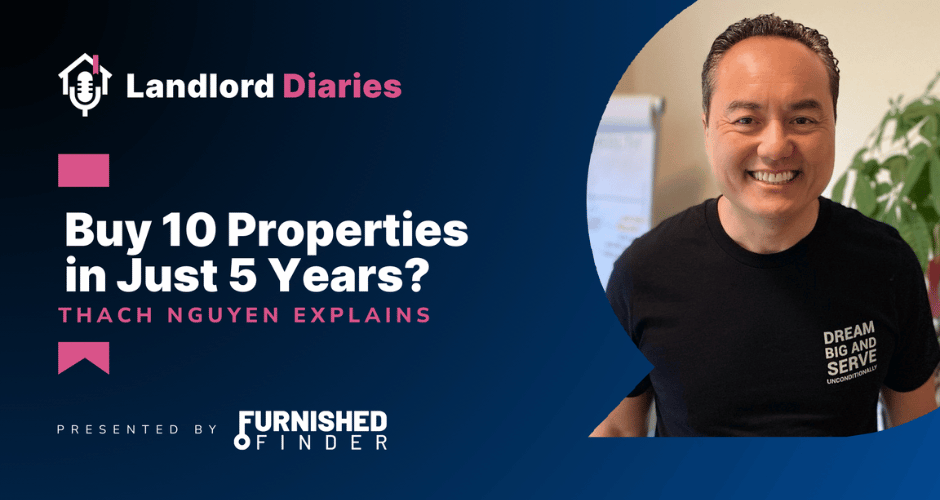
What if scaling to 10 rental properties in five years was not about chasing trends, but about stacking simple, proven strategies in the right order?
In episode 158 of the Landlord Diaries podcast (opens in new tab), real estate investor and Springboard to Wealth founder Thach Nguyen shared the framework that helped him scale from his first property to $100 million in real estate assets. His message was clear: real estate success is rarely built on one strategy alone. It is built by layering income, equity, and value creation over time. If you want to grow your rental portfolio quickly and sustainably, these are the strategies Thach recommends.
Start with house hacking to enter the game
For investors who do not yet own property, house hacking remains one of the smartest and most accessible entry points into real estate investing. By purchasing a primary residence and renting out a portion of it, whether that is a duplex unit, a basement apartment, or individual rooms, you reduce your living expenses while building equity.
The advantage here is financing. Primary residence loans typically require lower down payments and offer more favorable rates. That lowers the barrier to entry and makes it possible to repeat the process. Many investors who reach 10 properties do not start with massive capital. They start with one house, live in it, rent part of it, and then move on to the next. House hacking is often the first pit stop on the road to long term wealth.
Create active income to accelerate growth
Scaling quickly requires capital. That is why Thach used active income strategies such as flipping properties to generate larger chunks of cash. Flipping is not simply about short term profit. It is about producing capital that can be reinvested into buy and hold rentals.
When done strategically, flipping undervalued homes allows investors to capture forced appreciation and convert that gain into down payments for additional properties. Instead of waiting years to save, you are manufacturing your next investment opportunity. This approach builds momentum. Active income fuels long term passive income.
Add stability with turnkey rentals
Not every property needs to be a heavy renovation. Turnkey rentals play a key role in building a stable portfolio. These properties are already in rent ready condition and can begin generating income immediately.
For investors who are scaling toward 10 doors in five years, turnkey properties provide balance. They reduce renovation risk, simplify management, and create consistent cash flow while you pursue more aggressive value add projects elsewhere. It is not about choosing between value add and turnkey. It is about knowing when each makes sense.
Use the BRRRR strategy to recycle capital
One of the most powerful wealth building strategies in real estate is BRRRR: Buy, Rehab, Rent, Refinance, Repeat. This model allows you to force appreciation through improvements, refinance based on the higher value, pull out capital, and deploy it into the next deal.
For investors serious about rapid portfolio growth, the ability to recycle capital is a game changer. Instead of your money sitting idle in equity, it becomes fuel for expansion. When combined with disciplined purchasing and market research, BRRRR can significantly shorten the timeline to 10 properties.
Scale further with new construction
In the last decade, Thach expanded into new construction. In certain markets, building new inventory creates immediate equity and long term appreciation potential. New properties often command strong rents, attract quality tenants, and reduce maintenance costs in the early years.
While new construction requires experience and capital, it represents the next level of scaling for investors who have mastered earlier strategies. It is another example of stacking, not replacing, what already works.
Multiply value with ADUs
Accessory Dwelling Units have become one of the most powerful tools for increasing property value and income. Adding an ADU, converting a garage, or building a detached unit in the backyard can dramatically increase both rental income and overall property valuation.
In high cost markets especially, ADUs can be the difference between marginal cash flow and strong profitability. They also create flexibility in how a property is rented, which becomes critical when market conditions shift. ADUs are not just about extra space. They are about multiplying income streams on one piece of land.
Stack monthly rentals to maximize cash flow
Once you own the property, the final layer is choosing the right rental strategy. This is where many investors leave money on the table.
Long term rentals offer stability. Short term rentals can offer high revenue but often come with regulation and intensive management. Monthly rentals, also known as midterm rentals, provide a compelling middle ground.
Monthly rentals typically serve traveling professionals, relocating families, and corporate tenants who need 30 day plus stays. They often generate higher income than traditional long term leases, while requiring less turnover and operational intensity than short term rentals.
For investors adding ADUs, converting garages, building micro units, or house hacking, listing those units as monthly rentals can significantly increase cash flow.
Furnished Finder (opens in new tab) makes this process simple by connecting landlords directly with tenants seeking furnished 30 day plus housing. With over 300,000 listings nationwide, it’s the largest platforms dedicated to monthly rentals. Landlords can market their properties, screen tenants, manage leases, and collect rent in one place.
Build with the end in mind
Perhaps the most powerful insight from the episode was this: start with your end goal. Determine how much passive income you need to live comfortably. Then work backwards. If the average rent in your market is two thousand dollars per month, how many doors do you need to reach your number?
Clarity creates focus. Focus drives action.
Building 10 rental properties in five years is not about chasing one perfect strategy. It is about stacking house hacking, active income, turnkey rentals, BRRRR, new construction, ADUs, and monthly rentals in a way that fits your market and your goals.
Real estate rewards those who think creatively, act consistently, and optimize every layer of the deal.
And if you are ready to turn your next property into a high performing monthly rental, Furnished Finder (opens in new tab) is here to help you take the next step with confidence.
Episode 158 Transcript
If you don't own any real estate, you wanna get into real estate, right? Buy your first property right as a primary, and then if you want to save some money house, hack it. You can buy a single family duplex, triplex up to a fourplex, and that's considered all single family loan. So you can buy a duplex living one side, rent the other side out.
Remember, it's just a pit stop to the long-term wealth.
Welcome to The Landlord Diaries, the official podcast of Furnished Finder, your trusted companion for building success and monthly rentals. I'm Kelly Bailey with eight Cash Flowing Monthly Rentals in Texas. And I'm Katie Lyon, marketing director at Furnished Finder and real estate investor with 13 furnished rentals across multiple states.
In every episode, we share real stories, practical tips, and expert insights to help you grow with confidence from securing better bookings to maximizing your rental income. So follow up the show and let Furnished Finder be your partner in building a thriving monthly rental business.
What if you could stack real estate strategies and build a 10 property portfolio in just five years? In this episode, we're joined by Thach Nguyen Real Estate Mogul mindset, coach and founder of Springboard to Wealth. To break down exactly how to win in real estate, even if you're starting from scratch.
From finding undervalued properties to unlocking equity and adding ADUs that shares the steps. He teaches his students to create generational wealth through smart investing. Plus, we explore how monthly rentals can be the perfect addition to a stacked strategy. So this is a packed episode for mindset shifts.
Tactical advice and a whole lot of inspiration. Without further ado, Thach, thanks for being with us today. How are you? I'm doing good. I'm doing good. I'm doing good. I feel like the year's coming around fast, and it's just like what happened to 2025, right? And my family and I were going to Japan here.
In a couple weeks, right? So I've just got a lot of things going and it seems like time is just not enough time in a day to do things these days. Definitely that is the norm nowadays, but we can change our mindset and fix that. So let's you feel the energy. I'm sure you do. So let's go ahead and jump in to your story.
It's an incredibly inspiring story. Can you take us back to how you got started in real estate and what shifted your mindset from survival to building wealth? I was born in Vietnam in 1970, when I was five years old. My dad was 34 at the time. My mom was 29. I have four, four brothers. My mom was pregnant, my sister, and in 1975, that was where the Vietnam war was happening.
And so the US military decided to pull out of Vietnam. My dad was a translator working with the US troops, and so he got word that the US is pulling out. His boss said, you should take your family with us to get outta here. Because if the communist comes in and they find out anybody that worked for the us, they're probably gonna kill him.
And so every time I think about the story my dad had to make the decision, do we stay or do we leave a family of eight, but we only got a hundred dollars? Where will we even live if we leave to the us? We don't even know where the US is even at, but but the fear of dying and the family, won't survive in Vietnam when the communists take over, is bigger than the fear of not knowing where you're gonna live.
So my dad decided to get on the last plane with the US troops, and we flew out on the last plane. We was trying to pick up all my auntie and everybody to go with us, but nobody was home during the time and it's destiny, right? And so just the fact being here at Destiny. So I landed in the us we live at a different bunch of different homely home shelters and sponsor's house.
And then eventually my dad found a rental house in Seattle in 77. And we lived two year with some, a gentleman named Charles Zetler and his house. And then I just grew up in Seattle this ordinary kid, and I graduated from high school. I went out to college to fix aviation airplane and it wasn't inspiring for me.
And I fell, I don't think it's an accident, but one of my friends said he should get into real estate and for some reason it was calling my name as a realtor at the time. And I got into real estate in 1991 as a real estate agent. And I just, had a natural for just want to talk to people. And so I made a lot of money selling real estate as a realtor, and I met a real, I met a mentor that said, you should park your money in rental if you want to be rich.
Keep selling real estate. But if you wanna have long-term wealth, own real estate, and my wife was the smart one, she says, oh yeah we need to own this. And so we started making money from real estate commission checks. Anytime we had enough money for a down payment, we bought a rental house. We just did that and who would've known my first rental, 1991.
Fast forward today, I'm 55 years old. I still do real estate. I developed real estate. I buy real estate. I built real estate from single family to multi-family apartment building. Who would've thought today after 29 years doing this, that I have a hundred million dollars in real estate? Coming from Vietnam, it's mind boggling, but.
That's show how powerful the mindset is. Yeah. And your mindset when you're faced with challenges, right? Your parents were faced with an incredible challenge and what you choose to do with that and. Life is gonna throw you big challenges and little challenges in real estate will throw you little challenges and big challenges, right?
You might have some deals that don't work out and you might have a toilet that is running and it's all about how you approach things. So yeah. Zach, I think it's so great to speak with someone like yourself who just has so much experience and so much expertise and you are an expert in a lot of different facets.
Of real estate. You don't say that you only do one method of real estate investing or one technique. You appreciate the diversification, at least that's my understanding. But one thing you do lean on is the four steps to getting started the smart way in real estate. So talk to us a little bit about that, because I think that does speak to.
I don't care if you're gonna do wholesaling or house hacking or midterm rentals or long-term rentals or whatever. Comes down to this base for you. Tell us a little bit more. Yeah. When I started I didn't even realize I was on a road to got me where I'm at. And so now when I look back all these years, I looked at the journey I was on and.
I started as a realtor. That was my way of making active income. Some people active income is nine to five. Some people active income owning a business. Mine was, I was a realtor to make active income. And so when I decided, when SA said You should buy rental, the first I would say pit stop on owning real estate if you don't ever own a house before.
Right? Was house hacking. If you never own a house, you don't wanna go get a loan saying, I'm gonna buy a house with an investment loan. You wanna buy a house as a primary loan. Instead, you don't own a house. You're better off saying, this is the house I'm gonna use as a primary, so you get cheaper, lower rates.
Now you can buy not the time. I bought a single family home and I lived in it, and I rented the basement out because I knew it was just a pit stop. To where I want to go. So I didn't, I wasn't gonna buy a million dollar house. I just wanna buy a regular sized house. I live upstairs, I rent out the basement.
Now in Seattle we have a basement. And so I did that. And then after about a year and I move on, I bought another house and then I did the same thing. And every time I did that, I only had to put down three point half to 5%. And that's how you get into the real estate game, right? So there was many row, many.
Pit stop to get where I'm at. So the first one was I ho I sold real estate, but I got into rental by just basically house hacking my way through the first few. And then I choose to, I wanted to actually create more active income so I can actually buy more rental faster. And so I would, on top of selling real estate, I used to find off market deal.
I'll host, sell 'em to builders and investors so they can buy 'em, so they can give me the list backs. And so I would be out there door knocking houses that need work and I would sell them to investor. And at that time, they were paying me. I didn't realize I was even wholesaling back then, but I was wholeselling back then, so I was making extra money on top of being a agent.
As I was selling home to these investors, I saw the kind of money they're making flipping houses. I was like. Why don't I buy some of these? And so I started flipping houses to make more active in income. I was selling real estate wholesaling, flipping houses to make more money so I can buy more rental.
As I was making more money, then the next time was if I found myself another house, but I decided I couldn't house hack it. I would just buy a regular house and duplexes back then, and I bought 'em what I call turnkey, meaning they're ready to go and just rent 'em, right? And then eventually. I set got more advanced and I'll buy what I call value add property, proper knee work.
I'll rehab 'em, I'll create sweat equity out of 'em, I'll refi, I'd get my money back out of those. 'cause I created so much equity and I turned those into rental and I didn't realize I was doing the bird strategy back in the days. And for those that don't know the birth strategy, why don't you explain what the birth strategy is?
The birth strategy is a strategy where you buy home that need work, you buy ugly house. You rehab it, which is the R right after you, that then you will rent it out. After you rent it out, you can refi it and put it into permanent financing. If you create enough equity in that, what equity, you can actually usually get your original down payment money back out of that, so you have no money vested in it.
But it's still cashflow. And now with the rates has come back down, I say today the burr is back again. Okay, bird is back. Woo, bird is back. And so that's what the bird strategy is. And then I started doing new construction. So the fourth strategy was for me was house hack. I wholesale to make active income.
I flip how to make active income. I bought turnkey, and then I did the bur strategy, right? So these are all the strategy that I was doing back then until this, in the last 10 years, I started doing a lot of new construction at a DU. These are the strategy. But for rental. For rental, everybody you can buy, house hack, turnkey bur, and new construction.
Those are the new, if today I was teaching anybody, those are the full strategy to buy rental. How you rent 'em afterwards. Short term, long term midterm is up to individual. And if you're hearing this and you're getting overwhelmed and you're thinking wholesaling, oh my, what is house hacking?
What is Burr? All of these are options. Okay. It does not mean you have to be the master of all. It means that you need to, if you're looking to acquire your first property or your next property, it means you have options. It means that there is a buffet of ways that you can get a property just because one doesn't work when you're looking on Zillow and those numbers don't work out, that doesn't mean you can't get a rental.
That's, yeah. That's the point here. And for those of you who are listening, and you can't see that on video. He is talking about his road, he is going up and down and up and down, and that's how sometimes this is. But it's a path. And it's a journey. And what I'm hearing you say is that at different points within your journey and within where the market is, you're using different strategies.
That's to get what you want's. And what's cool about 2025 that I'm guessing you didn't have as easy access to when you were early on your journey was all the information and the free information and the programs and all of the things that is just at our fingertips today that you can learn to, if you're overwhelmed by some of this, that you can really dig in and learn about it.
If, again, if you keep it real simple, everyone, if you don't own any real estate and you wanna get into real estate, right? Buy your first property. As a primary. And then if you want to save some money house, hack it. You can buy a single family duplex, triplex up to a fourplex, and that's considered all single family loan.
So you can buy a duplex living one side, rent the other side out. Remember, it's just a pit stop to the long term wealth. Don't go out there if you don't need to. Buy a million dollar house at the beginning. Yep. So most people, most of the students that I work with right now who are beginner, they just buy single family, duplex, tropic, fourplex, and live in that for a year, and then they repeat the process.
So if you don't own it house, that's the strategy to do folks. That's the easiest strategy to do, easy way to get with the least amount of money. And house hacking is any way that you can use your house. To make extra income. You rent the basement, you get a duplex, you rent a bedroom, you have three roommates, you have one roommate.
Any way of how house hacking just means you're using your property to also make rental income. And if you're a va, you can do no money down. You're bringing me back to my very first investment property, or actually real estate purchase in general. My husband and I were living in downtown Austin.
Traffic is getting worse, but the experience was amazing. But we decided, we don't wanna keep throwing away money and rent. It's time to settle down and buy. So that was our first purchase, was a duplex. Yes. And we lived on one side while we rented out the other side long term. And then once we figured out about.
Midterm monthly rentals we're like, Hey, we moved out. We moved into a single family house a couple years later and we're like, Hey, it's time to, to midterm rent this property. Yes. And so then we had the midterm strategy on our left side of the duplex, we had the, long-term strategy on the right side of the duplex and those are the properties we have found are the most successful for cash flow, at least for us for monthly rentals are when we can add an A DU.
Yes. 'cause we have two properties in our portfolio now. We sold that do duplex at the Haida market, which was nice. To be able to do. But we have two properties that have ADUs in the backyard and we're able Yes it's amazing. And so those cashflow, around 1500 per month if everything is booked versus our single family homes often cashflow 500 to a thousand per month.
So I love the. Opportunity with ADUs and just added value to your spaces, whether it's a room rental. So how would you say equity is something that you really want to look at when you're purchasing or in your existing portfolio of how to, really bring out more opportunities in the property that you have?
Yes. So today, if I will teach someone who's a little more advanced, meaning they. They already gone through house hacking. They have a few property and they wanna scale fast, right? And they want to create cash flow. In today's time, for me, our find a property where I can add value first, the main house.
Because if I can buy, if I can borrow the main house, I can create where equity in the front. So equity is one, but also I can get the property at a lower price. That mean the mortgage is lower, so I can cashflow the main house better. Okay. So I would buy a value add house first. Okay. Or a multi-unit, but let's say for a house, but house.
But I'll also look for a house that ideally it's at least a three bedroom house, and then it has a garage attached to the house. Okay. And even better, it also has, if they don't have a garage attached, it has a garage detach in the back. Okay? Now I can tell you from a lot of student now that doing this, you can rehab a garage, a typical 300 square foot garage attached to the house.
Like in California right now, they can convert the garage. They call 'em junior a DU. In Seattle, we call 'em Attach A DU. Okay. And to convert those it costing studio. Right now in California right now, about probably 80 to $90,000. Okay. To rehab that, put kitchen, make it like a studio. But in California, from Northern Cal all the way down to San Diego, they are renting the studio out for about 1800 bucks.
So you see that if it costs someone, let's call it a hundred thousand dollars to do this garage. A 1% rule of thumb in real estate is a thou a hundred thousand dollars investment give you a thousand dollars in rent. This is a hundred thousand investment, but they getting 1800 is almost a 2% rule of thumb.
So that cash flow crazy now that extra 80, 90, a hundred thousand dollars. It actually spiked the value of the property up in most area, a hundred to 200 grand, more on the overall property. Yeah. It's interesting. I feel like for a long time we were in this, like you buy a property, you rent it, you buy a property, you rent it, or you buy a property, you fix it up, you rent it.
Now there's so much more creativity available, yeah, there's a lot more creativity on what we call value add. Now
looking for a simple, professional way to manage your monthly rental. Furnish, finder's, landlord tools brings everything together, tenant screening, lease templates, and online rent payments all in one place. Stay organized, save time, and stay in control. For more information, explore landlord tools today.
That's actually a fun conversation is what is a well done value add opportunity and what are ones I've seen go to waste and it, you spend all this money for the value add, but then you don't get the return you expect. How do you know you're doing a strong value add? That's great. I'll always say to people you gotta make sure you do first couple things.
You wanna make sure you buy home what I say in the area. I, there's four market in real estate. I call 'em A, B, C, D market. The A market is the luxury high-end market. The D market is where it's, really rough steel, right? And the C and the B market are where the everyday people live. They got good walkability, steel, they just not super expensive.
They're not really in a rough neighborhood. If you can buy rental in the B and C neighborhood. And what happened is that if you can find comp to see what's it's already worth in the area, what's a three bedroom, two bath house? It's already worth in the B and c neighborhood. Then you work backwards, right?
In a perfect world, if you can get 70%, if a RV is, call it a hundred thou call it a million dollar easy calculation, a million dollar. If you can buy it all in for 70% off, meaning purchase and rehab, 70% of the ARV. That mean that you're gonna create good value out of that. So you always wanna work backwards, find out what it's comparable, what's already done, and work backward.
Then you know how much you pay for the property and the rehab, and that's how you know how much equity you have. And rule of thumb is 70% of the after repair value or a property already. Nice. That's the rule of thumb. Yep. I like what you're saying because it's nothing over the top. You don't need a super fancy property.
In an A class neighborhood. Now let's, we've talked a lot about how to acquire your properties, strategies for acquisition, strategies for getting started, the importance of equities and all of these are like the foundations, the base for real estate investing. Now, let's talk about once you have those properties, let's talk about these midterm rentals.
What types of opportunities do you see? For people to use midterm rentals Yes. To maximize the impact and significance of their portfolio. Absolutely. Once someone have a property, there's so many different way how you choose to rent it. Okay. Long term is one midterm, short term. Now there is pass splits, lots of different ways. So I would say check with your area first. Okay. Not every area, right? Like I know I got a lot of student in Las Vegas, right? They don't allow much short term, so a lot of 'em have to do midterm. I have a lot of student in Hawaii, they don't allow short term, they only allow 30 days or more.
So you gotta check. Then also if you gonna do midterm, you gotta check to see, right? Is the area. Really good for that. So if it's good for a midterm, then you do midterm. If it's good for short term, you can do short term. For me, in Seattle, I have a lot of my property in the B plus neighborhoods, so I do long term and I have some properties.
I do short term. I don't do any midterm, but I do have a lot of students that does midterms. In Dallas, I have a student that did midterm in Hawaii. I have a lot of student that do midterm in Florida. And they work. And so it depends where you ask, but if you buy value add property and you can add more rooms to these and add a DU, if you make money on long term, you're gonna kill it on the short term or the midterm.
Yep. I think it's gonna be interesting to talk to you in a year or two that, and see if any of your portfolio has transitioned to midterm because. You're right. It's, you need to know your market, right? Yes. You need to know the regulations. If short terms are not legal, which is just the list is becoming longer and longer every single day, midterms are a fantastic option.
They're a great option for house hacking. And also for those people who have these B class properties, who are probably, a lot of them are smaller properties in good cities, and they want to have that. Bigger cash flow. So I think it's gonna be, really interesting what people like you with these larger portfolios start doing with them because it's, that, it's, again, back to that creativity, right?
That solution for the lifestyle right now and the housing needs right now and the shortage. Yes. I built in Seattle, what we call micro apartments. Okay. Another terminology they use called oo, small Efficiency dwelling units. And a typical building could be about 50 units, and the average square footage is anywhere between 270 to 300, 325 square foot.
And they all studios. And they technically, if you want to call it midterm rental or you can call it house, house pad, right? Because some of the guys I know they rent per room. So these are like 275, 300 square foot studio apartments. But we rent 'em out for sometime 12 months.
And then sometimes some of these folks that live there, they rent 'em for six months, right? But they just small units and they're individual, but they're brand new. They look very modern. But they are another version of, I will call house splits, house pad midterm, but the smaller space where people have the option to basically live there for, six months to a year.
And surprisingly, they're all furnish. Yeah. So those are midterms, right? I think we just discovered 'em and pad split. If you guys, if you're not familiar with pad split is a pla a platform that essentially lists room rentals, right? And they coincide and they work very well with us.
And we actually work with them closely because they we're the mark we're marketing platform, right? So they're gonna manage a lot of them and help you out with that. But a lot of them you. They list on our site, you can list on our site. 'cause it's just a different approach to get it rented. Yeah. Because if you have a rental, you need to have the tenant. Yeah. And around 20% of furnished funders inventory is room rentals. So what you're saying there are they are that, are they sharing the kitchen? Is it shared kitchen spaces? Or they each have their own efficiency kitchen? How does it work?
Good question. In the early day when we built the micro apartment, it'd be like. In every level of the apartment, there were the common kitchen and the room didn't have kitchen. They all share the common area in their level. Now every room have a small kitchen. It is like an extended stay. Yeah, it an extended stay. And what we did was in our building, we have half of them are furnished, half of 'em are not furnished. And the people who actually wanna bring their own furniture in, they can stay longer. The one who don't wanna bring furniture, they can rent it already furnished. I would agree with you all that more and more of the millennium that's coming through they, a lot of 'em, they don't wanna buy houses.
They just want to just rent, and then just make that place wherever they live, and then they move on to the next location. And I see more and more of that's happening more like all of my I would say micro units are surprisingly well. Educated, good income people that work for Microsoft, but they're young folks.
They come outta college, they got a good tech job, and they live there for six months to a year and then they move on. Now. Thak, I'm interested, since you have the perfect test with half and half, what are you seeing as far as. Cash flow or as far as rental income rates for those buildings that are half furnished and really half midterm and half more long-term base where people are bringing their own furniture in and probably signing at your lease.
Yeah. So let's call our unit 300 square feet. We rent 'em for 1400. In Seattle. And that's how much we get. But the one that actually are doing the midterm if you average it out for the whole 12 months, we probably get, probably close to 2000, two 22,000, some 2,500 in the summer.
We do well in Seattle in the winter for some reason. We don't do well in the winter. Even my short term don't do well. We make all money basically in May, June, July, August, September. October and then the rest of the month we have to feed it, right? Sure. For short term, right? Yep. Yeah, so definitely overall, right?
There's pros and cons, right? They move in and out more often, so we have to all go in and get 'em touched up, picked up, and then the next person versus someone who's long term and they just stay there for a long time and we just increase rent every year. But for sure, if you're going to actually want to get a lot of cash flow, midterm, short term is definitely.
A lot more cash flow than you would on long term. And are you seeing a lot of your students explore that option with a short term and a midterm hybrid because. At least from my perspective I'm seeing a lot of savvy investors realize more the potential there. I feel like midterm felt like a reach for them for quite a while, and finally the light bulb is coming on and they're like wait.
This is such an easy pivot. Midterm is easier than short term, and if I have a down season. Or I need a break, or I'm burnt out, or I'm in acquisition mode for another property. I can just shift this to midterm for a while. Yes. I'm curious what you're seeing 'cause you work with students who are very savvy right, and in all sorts of different markets, so That's right. Are people opening up to that hybrid method more from your perspective? Yes. Yes. Yeah. I'll give you an example. My friend Bob in Castro Valley, California. He bought a single family house. He converted the garage into the junior a DU.
Then he built a, about a 500 square foot, a DU in the backyard, and he, on the main house, which is a two bedroom, one bath, he get I wanna say 3,500. The junior a DU, he get like probably. 2000 and the a DU in the backyard, he had probably like over 3000. So when you add 'em all up, he get to $9,000 a month off this one property.
That's a great value add right there. It's crazy value add. That's the only way that you can be able to cash flow in an expensive city like Cash to Valley, which is Northern California. But the junior A DU and the A DU, they're all midterm rentals. That's the reason why he gets so much money and he rent 'em out because he's close to the hospital.
'cause in Caer Valley you're surrounded by three different hospitals and what's crazy is that the lady that rent there, they always want to renew. So it end out to be midterm price, but long term rental because the tenant loves it and they don't wanna leave. Yep. We love renewals and we get them so often.
We get them so often. Yeah. So I see that a lot of our students are mixing, from long term, short term and midterm. And I'm an advocate for all three of 'em, right? Yeah. 'cause I'm an advocate on creating equity sweat upfront. 'cause real estate to me is all the money is made in the buy, not in the sale.
Yep. So if you can buy a property, you can add value by what Bob did, he bought the house, we have the house out, the junior A DU, and the A DU. That's creating massive value. And then he mix. Midterm short term, but he does. He does the main house is a long term, and the two, the a DU and the junior do are midterms.
So he mix them on one site. Yep. Yeah. I, and I think adding value can look different depending on if you're doing short term, midterm, or long term. Yes. And you have to think about that, whether you're taking a property that you buy and when you buy it or you arbitrage it. Which is when you rent it.
Furnish it and re-rent it. You say, oh, this is ready to go. Or you can, it can be a house in big distress where you need to replace That's right. Some stuff and take it down to the studs. I don't care what level of value add you're talking about. Adding value for a short-term rental and adding value for a long-term rental is a whole different thing.
Yes. What's really nice about midterms, and I see investors leaning into this opportunity even more, is it feels like the value adds for a midterm rental are more simplistic, like a long-term rental, like you're talking free parking, washer and dryer, all of your appliances, right? Like good closets, things like that.
But you get more payout closer to the short term rental side. Not quite as profitable. Not quite as much cash, but you're, you take simple upgrades, simple value ads, and they can move the needle on your revenue production. Quite absolutely. Yeah. I always tell a lot my students, if you can buy a property where you can buy it already turnkey, like my friend Chris.
He bought a house recently where it was already a turnkey house, two bedroom, one bath with a finished basement. And all he had to do was just put a bedroom downstairs and that was his value add for the main house. And then he's gonna put two a DU in the backyard, which is the bigger value add. So we tend to mix a lot of things, if you can get something, a turnkey that you don't have to do much, right? And depending on where you live and what kind of price point it is. Then you decide, hey, long term might be a little tight, but right. Short term, it ain't allowed in, in, in this area, midterm, we'll do well. So it's a mixture.
Today in real estate investing, you gotta mix up turnkey. Yeah, value add, short term, long term, midterm path split. You gotta do all those. To be creative. And today especially, rates are different than what I started back then when I, actually when I started it was like 13%. I was gonna say they're better when you started, but they're not where they were a few years ago.
No, it wasn't right. But it's that pivot and that creativity, Thach, one of your big things is mindset. So tell us how your mindset has helped you to be successful and to help others be successful during all of these changes. Because real estate. Is synonymous with change. Yeah. From strategies to market status to legislation to day, wherever we're at. Yeah. Day to day. How does your, how has your mindset made you successful in real estate? Because a lot of real estate investors, and I don't care if you have a portfolio of 200 properties or you are renting out a room in your basement, burnout is real.
This is what I always say. In personal and professional, 80% of our results is controlled by our mindset. The other 20% is structure system, taking action. I love Tony Robbins. 'cause Tony Robbins really is what I call the godfather of teaching, mindset. And he always been saying it from day one. If you can't control.
That little voice between the two ears are yours. It doesn't matter. How great the opportunity is. You're not gonna thrive through it. So for me I learned mindset through hardship and I think everyone does. And I learned it first through my personal life, and then I took that and I applied it to my business life.
I don't tell this story often, but I will tell this story for you so you can understand what I mean by mindset. Great. I didn't understand mindset. I've been studying Tony Robbins and been mentored by Tony Robbins for many until you go through it, you don't understand it. But I sold a house one day to a couple and there was Rob and Robin.
This is back in the days like back in the days and they close on it two years later. I end up getting a page from the front office, right? Hey, that at my real estate office, hey, that, you got some guests. So I come up to the front and I get there and I see a gentleman and the lady all dressed up like, like super professional.
And I walk into the comfort room, we sit down, they said I said, can I help you? Because I didn't have any appointment. And I go, yes, my name is blank. I work for FBI and this is blank. She worked for IRS. And we are here because we believe that you sold a house to a couple and you knew they were drug dealers, and since you knew they're drug dealers, we can, if we prove that, then you are part of the conspiracy of cleaning up their money.
And with that, you will have 15 year in the penitentiary for doing what they call basically money laundering. Now, in that moment, I'd never been in trouble all my life. I feel like the curtain just dropped and the room just got dark and they gave me the card and they go we're gonna be testing you next week to indict you and take you downtown.
And so in that moment, of course, I called some friends and Someran says, you gotta go get an attorney to represent you. So I go talk to an attorney. An attorney says, you need representation, they're probably gonna come after you. And and they gonna try to squeeze you and your wife cammi to basically try to get as much information and a snitch or whatever you gotta do.
'cause they just want to win. And so you gonna need an attorney for both of you guys. So we did, we went and got an attorney. But here's what I realized. For two years, they indicted myself and my wife Cammy and trying to squeeze everything from every angle. Now, see, when you are fighting for freedom, you can't quit.
But see, when you fighting to run a business, you can quit. You can go screw it. I just I'll stop messing with real estate, right? I, everybody talking about buying rental, get passive income. This is so tough. The renter moves out on a toilet leak. I screw it. Real estate, this ain't for me.
And we quit too early and so I, I didn't have the option to quit. I was fighting for my freedom 'cause I knew I was innocent. But in the federal court system, the only way you can prove you're innocent, you gotta go through the whole entire grand jury every month getting squeezed for two years to prove you're innocent.
After two years of fighting sleepless nights, practicing what Tony Ramma teach, which is focus on solution versus on the problem. My wife and I both, they were squeezing my wife saying, you're gonna have five years. You don't tell us what you need, what we need to hear for me, 15 years. But they were just, that was just tactic.
You see what I mean? But even though we knew we were innocent, but we had to go through this whole crap just trying to prove, none of our family knew what we was going through, none of our friends, because we couldn't tell him. And so that was the only time and my first time ever realizing.
Mindset is the key to success because what you focus on is what you're gonna get. Even in the hardest and the darkest time, you can still keep focusing on solution. And so when we got clear from that mess, when realized now what Tony Robin been talking about forever. You attract what you focus, you right.
You, whatever you put your mind on it expand. How many times people get a problem and they just start to fix it on the problem and what happened? More problem shows up, depression shows up more, bills shows up. And so what happened is, now I'll give you a real example, what happened to me in real estate. I built my biggest complex ever in 2006, 251 unit apartment building from ground up, raised $12 million.
2 million of us have my own money. The other money was friends and family. In 2006, the market was hot as it can be. Everybody's building real estate everywhere. Seattle High Rise was going up everywhere. Crane was everywhere. And so we decided to build a 251 unit condominium project. I go and raise the money, everybody's excited and we break ground and.
In the first two weeks of breaking ground, we had a cell center and we had a big party and all my friends came and we sold out 251 unit and pre-sold in literally the first 30 days sold. Nice man. We are living the dream. Woo. Middle of 2008, the market, not anymore. Going down. Before the end of 2008.
Out of 251 pre-sold. 200 of them withdraw their offer in literally 60 days. Yeah. Now we have 50 unit left. The construction's about to be done. At the end of 2008, the construction loan is due. And so now I'm in the same dilemma, just like I was when I was going through with the feds. I got all my friends and family's money.
If we don't get this thing sold by the end of the year, the property now is in for pre foreclosure because the loan is due. And so again, two years, two years of trying to fix this problem, I kept looking for solutions Solution. To come out. The solution was instead of selling it, 'cause the market was off, we rented it and then we sold it.
But if I didn't look for a solution, I would've thought the answer was sale. Sale. Where the market already shifted, the sale was gone already, but for two years, that was mindset. So today, to answer your question, that is mindset. Yeah. In the and you never gave up. It's and I would turn all of the investors' money back also.
It's like you keep pushing on, you move forward in real estate and you're even coaching hundreds if not well, how many students do you have? 4,000, hundreds, thousands. Thousand, 4,000 plus. Love it. So it's like you're teaching them that same mindset of don't give up. So that actually made me think of a couple mindset things that keep me going, that I'm gonna share.
And Katie, I'd love to hear yours as well, is early on in my career I had a friend's dad who is I believe a CEO of a pest company, and he said. This is one of the biggest things that has helped me and and honestly it's been one of my structural mindsets for any position I have and especially in real estate, is what's the take emotion out, what's the problem?
How do you fix it? And it's so simple, right? But that's really when something feels like it's blowing up, especially, woo, the IRS shows up that would be big time. And FBI. Wow. But it's like, what's the problem and how do we fix it? You give a hundred percent and all you do, and what you said is we knew we were innocent.
Now you just gotta go prove that you're innocent. So I like with, as we're recording right now, we've got a toilet being looked at, right? Because it's on septic, it had a smell. Anytime you have smells or gurgling and septic, you wanna get it checked out, right? So it's like, what's the problem?
How do you fix it? So you just figure out the solution. You have your contractors, you have your cleaners, and you make it happen. Katie, what's one of your life mindset? That's helped you through real estate in your career? Oh, man I could talk about mindset all day long because I do think that a, we don't give enough attention to it as a culture, and I think it, it affects every single part of your life as a parent.
It's something that I talk about with my kids every day. Every day. It's, how do you want to have a good day? When my son gets outta the car, I don't tell him, have a good day. I say, make it a good day. I'm like, it's up to you. Make it a good day. And he always looks at me and goes, I'll try. And I'm like, that's all I can ask.
I'll try. You're in middle school kiddo. Trying is, that's a win. But one thing I heard once is that when something goes bad, it's okay to sit in the suck for a minute. And I think this happens in real estate sometimes we think, with. If you're gonna have a good mindset and you're gonna be positive, you have to be positive a hundred percent of the time.
Yeah. And I think it's okay if something happens, a deal goes south you're, you didn't get the property you wanted, sit in the suck for a minute, but then get up, put your big kid pants on and figure out what's next. Yeah. What creativity can you use? What other strategy can you use?
Who can you talk to? Get out of your own head. Yeah. So it's okay to be there for a minute and then you get up and you move on. I'm gonna say this about all this. Every breakdown is a breakthrough. Because at every level, at every level, in order for everyone to keep growing to the next level of climbing that next elevation on the mountain.
If it was that easy, everybody go to the top. But for every level, you will have some breakdown. That you will, that those breakdown are, are gift. For example, when I started I used to cold call and I wasn't good at it and the breakdown was I got rejected a lot.
Some people thought that would be failure. Throughout those breakdown and throughout those failure of didn't do well, it redfin, it refined my skillset better. So every breakdown is breakthroughs coming around the corner. So embrace the breakdown, because if you wanna play big in life, you gotta have breakdown because that's part of, actually the butterfly had to break through the shield to actually be the butterfly.
Yep. So all of us have to go through it, so embrace it because it's part of growing. Yep. I think that's a great way to end this episode is we've talked about so much variety and real estate, and we don't want anyone to feel too over, too overwhelmed to not get started. Let's end with one. If someone wants to follow you or, connect with you, how would you like them to do and then two, what would you say is one thing you want everyone to do? Today when they finish listening to this podcast, what's one simple thing they can do for their business? Perfect. If you follow me is my name, that's Win. You can find my Instagram, YouTube, just, that's win. I'm on Instagram, Facebook, in TikTok, everything or just my name.
The one thing I would give everybody is this. This is the lesson I learned from my teacher myself. Always start with the N in mind. Ask yourself this question. How much passive income do you need every month to live comfortably If it costs you $15,000 or 20 grand a month on to live, if you had 20, 25,000 a month in passive income, right?
Would that be great if you had no debt? If you living good right now, 15, 20 grand a month. If you had 20 grand a month in past income. I'm not saying that's an end all number. When I started, it cost me 10 grand to live and I told my mentor, if I had 20 grand a month in passive income, I'd be outta the rat race.
So my end number was, I needed, I wanted 20,000 a month. The average rent at the time was two grand. So my single amount of focus, the end in mind was, which is where I want to go, is to have 10 property bought and paid off, and then I'll accumulate more after that. So start with the end in mind on knowing how much passive income do you really need to live comfortably?
What's the average rent? How many door do you need and chase after those doors? And then that'll be y'all. Why? Love it. Hey, I'm gonna get 10 doors. And my why at the beginning was you got, was to retire my mom and dad in my first 10 doors. All right. I'm gonna wrap us up with in the comments. If you want to share what your end goal is so that we can hold you accountable on social media, then feel free to put it out there, put it out into the world and then make it happen.
We'd love for you to circle back and let us know once you accomplish that goal. And, hey, if you wanna be on the. Accomplished a goal, and it happens to include monthly rentals. We'll circle back. We can put you on the podcast and Thach. We just really appreciate who you are, your mindset, how much you've achieved.
And I'm sure this won't be the last time that we have something special with you. So just thank you so much for being here today. Thank you for having me. Thank you. Thank you. Thank you. I love it. Bye everyone. See you again next time.
Thanks for joining us on this episode. If you're enjoying The Landlord Diaries, be sure to like, subscribe and share it with others. With over 300,000 listings across the country, Furnished Finder makes it. Easy for landlords and tenants to connect directly. No middleman, no markups. Ready to list your property.