Advertising a furnished rental property requires choosing the right platforms and strategies for your target renters.
Whether you offer mid-term corporate housing, long-term furnished leases, or short-term vacation stays, a targeted approach will help you reach the ideal audience – be it vacationers, business professionals, students, or remote workers.
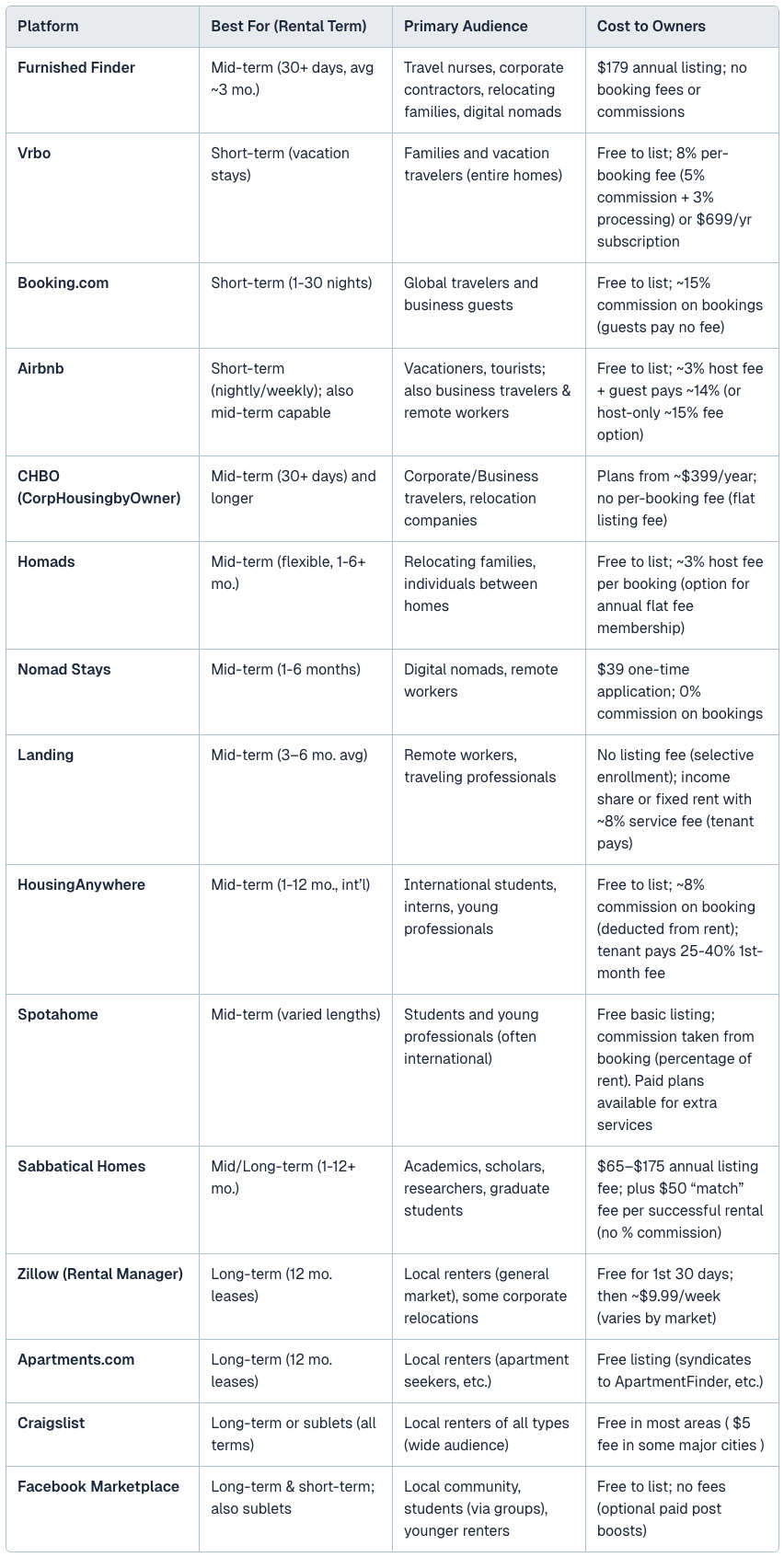
This comprehensive guide breaks down the top platforms for each rental duration and traveler type, with tips on using each effectively. A summary table is also provided for quick reference.
Let’s dive in.
Monthly & Mid-Term Furnished Rental Platforms
Mid-term rentals (generally 1 to 6 months, sometimes up to 12 months) fill the gap between vacation rentals and year-long leases. These are typically fully furnished homes or apartments rented month-to-month. The target renters are people in transition: corporate employees on temporary assignment, traveling nurses and medical professionals, digital nomads/remote workers, students on internships or academic terms, and families relocating or displaced.
The following platforms specialize in mid-term furnished housing and connect landlords with these specific audiences:
Furnished Finder
Rental Type: Mid-term rentals (30 days minimum, with typical stays ~3 months). This platform specializes in 30+ day furnished stays and does not cater to nightly vacation rentals.
Target Audience: Corporate/business travelers, digital nomads, relocating families, academic visitors (professors, graduate students), travel nurses and traveling healthcare professionals. Many Furnished Finder tenants are on work assignments or temporary relocations (average stay is ~90 days).
Key Features & Advantages: No booking fees or commissions. Hosts keep 100% of rent. Furnished Finder allows direct communication between landlord and tenant once a lead is made, so you can vet guests and handle payments offline (giving flexibility in how you collect rent). The platform provides useful tools: KeyCheck for tenant screening and background checks, lease templates, and a traveler messaging system. With over 20 million housing searches and 300,000+ property listings, it’s a well-trafficked marketplace for mid-term housing.
Cost to List: Paid listing, no commission. Landlords pay an annual listing fee ($199 for a 12-month listing). There are no percentage fees on bookings. Once you pay the listing fee, all rent you negotiate is yours. This flat fee model can save money compared to giving a cut of each month’s rent.
Tips: Since many renters are travel nurses or professionals on assignment, highlight proximity to hospitals, business centers, or universities in your description (“5 miles to City Hospital” or “10-min walk to Main Campus”). List all included furnishings and amenities. These tenants will want to know the home is move-in ready (mention essentials like kitchenware, linens, high-speed Wi-Fi, washer/dryer, etc.). Set competitive monthly pricing: check the site’s Market Insights tool for local demand and rates. Respond quickly to inquiries. Travelers often reach out to multiple listings; being prompt can secure you the tenant. Also, consider using Furnished Finder’s tenant screening tool for safety and include a simple lease agreement since these are longer stays than Airbnb (tenant screening and lease creation tools are available to landlords in their Furnished Finder dashboard).
Homads
Rental Type: Mid-term rentals (flexible lengths, typically 1–6 months). Homads allows hosts to set custom rental terms, so it can accommodate month-to-month or slightly longer leases.
Target Audience: Families and individuals in transition. Homads markets to people relocating to a new city and “testing the waters” before settling. This includes families searching for a permanent home, individuals moving for work who want a few months rent before committing long-term, etc. The platform’s focus is on fully furnished homes suitable for a family or anyone between permanent homes.
Key Features & Advantages: Free to list with a commission model (3% booking fee to hosts per booking). Homads lets hosts communicate directly with guests to sort out details, similar to the transparency of Furnished Finder. Uniquely, Homads offers annual membership plans for hosts who prefer to pay a flat rate instead of per-booking fees (this can eliminate the 3% fee). Because Homads’ niche is relocating families, your listing might face less competition if it fits that category (e.g., single-family homes in suburbs). Homads also emphasizes trust. Users create detailed profiles, and you can get to know a renter’s situation (family moving for new job, etc.) before accepting.
Cost to List: Free to list. By default, Homads charges a 3% fee to the host for each booking (and possibly a modest fee to the renter). Alternatively, hosts can choose an annual paid plan to avoid commissions (pricing for that varies). If you plan multiple mid-term rentals a year, an annual plan could be cost-effective; if just doing occasional rentals, the 3% pay-as-you-go is simple.
Tips: Since Homads caters to people looking to make a new city “home”, emphasize what makes your property and neighborhood livable. Mention nearby schools, parks, grocery stores–things a family or relocating person cares about, not just tourist spots. If your home is great for families (fenced yard, quiet street), say so. Use Homads’ flexibility by clearly stating your rental terms and any house rules up front. For example, if you prefer 3-month minimum or you allow pets (which can be important for relocating families), include that. Engage with the personal nature of the platform: be friendly in communication, and perhaps share a bit about the neighborhood vibe. This can help build trust with potential renters who want a comfortable transition.
Nomad Stays
Rental Type: Mid-term stays, typically a few weeks to a few months. Nomad Stays specifically targets 1–6 month arrangements for remote workers.
Target Audience: Digital nomads and remote workers seeking temporary homes with reliable work amenities. These are often solo travelers or couples who work online and travel, needing a base for a month or two in each location.
Key Features & Advantages: Niche platform for remote-work friendly rentals. Nomad Stays is selective. Properties must meet certain amenities suitable for digital nomads (e.g., fast Wi-Fi, workspace). For hosts, there are no booking fees or commissions–you keep all the rent. Instead, Nomad Stays charges a one-time application fee of $39 to list your property. They also waive any annual listing fee if your property has over 5 rentable rooms (mainly relevant for boutique hotels or large homes). Because the site’s users are all remote workers, you’re marketing directly to that segment without unrelated travelers. Nomad Stays also does some vetting. Inclusion isn’t guaranteed, which can raise the overall quality of listings on the site.
Cost to List: $39 application fee (one-time). No ongoing fees, 0% commission on bookings. Essentially, after the initial fee and if accepted, it’s free to receive bookings. (If you temporarily delist and later re-list, a re-listing fee may apply, but generally costs are minimal.) Nomad Stays earns revenue by charging travelers a membership or booking fee, not from owners.
Tips: Meet the “digital nomad” criteria. Ensure your listing highlights remote-work essentials: high-speed Wi-Fi (state the Mbps if you can), a comfortable desk or workspace, and any co-working spaces or cafes nearby. Photos should include a shot of the work area (even if it’s a dining table repurposed as a laptop desk). Mention community perks that nomads appreciate, like weekly cleaning, flexible check-in, or local experiences. Since Nomad Stays’ acceptance is not guaranteed, when you apply to list, put your best foot forward: describe how your property is ideal for remote workers (quiet environment, good lighting for video calls, etc.). Once listed, be responsive and accommodating with date flexibility. Digital nomads often have fluid schedules. If you can offer prorated extra days or an option to extend month-to-month, that’s a bonus for this crowd.
HousingAnywhere
Rental Type: Mid-term rentals (varies from 1 month to 12 months). Particularly strong for 3–6 month student exchanges, internships, or semesters abroad.
Target Audience: International students and young professionals. HousingAnywhere operates worldwide with a large network of university partnerships. Many users are students moving to a new city for a semester, exchange program, or internship, as well as recent graduates starting jobs. It’s popular in college towns and cities with global companies.
Key Features & Advantages: Global reach with local focus. The platform is in 30+ countries and partnered with 150+ universities, which drives millions of visitors. It provides a secure payment system–the first month’s rent is held and only transferred to you 48 hours after the tenant moves in (to ensure everything is as advertised). A major perk: Landlord Guarantee. If a tenant cancels last-minute, HousingAnywhere still pays you the first month’s rent. Listing your property is free and you can chat with tenants through the platform. They also offer insurance-like protections and customer support in multiple languages, easing international rentals.
Cost to List: Free listing. HousingAnywhere charges a commission only when you successfully book a tenant. The commission for landlords is up to 8% of the total rent amount for the booking. (Tenants also pay a one-time “Tenant Protection Fee” of ~25% of one month’s rent when booking, except in some markets like the Netherlands.) In the U.S. and UK, there’s no monthly service fee taken from rent collection–only the initial commission applies.
Tips: Target the student/intern crowd. If you’re near a university or in a city like Boston, Austin, etc., mention distance to campus or major companies. Students often search by university name, so include phrases like “near [University Name]” in your description. Provide details on whether utilities are included, if the room is private or shared, and any house rules (students appreciate clarity on things like guest policy or quiet hours). Be responsive in the platform’s chat–the quicker you answer questions from an interested student, the more likely they’ll proceed to booking. Also, because many users are coming from abroad, consider being flexible on move-in dates to accommodate visa or travel schedule changes. After a successful stay, encourage your tenant to leave a review on the platform to build your credibility for future renters.
Sabbatical Homes
Rental Type: Mid-term to long-term (1 month up to 12 months or more). SabbaticalHomes.com facilitates not just rentals but also home exchanges and house-sitting, all generally furnished. Typical stays are an academic semester or year.
Target Audience: Academics, scholars, writers, and students. The platform’s community is centered on academia – professors on sabbatical, visiting researchers, PhD students, Fulbright scholars, etc., often arranging housing swaps or rentals during sabbaticals and research visits.. This means tenants are usually responsible and looking for a quiet, study-friendly home.
Key Features & Advantages: It’s a niche “by academics, for academics” service. Listings can be rentals or exchanges (you can swap homes with another academic in a different city). The site has a personal feel – many users list their university or institution. One advantage is highly reliable tenants: you’re typically dealing with professors or grad students, who are generally considerate and trustworthy renters. Sabbatical Homes requires membership and modest fees which tends to keep quality high and scammers out. No large commissions – just listing fees and a small “match fee.” The site also allows a lot of flexibility in the arrangement (you can negotiate directly with the other member on rent, utilities, etc.).
Cost to List: Sabbatical Homes charges an annual listing fee for homeowners ranging from $65 up to $175, based on your role (e.g., faculty vs independent scholar – faculty get the lower rate). This fee lets you list your property. In addition, when you successfully rent or exchange, both parties are asked to pay a “Made-a-Match Fee” of $50 each. There are no other commissions or service fees beyond that. This keeps costs low — for example, an academic renting their home might pay $100/year total if they list and find a tenant.
Tips: When listing here, mention your academic connection if any (it helps build trust in the community). Even if you’re not a professor, you might say “Ideal for visiting faculty – quiet home 10 minutes from campus.” Highlight features scholars need: a dedicated study or bookshelf space, a piano (if targeting visiting music faculty), or simply a peaceful environment. Be clear about lease length and dates (academic schedules are key – e.g., “Available mid-August to mid-December, aligning with fall semester”). Because many users might also be renting out their own home at another university, consider home exchange offers if you’re flexible. Sometimes a professor coming to your city will swap their home in another city with you. Lastly, patience is important: this community is smaller, so it may take time to find the right match, but when you do, it’s often a very respectful renter.
Long-Term Furnished Rental Platforms
Long-term rentals are typically standard leases of a year or more. Fully furnished long-term units are somewhat niche as most long-term renters have their own furniture. However, furnished long-term apartments can attract corporate relocation clients, expats, traveling nurses on extended contracts, or anyone who prefers not to buy furniture (students, diplomats, consultants on a year-long project, etc.). Advertising a furnished unit for long-term tenancy involves tapping into general rental listing sites and emphasizing the “furnished” aspect.
Key platforms and channels include:
Zillow Rentals (Zillow, Trulia, HotPads)
Rental Type: Long-term leases (typically 12-month leases, though you can advertise shorter terms as well). Suitable for landlords with apartments, condos, or homes for rent to local residents.
Target Audience: General rental market, including local professionals, students, families looking for housing in the area. You can target those specifically seeking furnished rentals by indicating it in the listing (Zillow allows a “Furnished: Yes” filter). Corporate HR searching for housing might also check Zillow’s inventory in some cases.
Key Features & Advantages: Zillow is one of the most popular real estate sites in the U.S., giving huge exposure. When you list via Zillow Rental Manager, your property also appears on Trulia and HotPads automatically, increasing reach. The interface allows you to upload many photos, create a detailed description, and even upload 3D tours. Zillow offers tools like tenant applications, background checks, and rent payment processing (optional for landlords to use). You can advertise a lease and then manage leads through their dashboard. Because Zillow is used by a broad audience, you’ll get a mix of inquiries, so make sure to specify “furnished” prominently to attract the right renters.
Cost: Free trial period, then paid. As of now, Zillow allows you to list one property free for 30 days. After 30 days (or for additional simultaneous listings), there is a fee–typically around $9.99 per week, or discounted multi-week packages, depending on your market. (Zillow has adjusted pricing over time, so check current rates; it might be free in some regions or for the first listing.) The cost is relatively low compared to a vacancy, and Zillow’s reach can quickly find you a tenant.
Tips: In the title or first line of your listing, put “Furnished” in all caps or a standout way (e.g., “Furnished 1BR Apartment – Downtown – Flexible Lease”). Many long-term renters don’t expect furnished units, so you want to immediately signal it. Include an inventory of key furnishings in the description (“Includes queen bed, dresser, sofa, dining table, TV, kitchenware, etc.”) – this sets expectations and justifies any higher rent. Use Zillow’s filtering: ensure you check the box that it’s furnished, and if utilities are included, mark that too. Since Zillow is free (or low-cost) initially, it’s common to get a lot of inquiries; prepare a screening script or set criteria (credit score, income, etc.) and possibly use Zillow’s built-in application tool to streamline vetting. Finally, good photos are crucial. Someone committing to a year-long furnished lease will want to see each room clearly. Consider staging the space neatly and well-lit in photos, as you’re essentially selling a ready-made home.
Apartments.com (and Rentals.com, Apartment Finder, etc.)
Rental Type: Long-term leases (generally 12 months). Apartments.com is geared towards traditional rentals, from single-family homes to apartment units.
Target Audience: Local renters searching online for apartments and houses. Often skewed toward apartment seekers (young professionals, couples, students), but plenty of people use it for all kinds of rentals. If your unit is in a multi-family building or a condo, this platform is very apt.
Key Features & Advantages: Apartments.com is part of a network (owned by CoStar) that includes ApartmentFinder, ApartmentHomeLiving, and others – a single listing can syndicate across those, reaching 50+ million monthly visitors. Listing is free, which is a big plus. The platform provides a robust interface where you can list amenities, upload videos, and even get leads’ contact info organized. You can also indicate if a rental is furnished and filter searches accordingly. Another advantage: Apartments.com has a reputation for listings being up-to-date and landlords responding (compared to some classifieds), so serious renters often check it.
Cost: Free to list. There is no charge for a basic listing on Apartments.com and its affiliated sites. (They monetize via advertising and selling premium ads to large apartment complexes, but individual landlords can post for free.) You might encounter optional paid features (like promoting your listing or using their tenant screening services), but you can secure tenants without paying anything.
Tips: Use the platform’s filters to your benefit. Mark the unit as furnished and list any special lease terms (some areas allow filtering by short-term lease – if you’re open to 6-month or other terms, note that in description since filter options vary). Write a compelling summary that will appear in search results – e.g., “Fully Furnished 2BR w/ Utilities – Ideal for Corporate Rental – Downtown.” Apartments.com allows quite a detailed amenities list; check all that apply (e.g., if you have “flexible lease length” or “internet included” mention it, possibly in description if not a checkbox). Because it’s free and popular, your listing might get buried after some time. One strategy is to refresh the listing every few weeks if it’s not yet rented (or use a new title/photo to make it appear new). Also, monitor your email and the Apartments.com dashboard as quick responses can secure viewings faster. If you get too many unqualified inquiries, consider using the pre-screening Q&A feature (they have a tool where you can ask prospective tenants a few questions when they inquire). This can filter for those who specifically want a furnished place, for example.
Craigslist
Rental Type: All types (flexible), commonly used for long-term leases and sublets. Craigslist has separate categories for “apartments / housing” (regular rentals) and “sublets / temporary” (short-term subleases), as well as “vacation rentals.” For a furnished year-long rental, you’d use the standard housing category; for a 1-6 month sublease, the sublet/temporary section.
Target Audience: Local renters of all kinds. Craigslist’s audience is broad: students hunting for a room, individuals relocating on short notice, budget-conscious renters, and even some corporate or student housing seekers. It’s often the go-to for those already in town looking for something quickly. Because Craigslist is uncurated, you’ll get a mix of serious tenants as well as casual inquiries.
Key Features & Advantages: It’s essentially an online classified ad, very simple and very widely used (190 million monthly users across Craigslist). The major advantages are cost and reach: it’s free or very cheap, and almost everyone knows to check Craigslist for rentals. You can post a descriptive ad with photos and your contact info, and interested renters will email or call you directly (Craigslist anonymizes your email for privacy unless you choose otherwise). You can post and get responses the same day, useful for filling an immediate vacancy or short-term gap.
Cost: Free or low-cost. In most U.S. markets, listing a rental on Craigslist is free. In a few major cities (e.g., NYC, Boston, Chicago) there’s a small fee (~$5) per listing. Some other cities may also have introduced a nominal fee to cut down spam, so it’s worth double checking the Craigslist “posting fees” page for your city. Even where it’s paid, it’s minimal compared to any other advertising.
Tips: Stand out and stay safe. Craigslist’s simplicity means your ad competes in a text list. Use a catchy but clear title like “FURNISHED 1BR Condo – All Utilities Incl – Available Sept 1” to immediately hook those looking for furnished units. Post in the correct category; if it’s a sublease or a 3-month rental, use “sublets/temporary” so the right audience finds it. In the description, be thorough about rent, deposit, lease term, what’s included, and your preferred contact method. Include at least 4-5 good photos (Craigslist allows up to 24 images) as many people skip text-only ads. Repost or renew the ad every 2-3 days if allowed, because listings get pushed down quickly especially in large cities. Caution: Craigslist can attract scammers. Never send money or accept overpayment scams; likewise, some “tenants” might be phishing. Use Craigslist’s anonymized email to communicate until you’re sure the person is legitimate. When showing the property, follow common-sense safety (meet in daylight, let someone know, etc.). Despite these downsides, Craigslist can rent your place fast. Lots of independent landlords and subletters successfully find tenants here, especially for furnished sublets or last-minute rentals. Just ensure you vet respondents carefully (credit/background check if it’s a long lease, or at least verify employment for sublets).
Facebook Marketplace & Groups
Rental Type: Short-term and long-term. Facebook Marketplace has a Housing section where you can list rentals. Additionally, local Facebook Groups (e.g., “[City] Apartments & Rooms” or “[University] Off-Campus Housing”) are often used for sublets and roommate situations. You can advertise anything from a weekly vacation room to a year-long furnished house. Just be clear in the post.
Target Audience: Local community and social network users. Many younger renters (20s-30s) now check Facebook Marketplace for housing. Students are active in Facebook housing groups. It’s good for reaching people who might not be on formal listing sites but are browsing social media. Also, if you have a unique space, it can get attention via shares.
Key Features & Advantages: Free to list and very easy if you already use Facebook. Your listing can include a description, price, and photos just like a classified, but attached to your Facebook profile (or Page). Potential renters contact you via Facebook Messenger, which can feel more personal. You can screen a bit by looking at their Facebook profile (though keep in mind profiles can be sparse or private). Posts in Marketplace can be boosted to wider audiences if needed (paid boost), but usually the free posting suffices. In groups, you have a captive audience of people specifically interested in housing in that area. It’s a great way to reach students (e.g., an incoming grad student who needs a furnished place might post “Looking for 6-month furnished rental” in a group — you could either respond or post your offer).
Cost: Free. There is no charge to list on Facebook Marketplace for rentals. (Facebook does not currently charge fees for real estate/rental listings by owners or brokers on Marketplace, unlike some item sales that incur fees.) If you choose to “boost” a Marketplace post as an ad to reach more people, that would cost whatever budget you set, but that’s optional. Groups are also free to post, though some are private or require admin approval.
Tips: First, check Facebook’s housing listing policies (they disallow discrimination, etc., same as fair housing laws). On Marketplace, be prepared for a high volume of messages, not all serious. Respond promptly to legit inquiries and ignore obvious scams (like someone saying they’ll send a code or asking you to email them off-platform immediately – those are red flags). In your listing, use keywords that are searchable (“furnished,” “short-term ok,” “near Metro,” etc.). For furnished rentals, consider also posting in specialized groups, e.g., “Digital Nomads in [City]” or “Expat housing [City]” if relevant. When using groups, read the rules: some allow listings on certain days or have format requirements. A benefit of groups is you can target by niche: there might be a “Travel Nurse Housing – [State]” group, or an alumni network where you can mention your rental. Leverage your own network too. A personal post saying “Hey friends, I have a fully furnished apartment available for rent for the next year, please share!” might find you a tenant through word-of-mouth. Always take good photos. On social platforms, visuals are even more crucial to catch attention as people scroll. Lastly, once you find a tenant, remember to mark the listing as “Sold/Rented” or take it down to avoid ongoing inquiries.
Other Platforms & Strategies for Long-Term Furnished Rentals
Realtor.com / MLS via Avail: Realtor.com pulls rental listings from the MLS (managed by real estate agents) and also partners with Avail (a landlord tool) for DIY landlords. If you have a high-end furnished home, you could list it with a Realtor on the MLS (they’ll take a commission of one month’s rent, typically, but they’ll market to corporate clients and relocation agents). Otherwise, using Avail or Realtor.com’s free syndication can push your listing out to their network at no cost.
Corporate Relocation Services: If your property is in a city with large corporations, consider reaching out to HR or relocation companies (like Cartus, SIRVA, etc.) to let them know you have a furnished rental. They often place employees in furnished housing and might keep a database of available homes. This is more of a networking play than a platform. It might not immediately get results, but one connection could lead to a long-term corporate tenant who rents directly from you (often at a premium paid by their company). Ensure you have a professional flyer or email prepared highlighting your property’s specs and availability.
University Off-Campus Housing Boards: Many universities (especially big ones) have off-campus housing websites or office bulletin boards where landlords can list rentals. If you’re near a campus and open to student or faculty tenants, list there. Some are free; some may require a small fee or verification. This is an effective way to find tenants for academic-year leases.
Extended Stay Networks: Sites like HouseStay and CorporateHousing.com aggregate extended stay furnished listings (often from professional corporate housing providers). As an independent owner, you can try listing on HouseStay (they allow owner listings for 30+ day furnished stays, focusing on major U.S. cities). CorporateHousing.com is more of a directory; you might need to sign up and potentially pay to be listed among corporate housing options in your city. These channels target business travelers needing 1-3 month accommodations and can be another way to fill in gaps or find long-term guests.
Short-Term Furnished Rental Platforms
Short-term rentals (typically stays from a few nights up to 30 days) are popular among vacation travelers and tourists, as well as some business travelers on quick trips. These stays don’t require traditional leases and offer flexibility. The platforms below specialize in short-term or vacation rentals and have huge user bases searching for furnished homes:
Airbnb
Rental Type: Best for short-term stays (nightly or weekly bookings). Also supports month-to-month rentals (many hosts offer discounts for 1+ month stays).
Target Audience: Vacation travelers, tourists, and city visitors; also used by remote workers and business professionals for short trips.
Key Features & Advantages: Massive worldwide audience and brand recognition; easy browsing and booking interface; secure payments and liability coverage (AirCover insurance for hosts); flexibility in rental length with no fixed leases. Hosts can offer entire homes or just rooms, accommodating various traveler needs.
Cost to List: Free to list. Airbnb charges a commission per booking. Under the split-fee model, hosts pay ~3% and guests pay up to ~14% of the booking subtotal. (Hosts can also opt into a “host-only” fee of ~15% with no guest fee, which can make the listing price more attractive to guests.)
Tips: Use professional photos and a descriptive title to stand out (listings with high-quality photos get significantly more views). Enable Instant Book if you’re comfortable, to attract travelers who prefer quick confirmation. Highlight what makes your place special for your target audience (e.g. “Walking distance to downtown attractions” for vacationers or “High-speed Wi-Fi and desk for work” for remote workers). Encourage guest reviews by providing an excellent stay, as a high rating and Superhost status can boost trust and search ranking.
Vrbo
Rental Type: Primarily short-term vacation rentals. Ideal for nightly/weekly stays; some hosts also accommodate multi-week or month-long stays. Entire homes/apartments are the norm on Vrbo (they focus on full-home rentals).
Target Audience: Vacation travelers, especially families or groups looking for whole furnished homes (e.g. beach houses, cabins). Vrbo’s user base skews toward family vacations and leisure travel.
Key Features & Advantages: Large exposure via Expedia Group’s travel network – Vrbo listings appear on Expedia, Hotels.com, etc. Emphasis on space and privacy: all listings are private units (no shared rooms). Secure payment processing and the ability for hosts to set house rules and damage deposits. Vrbo also has a Premier Host program (analogous to Airbnb’s Superhost) which can increase your listing visibility if you maintain good reviews and low cancellation rates.
Cost to List: Free to create a listing. Vrbo offers two fee models: (1) Pay-per-booking – an 8% commission on each booking (5% service fee + 3% payment processing), and (2) Annual Subscription of $699 per year for unlimited bookings, which can be cost-effective for high-volume rentals. In both cases, guests also pay a service fee on Vrbo’s platform (this is handled by Vrbo).
Tips: Emphasize amenities that families or groups value (fully equipped kitchen, extra bedding, baby-friendly gear, etc.). Use all 50 photos allowed to showcase the property (exterior, every room, nearby attractions). Vrbo data shows professional photos dramatically increase views. If your property is in a vacation destination, mention proximity to tourist attractions, parks, or beaches. Promptly respond to inquiries as a fast response rate can improve your search placement. Also, consider enabling Instant Booking on Vrbo if you can manage quick turnovers, as many travelers filter for instantly bookable homes.
Booking.com (Vacation Rentals)
Rental Type: Short-term stays, from single nights to a few weeks. Booking.com is known for hotel bookings but also lists vacation homes and apartments. Best suited for very short stays (1–7 nights), though longer stays are possible.
Target Audience: Wide traveler audience, from vacation tourists to business professionals using Booking.com for work travel. Many Booking.com users are international travelers or business travelers who prefer the familiarity of this platform.
Key Features & Advantages: Enormous global reach (one of the most visited travel booking sites). No guest-facing service fee—guests pay the price you set (Booking.com’s commission comes from the host), which can attract cost-sensitive travelers. The platform offers instant confirmed bookings by default (no guest screening delay). Hosts can list multiple units and get support for syncing calendars via iCal or channel managers.
Cost to List: Free to list. Booking.com operates on a commission-only model–typically 15% commission on each booking payout (exact rate can vary by region or property type). There are no upfront fees, but you’ll need to account for the commission when setting your nightly rates.
Tips: Because Booking.com bookings are instant, keep your calendar meticulously up-to-date (to avoid double-bookings if you’re listed elsewhere). Write a clear, hotel-like description highlighting the furnishings and amenities (e.g. “Fully furnished 2BR condo with free Wi-Fi & equipped kitchen – walk to Convention Center”). Ensure you understand the platform’s policies: consider requiring a security deposit or using Booking.com’s damage policy features since the platform doesn’t automatically collect deposits. Encourage guests to leave reviews post-stay; a higher rating (out of 10 on Booking.com) will greatly impact future bookings. Also, be prepared for last-minute bookings. Consider setting up an automated messaging system to send check-in instructions promptly.
Other Vacation Rental Platforms
Tripadvisor Rentals (FlipKey): A vacation rental listing site under Tripadvisor. Best for short-term/vacation stays and attracting Tripadvisor users. Free to list; charges ~3% host fee and ~8–16% guest fee. The audience is similar to Vrbo’s (families, vacationers). Tip: Leverage the Tripadvisor traveler base by highlighting your great location and linking to local attractions (Tripadvisor integration can show nearby points of interest).
Specialty Niche Platforms: Depending on your property, you might consider niche short-term sites. For example, Misterb&b (short-term rentals friendly to LGBTQ travelers) or Homestay.com (for hosts offering spare bedrooms and cultural exchange). These cater to specific traveler communities. They are free or low-cost to list (often earning through service fees). Tip: Use niche platforms only if your rental and hosting style match their audience; they can provide highly targeted exposure.
Furnished Rental Platforms Comparison
The table below summarizes the key platforms discussed, the rental terms they serve, primary target audiences, and cost model for owners: