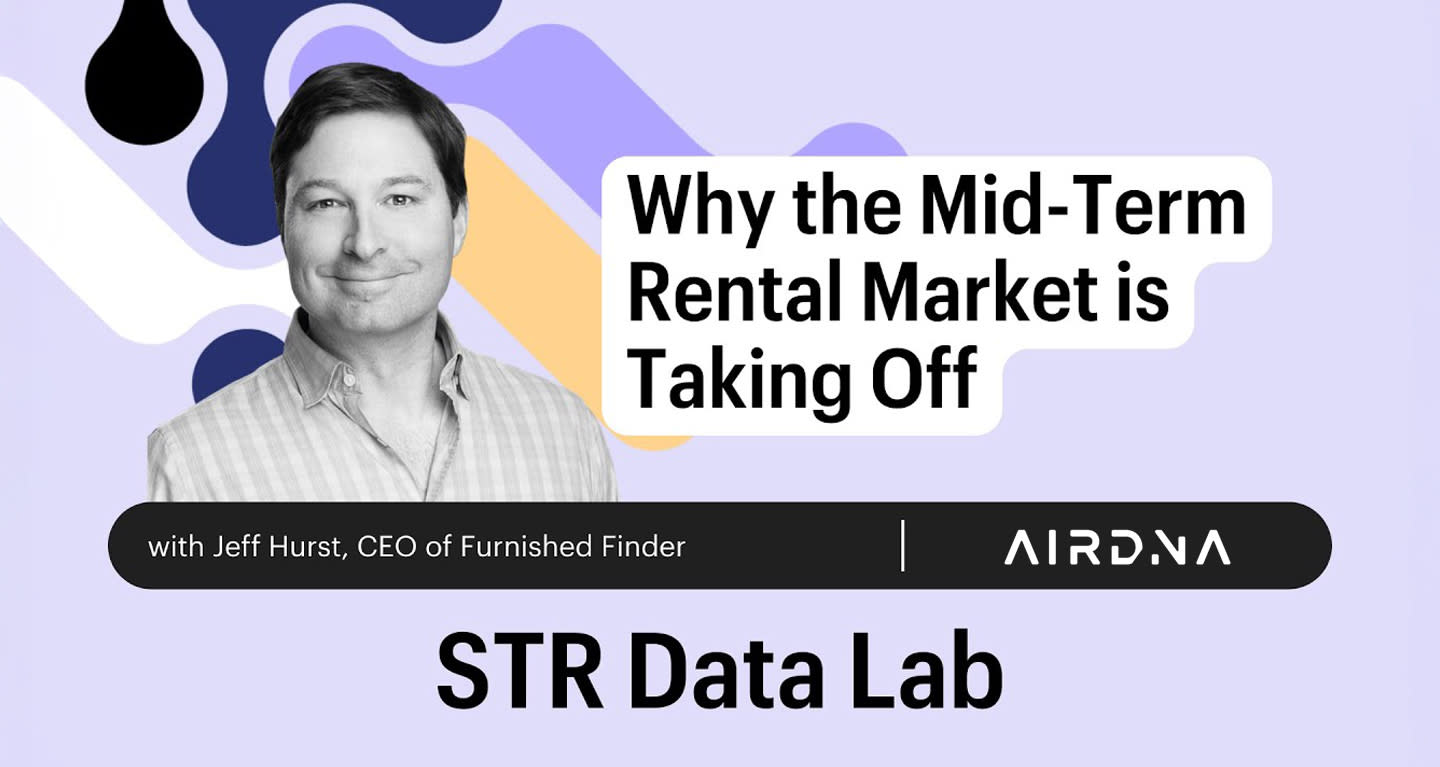
Furnished Finder CEO joins AirDNA podcast to discuss recent report on the monthly rental market
The monthly rental market — also known as the midterm rental segment — is rapidly gaining momentum as more people seek furnished homes for more than one month, but less than one year. This flexible, in-between housing option serves traveling professionals, relocating families, healthcare workers, remote teams, and others whose needs don’t fit into a nightly booking or a year-long lease.
Until recently, though, there’s been very little research available on how this segment is growing — or who’s driving the demand.
That’s why Furnished Finder and AirDNA partnered to release the first deep-dive into the U.S. monthly rental market, offering a full look at supply, demand, tenant trends, and the evolving role of independent landlords.
In a special episode of the STR Data Lab podcast, Furnished Finder CEO Jeff Hurst joined AirDNA Chief Economist Jamie Lane to unpack the findings. Here’s what landlords, tenants, and industry professionals should know.
1. Monthly Rental Demand Has More Than Doubled
According to AirDNA, U.S. demand for stays 28 days or longer grew 138% from 2019 to 2025 — more than twice the growth of short-term rentals during the same period.
Over 3.8 million nights were booked in the past 12 months alone, proving this is not a niche trend, but a fast-maturing segment of the housing economy.
2. Furnished Finder Grew 15× — But Demand Still Outpaces Supply
Furnished Finder grew from 20,000 to over 300,000 listings in just a few years, primarily from independent landlords. Still, Jeff notes that demand is growing faster than supply, especially in secondary markets and suburbs near hospitals, universities, and corporate projects.
Why? Because monthly rentals offer higher yields than long-term leases with less turnover than short-term stays — a “just-right” option for many independent landlords.
3. This Market Is Driven by Life, Not Leisure
Unlike vacation rentals, most monthly renters are traveling for work, relocating, or undergoing major life transitions. Furnished Finder's top tenant categories include:
Relocating families (fastest-growing use case)
Corporate and skilled trade professionals
Traveling nurses and healthcare workers
Academic professionals and grad students
Insurance and construction-related housing
These travelers aren’t looking for resort-like amenities — they want safety, comfort, and affordability for a longer stay.
4. Pricing Reflects Value, Not Just Convenience
The average Furnished Finder stay is about 100 days, with typical rents around $2,000/month. That’s a good value for tenants — and a sustainable, lower-effort income stream for landlords.
Unlike short-term rentals, there’s no race to wow with luxury extras. Monthly tenants prioritize:
Reliable Wi-Fi
Blackout shades, comfortable beds, and quiet sleep
Free parking
Pet-friendly policies
Well-stocked kitchens and living essentials
Landlords spend less on furnishing and still deliver a great stay — because the value lies in comfort, not flash.
5. Monthly Rentals Help Solve Real Housing Gaps
Jeff emphasizes that monthly rentals don’t just benefit travelers and landlords — they help fill a critical gap in housing affordability and mobility:
They offer transition housing for families moving between cities
They support workforce and project-based housing
They allow for multi-generational proximity without overcrowding
They make it possible to live close to hospitals, construction zones, or job sites temporarily
As housing availability tightens nationwide, monthly rentals can provide relief without major new development.
6. What’s Next? More Tech, More Professionalization
Though still early in its maturity, the monthly rental market is poised for major growth — and more investment, software support, and institutional attention.
Furnished Finder remains committed to serving independent landlords first, while building the tools and partnerships that can help bring more quality housing to the market — responsibly and affordably.
Want to Dive Deeper?
Listen to the full episode (opens in new tab) of the STR Data Lab podcast below, or read the full transcript for in-depth commentary from Jeff Hurst and Jamie Lane.
You can also download the joint report (opens in new tab) from Furnished Finder & AirDNA here to explore the complete data set and uncover trends shaping the future of monthly rentals.
Full Transcript - The Rise of Midterm Rentals: Why the “Missing Middle” is the Fastest-Growing Opportunity
Welcome to the STR data lab. Hello and welcome to the STR data lab. I'm Jamie Lane, chief economist at AirDNA and I'm joined today by a amazing guest. We have Jeff Hurst, the CEO of Furnished Finder on the show today. Jeff, welcome to the show. Thank you so much for having me. I'm thrilled to be here, Jamie. Yeah. So, Jeff, I I've known you for a few years now, and it started when you were at uh Expedia Vrbo. Uh, and now you're probably in one of the most interesting roles that I see in sort of the combination of short-term rentals and housing, and it's been the fastest growing segment of growth. Uh, and it's on midterm rentals. So, uh, how did you get here? Yeah. Um, well, I mean, I think it's sometimes better to be, uh, better to be lucky than good. And so, you know, the, uh, the longer version of how I got here. So, as you mentioned, I was in the short-term rental category for a very long time. I joined Home Away in 2010 on the strategy team. I was the chief strategy officer when we sold to Expedia at the end of 2015. Uh, stayed on and was a general manager becoming president of Vrbo. uh was then the uh co-lead of marketing for Expedia Group and ultimately the chief operating officer for Expedia Brands. Uh I left Expedia in 22 with without a plan except that I was going to take a year off and I did a pretty good job and took nine months off and got introduced to the founders of Furnished Finder and it was just a total shame on me moment of like I had no idea this thing existed. I didn't even really know the category existed. Like I knew about Extended Stay Americas and I knew about corporate housing, but there was the Sleepy platform that was founded in 2014. Uh they had four domestic employees and 200,000 listings on a subscription model. And the subscription model is what caught my attention because it felt a lot like original Vrbo, like 2008. Um, and so I got to know the founders, uh, was working with some, uh, with the private equity team that the founders had been involved with about how they get new management and liquidity. And I ended up becoming the CEO really with a mandate to come in and modernize the platform and help apply lessons from, you know, I'd say mostly what I got wrong, but a little of what I got right on the short-term rental journey. And so, we're two years in and, uh, really excited about the opportunity in front of us. I' I'd say we know the way you described it is most exciting. I'd agree, but I'd also say most misunderstood and that it is so different than short-term rental. I've been surprised. Yeah. No, it is it's been surprising to me to I mean when talking with midterm rental investors of how many people just like go after that category I came from commercial real estate side CBRE like and there was a ton of multif family investors that went after the long-term rental side then jumped into uh short-term rentals and saw the short- term term rental side and then thought that like this midterm rental is like oh it's just going to be some I'm long-term rental investors coming in occasionally some short-term rental investors maybe doing midterms occasionally but there's this whole segment of people that really focus on midterm rentals as an asset class that one it was amazing to see this sort of middle existed and two like what that opportunity was especially I mean during COVID and as more and more people sort of maybe tried a midterm rental for the first time and now see it as something that they sort of couldn't live without is that sort of optionality of finding a furnished home or furnished apartment and be able to rent it for 3 6 n months uh at a time. Yeah, it's been, you know, I do think the short-term rental boom made mid-term rentals more accessible than possible for independent landlords. And our platform is about 80% independent landlords, literally people with a single home, self-managing. Uh, and that that wasn't a big deal in 2005 and short-term rentals. Um, you know, really the rise of the RBO and then Airbnb made it more possible, but I think it opened eyes to this investing class that there is a way to yield that's not long-term, not short-term. And like, you know, like a good Goldilocks paradox, it's just like just right in the middle because it's a little less work and higher yield than long-term. And I think critically often, you know, you you mentioned a place in Georgia. I've got vacation homes around Texas. You often can manage these 15 minutes from your house. And so the local nature of them allows you to do something where you really know who's coming in a way that might be more challenging with leisure and you can do it with less capital. Yeah. So, we have a joint report that just came out uh looking at the rise of midterm rentals and it was a really fun report to do and for us cuz and we've sort of periphery like sort of seen the rise and growth, but we'd never really done a deep dive on midterm rental demand. Uh, and like I talk all the time about the growth postcoid. Like it's just been a boom for short-term rentals. We talked and you just mentioned it like that was a major tailwind for for Furnished Finder. And just some numbers behind it. So from 2019 to 2025, we saw short-term rental demand up 57%. If now we isolate just midterm rental stays, so those 28 days or longer, over that six-year period, we saw demand up 138%. That's more than doubling the amount of nights stayed. And on a trailing 12-month basis, that was 3.8 million nights stayed, which is that's a lot of demand when you think about I'm just talking about the US. So Jeeoff, like when you look at that level of growth that we've just seen looking at and the platforms we track, Airbnb, Vrbo, uh, booking, how does that compare to what you're seeing at, uh, Furnished Finder and sort of the the scale and pace of growth that you guys have seen over that time? Yeah, I mean, first of all, thank you. The team's been a joy to work with. I've been a big fan of AirDNA for a long time. You know, going all the way back to when Scott founded it and we were trying to figure out how we work together and so really enjoy what you guys do for the category and enjoyed collaborating on this and in particular because AirDn is like phenomenal at demand level data like you actually know where people are going in um in a we're a classified model and that's important to keep in mind like I know who the landlords are. I know who's getting in touch with them but we're not a booking platform. people don't pay on furnished finder because it is a little bit more long-term rentals and I think that dynamic allowed us to do something really interesting and so what I'd share in terms of what we've seen and you know this is going to predate when I was actually at the company because I joined postcoid obviously uh we had about 20,000 listings paid listings on the site before co uh you know as of now that's well over 300,000 so 15x growth over a period of about six years which is absolutely wild. Uh during that period and since I've gotten here, what we've seen is that demand's actually growing faster than supply. And you know, honestly, we're trying to help get supply to catch up. But the big reason that's happening is that demand has really shifted. You know, we got famous for this helping to house traveling healthcare, helping during the pandemic, and that's what people were signing up for our site for and that's what, you know, the majority of our travelers were that too. That's about 25% now. And so what we're seeing is that the use case is really proliferating and I think it has a lot more to do with macro trends in particular professional and how people live as opposed to how people travel for leisure or stay somewhere than what you really get out of you know Airbnb and certainly my exposure at Expedia. Yeah. So there was an important important point there that I wanted to sort of double click on and that was and when looking at a two-sided marketplace like Furnished Finder is like and Airbnb Vrbo and all these platforms sort of bring together both hosts investors and guests that want to stay them travelers um or or tenants. You said that you guys are seeing more demand growth than you are supply growth. So fundamentally and and are you like if you had to choose which was going to grow faster over the next year or two, would you be saying like Jamie like we've got all the demand we really can support right now. We need to add more supply into Furnished Finder to make sure that guests or that tenants know that people know that when they come to our platform that they're going to find a unit that's going to work for their use case. Yeah. I mean, anyone who's ever run a marketplace business knows there's a right answer here. You always choose more demand. Yeah. Okay. You always choose more demand. You know, you would rather have more demand and then you you know that if you're bringing the demand in, your you know, your partners on the supply side are going to add inventory or tell friends and the inventory is going to come online. I think there's a little bit about our story, which is probably that uh the slower supply growth is self-inflicted in some ways. We're so focused on independent landlords. You know, as I mentioned, 80% are single owner. It's basically like self-managing on Airbnb or Vrbo because we haven't built integrations with the software providers like Host Flea or Hostway or Guestie. We haven't built integrations with the long-term providers like Turbo Tenant or Rent Ready. And we certainly haven't built integrations with the big property managers. And so the professional inventories kind of on the sidelines because we're hard to work with. And we've got to do a better job of making it easier to work with them. So more of them choose to put their inventory on. But when I look at Zillow and http://Apartments.com (opens in new tab) and it's important to remember like we're in this valley like we're this niche. One side you've got booking, Airbnb, Expedia. The other side you've really got Zillow and Co-Star and for those that don't know CoStar's http://Homes.com (opens in new tab) , http://apartments.com (opens in new tab) big marketplaces, you know, tens of billions of dollars in market cap. The growth at http://apartments.com (opens in new tab) and Zillow is overwhelmingly multif family, you know, and when you look at their furnished, you know, you look, you can search on their site for furnished accepts less than annual leases, it's like 75 to 80% multif family. So, they're catering to these big corporates, but they're also growing really fast. And Zillow talks about it all the time in their earnings releases about how Reynolds is really driving the business. So, we've got to find a way to do a better job making it possible to work with us when you run one of these professional companies and but we view our mission as to help the independent landlords and so we want to keep core to that but a lot of independent landlords use platforms like guesty and hostaway now or use turbo tenant rent ready so we've got to meet them in the middle and I think that'll unlock the supply growth yeah and maybe comparing more to like a booking.com (opens in new tab) in Europe which has done a amazing job of and and supporting corporate apartments and you go and and you're going to go and do a midterm stay in Europe like most of that demand I suspect would be booked through Booking.com (opens in new tab). Uh and they've done an amazing job of and not only bringing the inventory but also making it easy to book. Um, and you think about where Vrbo is now and having transitioned from and a subscription model to where every property is essentially and able to be booked instantly and is a a a pretty big transition. Uh and then it does look like and these tenants do want like at least uh that inventory available like they're not like doing this months in advance like they have the reason and there's a lot of reasons why people sort of choose midterm rentals and when we were doing this we sort of made our lists and I was going to run down them. You got like digital nomads, you have people relocating sort of needing temporary housing after moving. You've got medical travel. If I'm going to do a treatment, I want to be near the hospital. You've got consultants, project teams, and there's insurance stays. So, I have a tree fall on my roof or I get hit by a hurricane. Like, I need to find temporary housing. There's traveling nurses, medical professionals, doctors, and residency and construction, skilled crews, like seasonal migrant workers. like and you could make a huge list of and a lot of those people you would think that they would want and not only to be able to find that inventory easily but also to be able to and book it um and have that be something that they can and get to easily. So, how do you see that and sort of evolving and over time? Yeah, it's it's a um you know, I'm constantly thinking about like, okay, we're here in the middle. Do we feel more like short-term rentals? Do we feel more like long-term rentals? like what's the way for us to navigate this? When it comes to booking process, we feel a little bit more like long-term rentals. And so like the booking.com (opens in new tab) analogy in Europe, you know, most of that corporate housing actually works more like a cond hotel. Like many of them you can actually book for a week or two weeks or even a night. And so the structure feels more like hotels. The rate structure, the availability structure, the way they think about RevPAR, it's a little bit different on the long-term side. And I think we we work a little bit more that way. When we look at our booking process, it's typically booked within a month. Um, and interestingly, and I think critically for people from the short-term side, you're no longer playing Tetris with your calendar. Overwhelmingly, the people who are most successful on our platform are taking one booking at a time because that booking so frequently extends. Think about a remodel, think about a corporate relocation, think about a consulting project. All those things, you end up wanting to be able to accommodate the extension. And so, you're really signing a lease. You're often getting paid, you know, a check, often in person. And critically, a huge part of our platform that landlords and tenants value is the ability to communicate openly. You're doing FaceTimes, you're visiting in person, you know, you're you're traveling two hours away and need a place to stay, and you're going to go actually look at it, meet the landlord, and understand it in a way that's not possible with the short-term rental platforms. I do think there'll be convergence, but I think that convergence will feel a little bit more like Zillow. You can schedule it online. you can, you know, buy some of the products in a more easy to follow way, maybe a virtual tour than it will like I'm just going to go direct book it. And a lot of that is because the occasion's professional. There's a stipend you're, you know, very frequently and you mentioned your tenant types. You know, corporate and skilled trades the top, it's about 30%, healthcare is 25, relocating families is 25 also. Academia is 10. Leisure is small, but for a lot of those use cases, like the dollars really matter. The service fee for a traveling medical professional who's making $90,000 a year, you know, if you do nine months of traveling travel on a stipend and are paying an Airbnb commission, it's over a week's take-home pay. You're going to work to save that money because that stipen money you save is taxfree. It's a, you know, it's the difference between a vacation and a good Christmas or not. And so those types of things make it a little more manual and you're kind of like signing up to do some extra work to save some money. Yeah. No, that that that makes sense. The other question that and you mentioned the sort of categories um um and medical stays and becoming a much lower share. What what are the other sort of trends you've seen in terms of the types of categories that midterm stays is really resonating with and do you guys consider like student housing sort of separate even though maybe some students some internships like sort of sit maybe midterm adjacent like what are the other sort of uh growth categories there? Yeah. So the fastest growing category we have is relocating families. And I think it's totally macro driven. You know, I think a lot of them they either can't afford a house or I think more commonly they can't afford to have a mistake on a house. And so they want to move to a neighborhood for 6 months, maybe 12 months before they move the furniture or before they invest in furniture because furniture is a pretty bad investment. and then they choose to to buy or really interestingly for me I'm seeing the bookend generations you know the boomers and then Gen Z actually living in these and I thought that was total crap when Jesse talked about it at Airbnb forever now I completely buy into it. Yeah. Um and so the tenant types are a lot different and really that relocating family long-term housing is the fastest growing um by a landslide. The next is probably corporate. Um, but corporate is not it's not as digital nomad as you might think if you're in the tech space. Like it's way more skilled trade, construction, opening a new restaurant, uh, traveling sales. And when I think about that use case, it it is a throwback to short-term rentals of like short-term rentals originally won because it was so much more value than staying in a Marriott. You know, two rooms at a Marriott and Destin or a short-term rental. You're going to save money. You're going to have more space. It sold itself. It's kind of the same dynamic for that use case for us versus an extended stay America. And that you're going to spend $70, $80 a night, so it's $2,100 a month. Or you can spend $1,700 with us and have a studio with a full kitchen and a separate space and private parking. Like it's just a way better value proposition. And interestingly, the biggest use of capital in the hotel space right now is actually in extended stays. And so we see this validated there. But where these use cases are, it's not Manhattan. You know, it's not it's it's way more likely to be the suburbs. You know, explosive growth category for us has been data centers. They're overwhelmingly in places where there's not a lot of housing and there's definitely not a lot of leisure housing. You know, it's Abalene, it's Monroe, it's Hillsboro, Texas, it's these places. And if you can get in there, there's actually a ton of capital available in need for housing and critically a need to go really fast. And so there's strategies in all these niches that are very unique compared to beyond the water, beyond the mountain, being near urban center, those sorts of things. Yeah. I'm I say here in Atlanta, uh lived here and where we've I talk with people all the time at the coffee shop or a restaurant like where are you where are you from? And they're like, oh yeah, and here six months uh on a and movie crew, TV crew, like it's exploded here. and the sort of demand for finding temporary housing for um the um film industry has just been incredible just to to see and you you you mentioned you know uh Atlanta I think is maybe the best use case in the there's been regulatory things happening padsplit's founded there which is a really interesting use case for renting by the room and how you do co-l livingiving and you know Atlanta's a big urban center where there is a lot of sprawl there is still a lot construction like to me it is like it's the best place to try and understand the category. Uh earlier you mentioned academics and when we think about academics it's very much not undergrad you know that's much more of a multif family occasion density for us it's way more grad students and it's actually early tenure professors or pre-tenure professors you know those professors need to move around a lot to find tenure and as they move around you know they don't don't have a lot of money yet they often don't want to move furniture and so we're a great use case for that so when people are asking about investing in the category I'm usually saying close to hospitals close to universities close to commuter corridors close to construction and a lot of people live near those things. They can naturally understand them without thinking about like I wonder who goes to Park City. I wonder who goes to Gatlinburg. Like it's a different it's a more digestible thing to wrap your arms around. Drive by the parking lot of an extended stay America and see what logos are on the trucks. You'll learn a lot. Yeah. No. And in terms of understanding the midterm rental market, we used to rent out a private room in our house and way back in the day like 2012 to 2017 when we had our first kid and like the use cases we would get like it would be people and trying to try the try try out the neighborhood. We rented our home for three months to someone that was in their residency at Emory the University Hospital nearby. like it it really is a uh microcosm of all the different potential demand drivers for midterm stays. Yeah. And about 20% of our platform is room rentals. And so that art feels very much like Airbnb. You know, there's over 60,000. No, that's that's interesting. So, one of the other and Atlanta's a great sort of market to talk about this too is how regulation has been impacting this sector. And I'm sure and you've got this background of knowing like regulation is the biggest threat in my opinion to the short-term rental industry. And we're seeing that play out especially in some of the large metro areas uh New York, Los Angeles, Denver, uh Atlanta, Dallas being great examples of that of uh legislation happening and essentially outlying and big aspects of short-term rentals in some of these major cities and more and more we haven't seen these listings disappear off Airbnb Vrboing. we've seen them sort of transition to midterms days. So what like how much do you attribute Furnished Finder's growth to this sort of rising regulation um verse just general organic demand that and just sort of centers around and the more use cases we found across sort of midterm stays. Yeah. I mean, well, first of all, uh I don't think that the regulation is good policy, but I do think it's good politics. Like, so for, you know, if you're in the short-term rental industry, like I do not expect it to go away. I don't expect there to be silver bullets. You know, I fought it for the better part of a decade. And like, you know, it is it's good politics because most of the people who own the homes that are short-term rental assets don't vote there. And so, it's it's a tricky dynamic. And uh you know, for us, it is not a driver of our growth. uh we see spikes with it. But interestingly, some of our lowest some of our least happy customers are those who come over from short-term rentals due to regulatory concern because we do yield less and it is a different category and they've got expectations and potentially even an investment thesis underwritten on how short-term rentals are supposed to work pre-regulation. And then when they substitute us, we are a lower yield. Uh we do have a different model and it just doesn't often pencil as well. Um, not to mention most short-term rental inventory is way more likely to be close to, you know, Deep Ella in Dallas or places that are leisure tourist attractions than it is next to, you know, hospitals and commuter corridors and where there's construction. So there there's a structural misfit and the inventory and the use case. The thing I'd most highlight is that the day after major regulation on a topic like this, demand has not changed at all. the person, you know, the person who is trying to go to Atlanta for a long weekend is not they don't substitute it with I think I'll just stay 28 extra days. Like it's just not a use case. And so our growth is about a handful of macroeconomic things. It's definitely about a housing affordability crisis and a housing availability crisis. And so that explains a lot of relocations. I think it explains a lot of academic um it is about increasingly uh the need for mobility and that's really about construction I think primarily but it's a it's got some tangential effects from flexible living from co and so I don't think it's digital nomad driven but I do think there are a lot of people who got used to being able to work somewhere for a few months and or you know serve a customer or a client that sort of thing that is a tailwind and so we see that proximity to workplace as driver. And then I think that piece we talked about with the bookendin generations, you know, boomers are doing this to be close to their grandchildren for extended periods of time and, you know, help with a new baby or be there for an important time of year and like it's great for a lot of the parents because they don't actually want the grandparents in the house. They want them two blocks away or in the same town. And then the younger generation, I think pretty, you know, I think pretty adeptly is realizing that the path of Gen X and the boomers to wealth, which was primary residence, is not certainly isn't their only path and maybe isn't the most attractive path. You've got all these different investment options, all these different ways for liquidity. And your opportunity for career and personal advancement if you are living with mobility, you know, month-to-month, six-month leases is actually quite a bit greater. Uh, I don't know if it's like society good, but I understand where they're coming from in terms of why they're living this way. I think it's rational and I think it is a macro trend. Yeah. So, we haven't talked about this, but I'm interested in your opinion of like how much of the midterm rental demand do you think is sort of net new stays or and let's talk specifically about what you're seeing in Furnished Finder like net new stays that maybe would have never happened like the example was and kids or grandparents visiting their kids like they might have just stayed in their extra room like been overcrowded and now that there's this easily accessible option on Furnished Finder are like, "You know what? There's a house in the neighborhood that we can rent out for the 3 months when we're helping you take care of your newborn. Like, we're just going to do that. It's going to be better for all of us." As opposed to like maybe someone was staying in an extended say hotel uh for the three-month time. Like, and it's an okay product, but it's it's not a single family home. uh and and that maybe some of this demand uh some of these stays were are pulling from other types of lodging options before. I think it's probably majority net new. Um yeah, I certainly don't think it's cannibalizing short-term. You know, I we compete with Airbnb quite a bit just because like they've got a lot of inventory that suits a similar type of need, but the majority of our inventory is not on Airbnb. And I think the use case that's happening, I do think it probably impacts some of the extended stay hotels, but I think it's more likely that someone who didn't want to make the trip because they were going to be in a 450T efficiency is willing to make the trip when for the same amount of money they can be in, 1100T studio or a one-bedroom. And I think the same is true for the grandparents. The grandparents might feel more like a burden in the guest room or be less comfortable in the guest room. And knowing that they don't have to be in the extended stay America or the $8,000 a month short-term rental, they've got an opportunity to be in a product that creates a new occasion for them to go live closer. And I believe, and I don't have hard data, but I believe for construction, it also opens up the opportunity to build things faster in new places when people are substituting this type of inventory. Like I think if the inventory comes from anywhere, it probably comes off of the for sale market, but temporarily. I think that's mainly because people can't get what they want to sell for it or it's a long-term that gets converted to a furnished midterm, but it's actually still serving like the ne the neighborhood societal need of the long term. It's still a professor who's going to live there for a year or two. That professor is just not paying for furniture. And furniture is a bad investment. Like it's like a car. It depreciates as soon as you take it out. It's got high switching costs. It gets damaged. And whenever you move, you're like, you know, you end up making pretty irrational decisions around like, well, I'm not going to move there because my armwire doesn't fit or it's not a great spot for my nightstands. And it's like, I hate these nightstands now. What do I do? Yeah. And it makes sense that some of it was and and what I totally agree with you on the sort of creating that new demand. You go and look at the hotel industry, like the darling of hotels right now is the extended stay product. Like it's not slowing down. They cannot build those hotels fast enough. So it does look like it's across the board, just more demand being created for this segment, not sort of stealing from any one group that's offering it. Yeah. And I mean, since the rise of short-term rental platforms in, you know, 2010ish, hotels have done fine. Like, they're fine. Uh, you know, places where they got the regulatory ban, they've probably done better, but like it's not like they stopped building. It's not like they suffered. I think there's been some shift back to them. And they'll do fine here, too. Like, America is short millions of houses. Yep. We're not short rooms. We're short houses. And so if we get more people to rent out rooms, more people to co-live, or if this becomes a reason for building duplexes, quadplexes because they're more economically viable for investors, it's massively good for society. Like just unequivocally good, you know, and it's like, you know, I think it for California, it's kind of like the ADU um laws they put in place. ADU is a good investment full stop in platforms that help you rent it out. We'll help landlords make money, we'll create wealth, and we'll help with the housing crisis. And so we're we're trying to enable more of that for independent landlords. Yeah. No, totally agree. And so talking about affordability, so the pricing of units on Furnished Finder is actually one of the things that surprised me the most. Uh and you tell me if I'm wrong, but like the thinking about like let's say an average onebedroom on Furnished Finder might be like $2,000. You rent it for three months. Like that's $6,000 stay. Not too different than a week-l long stay down in Destin I would have rented on Vrbo uh uh for a week, right? Uh so transaction values may be and pretty similar but totally different lengths of stay. Uh yeah. Yeah. I mean we're you know our average length of stay is almost 100 days now. So you're talking about a three-month plus rental. Um you know important to know about 75% of our inventory is two-bedroom or less. very different than short-term rental, you know, and so when you think about the occupants, you know, business travelers typically two or fewer, traveling medical typically one, relocating families two or more, they're really looking for a two-bedroom or onebedroom type of occasion. And for us, you know, the average rents around $2,000 a month. Um, and you know I the personal anecdote I relate to like when home away was very young. Uh, I remember taking a trip with uh Carl Shepard to Basalt, Colorado because we were looking at buying instant software which we ultimately did. And I remember being shocked. It was my first work trip after I left Mckenzie uh where I would usually stay in a Four Seasons or something like that. You know, Carl and I stayed at a Days in Basalt and it was like $70 a night and I was like, "Wow, this is very different." And Carl talked to me. He's like, "Listen, we are we're a young company and travel is a luxury and we're not going to spend on it. Like, we're going to spend money on things that drive the business." And like, small and medium businesses need to think that way all the time. And this is professional spend to achieve a career goal. This is not leisure spend. This isn't your spring break. This isn't your like must-have it right occasion. It's got to be comfortable. It's got to be functional. It's got to be convenient. And that's the type of thing that orients itself more to value of getting the job done, sleeping well, being safe than it does pickleball courts and arcades and where am I going to put the infrared sauna? Like there's no competition on that in mid-term rental. Midterm rentals, you know, I think if you're spending $10 a square foot to furnish it, you're on the high end. Um, and for a short-term rental, that's probably more like $30 a square foot. And so there's just way less capital deployed to get a good return. And and this is where in looking at the data, it does feel like midterms sit much more like firmly in the adjacent to long-term rentals than they do to short-term. Like it's it's not just taking the short-term rates and discounting them by 20% for a midterm stay. It's fundamentally different sort of pricing structure that looks much more like all right you're it might be a premium to a long-term given that you're a furnished stay and there's a little bit more risk on vacancy but it's not pricing off of what's happening in the short-term market definitely not you know I think that you know as a rule of thumb you can kind of think about furnished rentals furnished midterm rentals being 30 to 50% more rent in a long term and a lot of people will do 100% more. You know, it really depends on outfit and location and use cases. But like there's a rule of thumb there you can use. There's not a rule of thumb that feels like, you know, take 75% off your short-term rate. Like it just it just doesn't work. And and I think that the main reason is the inventory is so frequently different. You can't just go price the place with the pickle ball court and the hot tub and the infrared for midterm like use case. They overlap in places where maybe there's a family moving, you know, you know, an affluent family moving to Austin from Seattle might want a really nice midterm for six months while they remodel or figure something out, but it's a more of a niche use case. Um, and you can build a business around that. And I think that's one of the things that's a lot different is people in midterm hustle more than people in short term as it comes to generating their own demand and really closing bookings. you know, short-term has become very reliant on direct digital strategies and the OTAAS, and you can really fill a calendar and have a great business that way. It's a little less that way with midterm. We're doing our part, but a lot of people are still out there hustling. Yeah. and and you sort of you hinted this on the amenity side. So, I'm guessing most people when they're looking for a home on Furnished Finder, they're not checking the box for I need a a hot tub or a pool or and sports court or a game room. It is much more and what do I need to live on a day-to-day basis? I need Wi-Fi, air conditioning, and if you've got free parking, like all the better, you know? I think uh pets is probably a bigger deal even than short-term. Yeah. You know, if you travel by yourself nine months a year, the companionship of a pet is probably a little more critical than if you're going away for a long weekend, you're going to leave your pet with a friend or board them, that sort of thing. So, pets is a very big deal and a great way to increase your yield. Um and then it becomes things that are more like, you know, noise machines, blackout shades, talking more about the quality of the mattress. you know, sleeping on a subpar mattress in Destin for three nights, you can be fine. You don't really want to do it for 100 nights in a row if you're working a 10-hour day building a data center, you know, like it matters more. And so things where you invest more, but the things you invest more in are not about the wow they create in the pictures or the wow they create when you walk into the unit. It's about the wow when you get in bed or when you open a drawer and are really thrilled that they have the kitchen utensil you thought you needed or that there's a, you know, pressure cooker or whatever it is you like. And those things typically aren't that expensive. You can make those things be really meaningful. Yeah. The the other thing I I loved when sort of digging into the category was how much more accessible midterm rentals seem in terms of like investing. like talking with investors of like and investing in a million-doll home in Gatlinburg verse a $250,000 home in Birmingham like is like an entirely different amount of capital that you need to get in and actually find a cash flowing investment. Yeah. And and I think it's got a way uh a way higher floor as an investor also. And so I talk to people about like, hey, go underwrite for a long-term rental. And if you find a long-term rental that's going to be a fine investment, you have the chance to make it an exceptional investment by making it a midterm rental. And if for some reason it doesn't work out, you're still falling back to a fine investment. And short-term rentals don't always have that dynamic. And in short term, you're competing with a lot of vanity investors, people who aren't doing it for any economically rational reasons. They just want to own a house in Crest. And they're going to spend whatever it takes to own a house in Crest. They've got money and it doesn't matter. No one's doing that with a quadplex, you know, in Waco. And for the million dollars you might have spent on the place in Gatlinburg, you might own a quadplex or even an 8plex where you've got all these different formats you can play with. Some are long-term, some are midterm, and your furnishing cost is less expensive. And critically, I can't stress this enough, the amount of time it takes to manage these is way less. Four turnovers a year. and people aren't calling you every day because the you know Netflix or Sonos or the pickleball network or the ping pong thing like you don't have the same type of uh tenant attention required and property manager rates are quite a bit lower. You know, you can easily have 50% of your total rent as a short-term owner go to a manager when you add up fees and taxes and all of the add-ons that you don't participate in as the asset owner. Long-term, it's more like 15% and I think midterm's way closer to that 15% number of you're just able to keep more of your money and you're able to self-manage frequently because you can own one of these 10 minutes from your house instead of three hours from your house. Yep. And have you guys seen institutional capital come into midterms yet or is it mostly just staying in the long-term side? There's definitely institutional capital going into midterms as it relates to the uh the corporates. And so, you know, when you see the the growth on Zillow and Co-Star and what they're doing with multif family and I think, you know, even some of it, the the product from a short-term investor probably feels a little bit like failed SER or what Placemakers got right today. You know, these uh these models where you're earning a management fee to add furniture and manage these things in multif family. There's going to be more of that. I haven't seen anything that feels like, you know, Blackstone money going into midterm yet. I think it will come. You know, I think there is a there's a very coming soon wave of professionalization where you're going to need to figure out who is going to be the property manager category here. Um, you know, the urban property manager is probably more likely to be a realtor than it is that it's going to be an extension of whoever's doing it in Dest Padre or that sort of thing. And then you're going to probably see more institutional money come in. You know, you certainly see it single family already. Um, but I I expect that'll happen. I hope what happens is you see it as a coming construction boom as opposed to just asset trades. Yeah. So you think we're we're still really early in terms of professionalization. It's literally it's 2008 in short term. Yeah. Really? I mean you think about you know the biggest platform in the space doesn't have rates or calendar connectivity to any software platforms and there are no dedicated software platforms. The long-term platforms don't accommodate furnishing or any rate structure that's not annual and short-term platforms don't accommodate pricing and a lot of the things we need to make midterm work. Like there's going to be convergence. I, you know, I know a lot of players in the space are looking at it and trying to figure it out. And the good news is the short-term guys are very well positioned for it because midterm is way easier. If you're a good manager, this is way simpler, fewer turnovers, easier tenants. Um, but it's different enough. So, yeah, it it does feel like some of these short-term rental tech companies are pushing into midterm, whether it's Wheelhouse and Price Labs creating pricing for midterm stays, guesty, hostaway making their property management systems a bit more and userfriendly and and accessible for midterm stays, but there's like still that missing middle in terms of tech specifically built for midterm operators. Yeah, totally. I mean, I'm not aware that any of the short-term players connect to Zillow. I know they don't connect to Furnished Finder, but we'd love to. We're going to figure that out. Um, but there there's there's a missing middle. And, you know, I think one of the things that from a commercial model is something important to remember. You know, on the long-term side, most of the independent landlords don't pay commission and have either subscription or like pay for placement fees. Our model, it's you know, is basically $199 a year. And so which is cheaper than Vrbo was in 2008. And so there there'll need to be something where we figure out how do you get the economics to work for these operators that are used to earning, you know, some percent of booked value or some commission model. And I am confident we'll figure it out, but it is a uh category that just has lower structural economics. And so we've got to go find a way to get the connectivity to work so that we can really grow the category. And I think it'll be great for investors because I think they are going to have hybrid strategies that may not be available today, regulatory options to move into a category without selling your furniture that may not be available today and kind of keep the system in place uh that will just grow liquidity. Yeah. So, so Jeff and thinking about the future and sort of wrapping up like you were at Home Away, you were in short-term rentals in 2010 and saw the sort of path that that sort of grew at. You're now at Furnished Finder and looking at midterm rentals in 2025. And if you're going to look ahead over the next three to five years, like what do you see that this growth trajectory looks like? Yeah, I I think we will. Um, you know, we went from 20,000 paid listings a little over five years ago to 300,000 today. Uh, I think 500,000's very reasonable just with independence. If you assume an industry dynamic kind of similar to short-term, that means you could probably get to a million uh by doing a good job with professional and adding inventory from the multif family players, you know, and the um uh longer term markets and then finding a way, you know, I always talk about like Michigan is a great short-term use case for us of like we're great at Michigan winners and you would never want to use us for a Michigan summer. Like it wouldn't be a good yield strategy. And so I think you're going to see that the supply is going to be available and hopefully it'll actually help create construction too. Uh had a great conversation with Pace Morby lately where they're talking about how do we add ADUs? How do we build this on existing lots in a way that's compliant and creates the housing needed for mobility and long-term and I think we'll see a lot more of that and I think they'll potentially even start to be subsidies or regulatory carveouts for it. On the demand side, I don't see you know we're not going to build 10 million houses in the next 3 to 5 years. So, we're going to need more of this type of mobility and liquidity in housing to solve the affordability crisis and the housing crisis. And I think that it is a durable trend that the younger generation is going to be interested in building wealth in different ways and having mobility that feels like this type of product. And so, I expect demand will keep growing faster than supply, but I think we're about to see some inflection points that both are going to grow a lot faster. And it's going to be really exciting. No, I I totally agree. I think it's a really exciting category to watch and one that is and could be and an really strong third pillar uh around sort of um industry demand. So Jeff, this has been incredibly helpful uh really interesting conversation for me. Uh we are going to link uh in the show notes to our joint report uh that uh we have uh put out. Uh we'd love for everyone to sort of download it uh read it. uh provides some great information on on what we're seeing in terms of both demand uh trends from the ARDNA side on on how and why people are are renting uh sort of are doing midterm stays and then really great context from Furnished Finder and what they're seeing in the terms of the supply, the rates, uh the type of properties on their platform and and uh what's renting. Yeah, I mean we we've loved the collaboration. Appreciate the work you guys do. You know, my ask for your audience is just be curious. You know, if the if the guy that was the president of Vrbo had no idea this company existed or category existed, like I get that you may not either. You know, come to the website, check it out. Uh we host a podcast called Landlord Diaries that helps you understand how it works. Bunch of great content on the site and um it's like 2008. It's $199 a year. So give it a try if you've got a property worth trying. Awesome. Thanks, Jeeoff. And if people want to find you, want to find Furnished Finder, what's the best way to do that? Uh, best way to find me is uh on LinkedIn and best way to connect with Furnished Finder. We've got a over a 100,000 landlords in our Facebook group. And then we have hundreds of people who answer the phone every day. So get on the site, shoot us a um shoot us a note. We'd love to connect. Awesome. Thanks, Jeff. Thank you, Jamie.