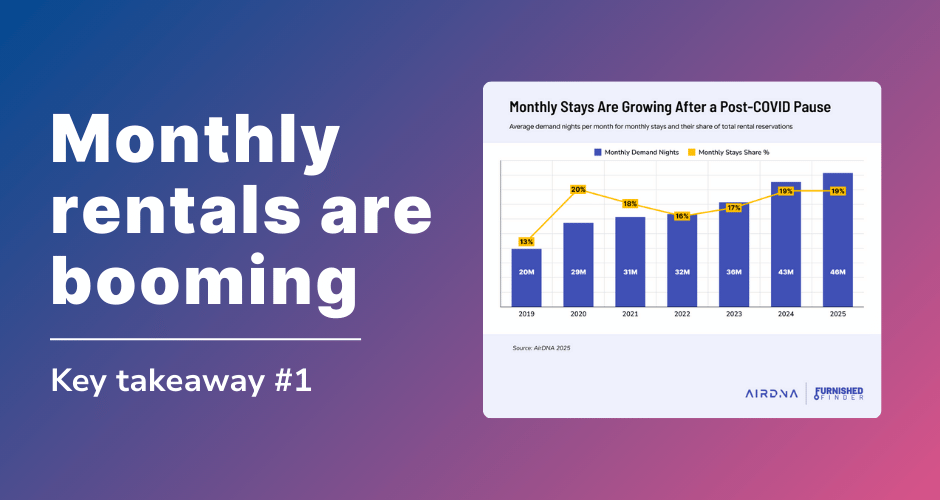
Not too long ago, monthly rentals quietly bridged the gap between short-term stays and year-long leases. They served a purpose but weren’t seen as a go-to option.
That’s changing, and fast.
New research from AirDNA, in partnership with Furnished Finder, reveals just how rapidly monthly rentals are gaining ground. The report, Monthly Rentals: The Hidden Gem of Housing (opens in new tab), takes a closer look at how extended stays are becoming a core part of the rental landscape. Read the full report here. (opens in new tab)
From niche to necessary
One of the standout takeaways? Monthly rentals are no longer a quiet corner of the market—they’ve gone mainstream.
Since 2019, bookings for stays of 28 days or more have grown by 136%. That’s more than double the growth rate of traditional short-term stays. Today, monthly rentals make up 19% of overall rental demand across the U.S., and the pace is accelerating. This includes demand for long-term rentals, making the number even more meaningful.
What’s behind the shift? People are prioritizing flexibility—especially in times of transition. Whether it’s remote work, relocating, or simply wanting a change without a long-term lease, renters are choosing homes that fit their lifestyles. Monthly rentals offer that freedom, with the comfort of a furnished space and a clear, predictable monthly price.
Why renters are choosing monthly
The growing demand is being shaped by several overlapping trends:
Remote and hybrid work have untethered professionals from one location.
Limited housing inventory and rising costs have made flexibility more appealing.
Life transitions, such as family moves, medical travel, or temporary assignments, are creating new reasons to rent monthly.
Monthly rentals meet renters where they are. They're a practical, comfortable option for people who want stability without being locked into a year-long lease.
Real growth, real opportunity
Furnished Finder’s growth reflects this national trend. Before 2020, the platform supported around 20,000 listings. Today, there are over 300,000 furnished monthly rentals available.
Between 2022 and 2025, booking inquiries tripled—and the number of unique travelers more than doubled. That’s not just growth—it’s a shift in how people find and choose housing.
And it’s not just travel nurses anymore. Monthly renters now include remote workers, families in transition, students, insurance-displaced tenants, and professionals on the move.
What this means for property owners
If you're already hosting on Furnished Finder, this data likely confirms what you’re seeing: longer stays, reliable tenants, and lower turnover.
If you're considering listing your property, there’s never been a better time to step in. Monthly rentals are growing faster than short-term stays, with steadier demand and fewer seasonal ups and downs.
This isn’t a trend—it’s a new standard.
A growing pillar in the housing market
Monthly rentals aren’t replacing short-term or long-term housing—they’re filling the gap in between. And they’re doing it in a way that supports modern lifestyles, work flexibility, and housing mobility.
What started as a niche has become a cornerstone. And as the Monthly Rentals: The Hidden Gem of Housing (opens in new tab) report shows, this shift is just getting started.
Want to explore more of the data and insights shaping this space? Dive into the full report here (opens in new tab).
Transcript
The report helps because I think it just demystifies it and helps people understand like this is real. It's corroborated across multiple data sources, and hundreds of thousands of people are making billions of dollars by putting the strategy to work. And you see it across hotels, you see it across short term.
You see it across long term. We talk a lot about what Zillow and Apartments.com have been up to. Apartments.com has about a hundred thousand of these types of listings on their site. Zillow about 50,000, and so it's just adding more certainty that there's an opportunity here.
Welcome to The Landlord Diaries, the official podcast of Furnished Finder. Your trusted companion for building success and monthly rentals. I'm Kelly Bailey with eight Cash Flowing Monthly Rentals in Texas. And I'm Katie Lyon, marketing director at Furnished Finder and real estate investor with 13 furnished rentals across multiple states.
In every episode, we share real stories, practical tips, and expert insights to help you grow with confidence from securing better bookings to maximizing your rental income. So follow up the show and let Furnished Finder be your partner in building a thriving monthly rental business.
Welcome back, Jeff Hurst. Reminder, he is our Furnished Finder, CEO and President. He's also the former COO of Expedia Group President of Vrbo and Chief Strategy Officer of HomeAway. What we're gonna cover in today's episode is Jeff, Katie and my perspective from our first ever. Industry report created in collaboration with AirDNA.
It's called Monthly Rentals, the Hidden Gem of Housing. This is a first of its kind publication that combines Furnished Finder and AirDNA proprietary data sets to deliver the most comprehensive data-driven view of the monthly rental market. The report explores where the industry stands. Today, the trend shaping, demand and supply, and practical insights for both current and prospective monthly rental investors.
Jeff, why don't you give us a 30,000 foot view of what this report entails? Absolutely. And Katie and Kelly, thanks for having me on the show. I get to see you guys all the time, but it's always fun to see you and we get to chat with everybody else. So first of all, huge thanks to the AirDNA team, especially Jamie and Bram, who helped us coordinate this report and drive insights and use their vast dataset to compliment the data that we have internally.
And of course, thanks to the Furnished Finder team. Across our analytics and marketing team who really helped make all this possible. When I think about the report, it is demystifying and helping people understand what's become a really big category. And so at a 30,000 foot level, I'd say a few things.
One, monthly rentals are reshaping rental economics, and it's really about this, as I often describe it, the valley between the giants, like this monthly furnished occasion's kind of between what CoStar and Zillow do for long-term unfurnished. And then what? Vrbo and Airbnb do for, short term furnished.
So it's not a year, it's not three days, it's this thing in the middle. And Furnished Finder has really become synonymous with it. But there is a lot of activity on AirDNA's dataset, meaning booking Airbnb and Vrbo that helps compliment what we see. What we found was that it's big and it's growing fast, which people in the category already know.
What was. Soothing to find is that it's really driven by macro trends. So it's a durable thing that's here to stay. Affordability and housing shortage, worker mobility, and really skilled labor and how people are choosing to live and work across the United States. With that comes that monthly tenants do not equal leisure tenants.
Huge differences in who? The consumers are and what type of footprints work well and even where they work the best. It's not leisure destinations and these are much longer stay occasions, not surprisingly. And then finally, the what makes someone successful in this is really solving for what helps someone be comfortable, have a good commute, feel safe, and feel a part of a community much more than it is the wow factor.
And so investors have a very different opportunity to participate in this because it's a lower cost of entry and often a better cash return. All right, so clearly this report helped us uncover a ton of insights, some of which we were, really tuned into, and others that we just got a little more specific of a view of.
So before we dive in too far of the details of the report and explore the things that surprised us each the most, Jeff, help us give our listeners a little bit more of an understanding about who AirDNA is and why they were so important to work with on this partnership for this report. Yeah, so AirDNA is really the longest term keeper of truth in the short term rental industry.
And so they've been tracking Airbnb and Vrbo and booking data for, well over a decade. And so they're looking at review velocity and listings and have built their own proprietary algorithms and data sets. To understand what's happening at a detailed level in short-term rental, and have also built an opportunity to like forecast that into the future.
One of the things that their team had spent a lot of time on in the past year was trying to understand 28 day stays better because. It doesn't work as well for the way they built their platform from a data perspective. And so they've made a lot of progress on that and wanted to take this opportunity to compliment their data with ours, because since we're a classified site, we have a lot of information on who's having conversations and what's happening with inventory, but we don't have the same type of information they have on what's actually booking and what do the reviews say.
And so the marriage of those two things, a more supply centric. View versus a more demand centric view allowed us to get to a very different set of insights. Yeah, it's a fantastic report. So before we get too far reminder, if you wanna view it, it is in the show notes of this podcast episode. It's also on Furnished Finder in many different spots so you have it readily available to you.
One thing I really found intriguing in the report was the idea that monthly rentals are outpacing short-term rental growth. And I'd love to dive further Jeff into why that is, because it totally makes sense to me as a monthly rental operator. You've got. Gentle tenants that are gentle on your property, you can self-manage because you only have a few flips a year.
It provides cashflow opportunity in a market that is oftentimes not available on the long-term rental site, especially with the higher interest rates. So I'm very intrigued and ready to discuss, just that part of the report of why monthly rentals are growing so fast in comparison to other markets.
Yeah I think this was one of the big questions for me coming in. My history at Vrbo, this isn't as big of a part of our business as it was at Airbnb. And so what the AirDNA data shows is that, pre COVID, 30 day plus stays were about 13% of total stays in their dataset. During COVID that jumped to 20%, which I think everybody was like, oh, that makes sense.
People don't have any other options and they're trying to get outta their house. And so the question was really like, is this gonna be a durable trend or not? And what we've seen is that over these past two years, the growth has really accelerated again. So we're back up to 19% of the total nights stayed are in this month or longer stay occasion.
But interestingly, over that time period these stays are growing about twice as fast as the non. Monthly stays. And so what you're seeing is even within the short term rental platforms, the disproportionate growth is coming from 30 day or greater stays. I think a lot of that on these platforms has to do with that.
There is more occasion for digital nomads. There is more occasion for the opportunity to live somewhere and work from there for a longer period of time. But it's also seeing that they're starting to see these lines blur. And the other thing we look at in the report is that hotels are placing the biggest capital investments into this type of category.
So they're seeing the opportunity. Also, even just last week there was a big announcement between Hilton and Placemaker. They're investing more in these apartment style accommodations because everyone sees the writing on the wall that there's a big demand for this type of flexible living. Yeah, it's really interesting because I feel like a lot of people think about monthly rentals only in terms of travel nurses and the massive boom that came for the need of traveling medical professionals in 2020 right around the pandemic and remote work and everybody was, Hey, I'm homeschooling my kids.
I can go be near my grandparents or other family or explore this, or we need to travel or do whatever. So that was a really natural and obvious boom. And there's a myth out there that monthly rentals are struggling since then, or that the demand is not back. But to know that the demand during that peak really unique season was 20%, and now we're at 19% and we're talking, we're demand of the entire rental market.
Not just short terms or it's like even long terms, which are always gonna have the vast majority. We're right back there. A, and it's for different use cases. Like I'm seeing different travelers in my properties, but they're still as reliable and they're still gonna need these places to stay.
Yeah. The healthcare market's still big and it's still growing. It's just that it's not growing as fast as all these other tenant types. Business is the biggest part of the market now, and a lot of that skilled trade, data centers and these sky, high rises and all the different infrastructure that's being built, people are moving around to accommodate that.
And then healthcare is still 25% and it's still growing, but it's not growing as fast as the other categories. And the third category is relocating families, and it's growing the fastest. And I think that's what's like. The most different from four years ago, but also the most intuitive interest rates are high.
There's a housing shortage, there's affordability concerns, and people want to try before they buy. So they're renting a place in a neighborhood before they actually buy a place, or they're increasingly looking to this type of inventory when they remodel or when they're in a transition between buying and selling.
And so it's becoming more of a community asset. And in many cases, some of the inventory actually maybe is also a short-term rental, or used to be a short-term rental because the regulatory landscape has changed a lot in the past six years with many cities adopting that. Short-term rentals have regulatory restrictions if they're rented for less than 28 days, but don't if they're rented for more than 28 days.
Looking for a simple professional way to manage your monthly rental furnish binders, landlord tools brings everything together, tenant screening, lease templates, and online rent payments all in one place. Stay organized, save time, and stay in control. For more information, explore landlord tools today.
The report really showed that with that 19% of the entire rental market we're no longer a niche part piece of that market. Like we are an established part of that market that has plenty of room for growth still. So I'd love to hear more on that side of where do you think the monthly rental growth is coming from?
Yeah. Yeah, it was great to see a dollar figure, AirDNA estimates, it was over $6 billion across Airbnb, Vrbo, and booking. That obviously doesn't include the activity on our platform, which would be several billion dollars more and doesn't include the activity on Zillow and apartments.com and all of the, just peer-to-peer activity.
So this is tens of billions of dollars of rentals for sure. And the growth is happening. Everywhere. So if you think about it from a supply perspective, it's commuter corridors, it's hospitals, it's good schools and neighborhoods, it's universities, and those are all very spread out compared to leisure destinations.
And then if you think about it from a tenant perspective, it's what I was just talking about in terms of business, healthcare, relocating families, academics. But it's actually been diversified so much more than five years ago where it would've been majority healthcare. And now healthcare is only 25%. It's like it's grown, but also become so much more reliable because the diversification of the tenant needs are so much stronger.
Yeah. And I think that the because of that, the types of owners that are getting into this are becoming, a little bit more professional. You are seeing blurring of lines with short term, the Furnished Finder investor base and our landlords are 85% of 'em. This is their only property.
And so that piece like really speaks to, there is still a ton of care and attention to detail that, when I talk to my colleagues that are from the short term industry world, feels more like 10 years ago in some sense of there's still a cottage industry feel and it's starting to grow up.
And so for people thinking about investing. It's still early, it's still a great time to get in. You haven't missed the boat and nothing you're saying or explaining is crazy. We're saying good schools. Good neighborhoods, like good sit. Like you're not telling people that they have to be on the beach or in the mountains or have a fancy cabin.
There's nothing that is extraordinary about midterm rentals in their format or function. How do you think that has supported the growth for the demand of these properties? I think the two things that have really made it possible to grow faster here on the supply side, it's an app. It's a more approachable price point.
You don't have to buy this in Aspen, you don't have to buy this in Steamboat, and you don't have to buy a four bedroom with pickleball. That's becoming paddle ball, that's got all of the different amenities and can be up to 40 or $50 a square foot just to outfit, the 70% of the properties, or two bedrooms or less.
A lot of these are studios. We have 60,000 rooms on the platform. And so when you think about the growth from 20,000 to 300,000 listings, it's been all shapes and sizes, but it's really focused on this smaller footprint which is a more affordable price point and more affordable destinations. And so it's just more approachable for investors to get involved.
We've seen lots of creative ways people do that. A lot of times the external landlords get married and one of 'em decides not to sell a house while they furnish it. But you can also get into this through arbitrage because it is a much more available type of, Hey, I'll sign a lease agreement for three years if you give me the right to sublet it for a month or more.
Because those 90 or 180 day bookings are not as disruptive to a tenant base as somebody coming in every weekend and turning it over. It's just not as disruptive. So we see all of those contributing, but I think the big thing is that it's a great cash on cash return, often better than long term, and often equal to short term, but with way fewer headaches.
Yeah, and I'd love to just point out some things that we've heard about the report from our active Furnished Finder landlords. We've heard time and time again already that it's just backing up the data that they've already been seeing in their market. So this report brings to light some of the things that they already know about their market, but really highlights it across the entire.
United States, right? And myself as a landlord on Furnished Finder for about over five years now with properties ranging from a 300 square foot, a DU, all the way up to a multiple three bedroom, two bath homes. It's a wide variety of reasons why people are coming for monthly travel.
And so I wanted to highlight some of the. Some of my properties and just what brings someone to the suburbs we're in. So I've got one in Austin, Texas, but a majority of our properties are in the outer suburbs, right? Georgetown all the way up to Belton and Temple area. So you can not only. Make it profitable in the urban areas, but even better sometimes in these suburbs where they're still commuting to large corridors.
And so we've had a variety of skilled workers for a meta build, solar farm electricians, manufacturers. We've had individuals and families that are just looking to decide if they wanna live in that area. But what I love about those individuals or families is they often decide. Hey, you know what?
I'm not ready to buy yet. I like this area. I'm just gonna stay and I'll let you know when I'm ready to move. So we're going on multiple years with many guests in that category. And then if you unfortunately have a 10, like if you unfortunately have a flood or a fire in your area, we've had quite a few guests that have experienced something in their home or a large remodel.
So it's just a it's just a. Functional category that makes sense why it's growing at the pace that it's growing. So Jeff, I would love to know what you think that shift means for the average landlord, especially ones that either are new to Landlording altogether or they've been doing long-term rentals for years.
I, I think what it means more than anything is that there's a more approachable entry point to get a better. Better yield and a better cash return. And so managing a short term rental is hard. I've got three of them. I managed one of them myself for the better part of a decade now. They're all property managed.
But when you're doing it yourself, it takes a whole lot of your time. They're rarely within a drive of your house, and things happen more often because of the type of renter that's there and the type of vacation that's going on. And so now I have property managers for all of 'em, but property managers for short term rentals really impact your yield too, because they charge typically at least 25%, oftentimes more if you're in a more remote location.
And so a lot of the benefit ends up accruing to them in terms of how the economics work. And so on the flip side, midterm makes more money than the long-term rentals, but you can also manage them with less time and a lot closer to your home. And I think that last piece is what actually makes it the most appealing.
I'm always encouraging people to invest in what invest in what you know, invest in something you're passionate about, and. Usually people know a lot about where they live. They can think about who is in my neighborhood and what are the use cases and the needs, and how can I actually serve my community?
Do I know people who are here for the university, like in UT Austin, or do I know people who are building those data centers or, traveling healthcare. There's this opportunity for you to use your own knowledge in your own backyard. And when you do need to put time into it, have a 12 minute drive instead of a six hour drive, like my place on the beach in Texas, to be able to put in some of your own sweat equity and labor to help make it a better return.
And so I think that's what's so appealing about it is it's the best of both worlds. I think an important thing to mention here too is that we just released a brand new version of our stats page, as we've called it for so many years. We have renamed it our Market Insights page because it truly is more than just stats.
Now it is insights, and you can put in a market and you can discover these types of things that Jeff is talking about. You can see what types of travelers are coming to your market or the market that you're interested in how long they're staying. Property sizes, they're interested in what types of budgets they're working in and help you make these important decisions.
The AirDNA report gave us a huge. Insight into what's going on in high level in some markets and really the direction that midterm rentals as a whole are taking. And then that Market Insights paged on Furnished Finder takes it to the more in tune level for the individual investor and helps them look specifically at their market and get those cues to what is the story.
That your market is telling and how can you fit in there as a landlord, because you don't have to have a beach house, you don't have to have a property manager. It's very simplistic. All of our properties in our portfolio are the most simple properties you've ever seen. Like they, they are nothing fancy.
I wish they were fancier. They're not. They're so incredibly simple and they're in. A very uninteresting part of the country. And I say that with no offense, it's a stable and it's a growing and developing part of the country in the Midwest, but there's not beaches. There's not mountains, but there's good people doing good work in the community that need a good place to stay.
When we're talking about the shift from midterm rentals as something that used to be an odd strategy or fringe strategy for landlords, people might think, wait, you're doing what you're renting to who you're furnishing it, but you have to, people rent it and they have to stay there for at least a month.
It's mainstream now. And it's somewhat of a mindset shift for investors and landlord. But what do you think that shift means for landlords and investors and how do they wrap their head around really how to get the most out of their property, and how does the report help us with that?
Yeah, I think the report helps because I think it just demystifies it and helps people understand like this is real. It's corroborated across multiple data sources. Hundreds of thousands of people are making billions of dollars by putting the strategy to work. And you see it across hotels, you see it across short term, you see it across long term.
We talk a lot about what Zillow and Apartments.com: Apartments and Homes for Rent have been up to. Apartments.com: Apartments and Homes for Rent has about a hundred thousand of these types of listings on their site. Zillow about 50,000. And so it's just adding more certainty that there's an opportunity here. When I think about what do you do about it, you know the report does point to some of the fastest growing cities on the Furnished Finder platform.
It helps you geographically calibrate with AirDNA, but it really is helping you do you know it's helping you get comfortable more than it's helping you make a decision. Then you use something like Market Insights and your own research and we've published, excellent materials on our website and through Landlord Diaries before that help you think about how do I think about pricing?
How do I think about who my target tenant's gonna be? But now Market Insights is doing more of that legwork for you. It's telling you what tenants are going to Austin, Texas. It's telling you what they're shopping for by price point. It's telling you what footprints they're looking for so that you can be a little bit more dialed in and then supplement that with thinking about, okay, there's also an extended Stay America nearby or Spring Hill suites, or I can see how these developments come together to get yourself to a better place of certainty.
I think what's most compelling about it all though is that. In a short term rental, you know you're buying something on a lake, you're putting a lot of money and furniture into it, and if it doesn't work, you don't have a great backup plan except to sell it because long-term winning in those leisure destinations is not a great alternative for investors.
In this asset class, I always say, if you can underwrite it as a long-term rental. And be comfortable with the return, then you've got a chance to turn it into a midterm rental and be astonished with the return. And that's really the difference in mindset, is it's raising the floor and then providing a much better ceiling.
But the floor is a really important part for most people's first investment is that if you know it's gonna work as a long term, you know it's gonna be okay. And then there's a chance it can be really terrific as a midterm furnished without a lot of extra work or capital. You can also run it as a room rental.
I don't have any room rentals. I know Kelly has tried it before, but we're seeing 20% of our inventory on Furnished Finder is operating as room rentals because the demand is that simplistic. Yeah. And Kelly's had great success putting an unfurnished place on the website and saying, I'll furnish it when you get here.
And then you don't have to worry about buying the furniture until you know you've got someone who's gonna start paying rent. And it's actually a great deal for the tenant 'cause they get to have a little bit more influence over I do want two twin beds instead of one full. Let's put that together and make it work for my family.
What's the report telling us about? About, speaking of simple right and room rentals and just property sizes. What are you seeing in the report as far as. Demand for these larger properties versus smaller properties. I know most of my properties are really small. I do have a couple of larger ones and they're full.
Kelly tends to lean a, your skew larger than mine, but still not giant. But I'm seeing personally with my portfolio as the demand diversifies, I'm having an easier and easier time filling all of my different property sizes. But it seems like there's still that like steadfast demand for those smaller properties.
I think that the it is a more value driven occasion than short-term rental. You've got, a lot of times you're on a stipend and if you don't spend the whole stipend, then you actually get to keep it tax free. Like that matters. And so you're more likely to probably optimize for a smaller budget, smaller price point.
Even with you're a family who's relocating, like it could be a big part of your budget, or if you're over on a construction budget, like it's your cash, it's not someone else's. And so I think that it will always skew a little bit smaller. There is a chicken or the egg dynamic on some of this.
Though of that, we don't have as much large capacity. Four or five bedroom inventory on our site. And so there's fewer opportunities for people to go find it on our site. And so I think what we'll start to see is more people will try it and over time the dynamics will shift more into 3, 4, 5 bedroom.
But I don't think it's gonna be. Massive. The best performing vacation rentals in short term are typically your larger format homes because more families can chip in and get a different type of value outta the shared amenities in the yards. I don't think that'll be the case here, but I definitely also don't think we'll be 70% two bedroom or smaller.
Five years from now, I think that'll start to shift into at least three and four bedroom as more and more people see these as community assets in places where people can live while they remodel or can help a family try before they buy. And a lot of that will just be like, oh, we don't have to tear it down.
We can turn it into a monthly furnished rental. It doesn't have to have the same curb appeal, it just needs to be convenient and give somebody access to the neighborhood. Yeah, and with the right layout, we've heard on the show multiple times, those larger four bedroom homes or greater can be great room rentals as well, because oftentimes they have their own private bathroom with each room.
So it can work very well and potentially be more profitable than it would as an entire space. Yeah, and we're really excited about our partnership with Pad Split and working with them and they're a great resource to learn more about how do you turn a four bedroom into four separate room rentals and manage it yourself or have someone manage it for you?
Because it is a different way to increase your yield even more, although there is also a little bit more work because you might be trading out, individual rooms every few months instead of all at one time. Yeah. And with the report being created by air or in partnership with AirDNA, I really want us to hone in a little bit more on the value of monthly rentals and short term rentals combined.
So the port, the report really points out some things, like many monthly rentals can actually achieve comparable annual income, similar to short term rentals because of high seasons and low seasons. And then when you take into account all of the. Added overhead for the flips and the cleanings the furnishings, et cetera.
It really balances out well. But the interesting thing is that while. Monthly rentals and short-term rentals could be comparable for annual income. The booking windows for monthly rentals are around the same day as short-term rentals, right? They're not planning way in advance because think of insurance clients that they have a fire flood, they don't know that's going to happen.
Or someone that is relocating well, they may need something to wrap something up where they are before they're new to the move to the new. New place and they don't know what area they wanna live in. So what would you say the report really points out between, short term and monthly rentals? I think that it's a the most important thing I took away from it was that you have to be very strategic about how to get the two to play nice together.
And so when you look at Furnished Finder, the most common mechanism on our side is to only be monthly furnished. And for that, the calendar's different. You don't take bookings way far out in the future. You typically take one at a time. You hope they extend. You have a 30 day notice period, and then you get the next one.
So it's not a game of Tetris. You're really committed to that strategy. And if you do have a gap, you might take a short term for the first few weeks while you wait for your next monthly. But you're not taking a short term three months out, seven months out, and nine months out, because it makes it really hard to take extensions and find the, the lower turnover guess you want.
Now, similarly, on the short term side, you need to be really strategic of like maybe you're in Michigan and in the winter you want to take monthly rentals, and so you block out the whole calendar, and I think this is where people can get in trouble and get cold feet, is that. Most people are surprised that the booking window for a 90 day stay is this much shorter than the booking window for a three day stay.
And it is because, I was a consultant earlier in my career. I rarely knew four months in advance where I was gonna be in four months. I found out in a few days or a few weeks notice that, hey, you're off to Pasadena, or, hey, you're off to India. And away I went. And that dynamic is what you've gotta be a little bit more patient.
And I think like steely nerved when you're in the monthly business, because a lot of the best bookings are gonna come in the last two weeks. And you're gonna have to hustle a little more. Work with platforms like ours or Zillows or Apartments.com, where it's more of a classified model. You've gotta reply fast, you've gotta help sell, you're gonna do a FaceTime, you're gonna meet in person.
But the good news is that also gives you way more control. Over who's coming and you knowing the, knowing what their use case is and their occasion, and you know how they get the most out of your property and take the best care of your property. And so there's pros and cons on both side, but you've gotta be very intentional about it.
You can't just put it up on furnished finder and assume that when you've got a 78 day window, it's gonna get booked like unlikely. You've gotta be really working in a different manner to get those two to play nice together. Yeah, that hybrid strategy has so much potential, but you do have to be incredibly intentional with it, right?
You have to do it on purpose and think really strategically about your calendar. I've seen so many people who say, oh yeah, I do the hybrid. I have it available for short term and midterm. I'm like, that's not a strategy. That's just, you're hoping something will stick. Yeah. And typically that doesn't work out the way that you want it to work out.
I have also seen that the booking window has. Become a lot shorter anecdotally for my properties and people. The travelers are much more comfortable with that shorter booking window. When I used to have a last minute booking, that traveler felt stressed, or I need to find somewhere that I can get to in five days, like you really felt the stress from them.
Now it's this short. Book to stay window has become very comfortable. It's become the norm, I think, just with how fast paced things are changing and needs and contract details. So it is, you have to have a little bit of guts to stick in there and wait for the good booking and the, and the tenants are willing to, if the perfect place they're gonna be for a hundred days is available.
10 days from now, they'll go do an Extended Stay America or an Airbnb or something for the 10 days in between because they want that perfect place, and so you've just gotta put yourself in their shoes. Also, they do have other options. They don't have to take the only thing that's available on June 3rd when they need it.
They can take the thing on June 10th and figure out what to do for a week. Yeah, they're problem solvers, right? We're all, when we go to Hilton Head for the weekend, we're locked in. I'm not switching places, but if I'm going somewhere for three months, I'll be a little more flexible. Yeah. And they're problem solvers with a bigger incentive to solve the problem.
When you're taking your family to Gulf Shores for spring break and it's all everyone's talked about all year, then you've gotta get it right. You don't wanna lose the place that your kids are excited about. You don't wanna screw up the trip. You'll spend the extra money for certainty.
When it's just you and you're there four days a week and you're gonna be working 12 hour days and all you wanna do is sleep and you've got a chance to. Put away an extra $600 over those three months by saving money on fees and tax-free stipend. For most of our customers over the course of a year, booking on Furnished Finder versus a commission-based platform, they're gonna save several weeks of take home pay.
They're gonna solve the problem because it's how they afford to take their family on the vacation. It's worth it. Yeah. An interesting example I saw from one of my friends this week was they bought a property in the upper peninsula of Michigan and they just, they went and stayed in a Furnished Finder.
They love the area so much that the next year that bought a property and they do the hybrid. Method where they rented out short term during high season and then midterm monthly during the winter season. And I saw a post from her that showed that her guests are there for five months. And right now I think it's like ranging from negative four to negative 11 in the temperatures.
But they're there to work, right? It's someone going on vacation is not going to choose to be in that climate. That's, but when you're there for work, that's exactly what you know, what you need is a monthly rental that's ready to go. And so she's got a great example of how to balance the hybrid strategy very well.
Now, when we talk about, I'm in. In Texas Katie's in Denver, Texas. The example I just used was in Upper Peninsula in Michigan. So we've got case studies from all over the United States of how monthly rentals work, but the report really pointed to New York and how New York is one of the leading cases for monthly rentals.
What can you tell us a little bit more about that, Jeff? Yeah, absolutely. The, this is a place where AirDNA's datasets super unique compared to ours. New York is not a huge market for Furnished Finder. We don't know as much about it, but for. Airbnb and AirDNA's dataset, New York and Los Angeles for a very long time were two of their biggest markets on earth.
And for a very long time, New York was the largest Airbnb market on Earth. And then New York enforced in 2023, a very tough law against short-term rentals. And so a lot of the inventory had to pivot and a lot of the inventory pivoted into 30 day plus days. And so you saw inventory in New York and to some extent in Los Angeles really really decline.
But you did actually see a huge demand for those monthly occasions increase. And so we've seen growth in both those cities also, but we've actually seen more growth in places like Jersey City and Hoboken, where it's a little bit more affordable and people might be commuting into New York City. And so the thread that you can learn from the New York and LA experience is that in all 20 of our fastest growing cities, we referenced in the report, there has been some sort of short term rental regulation.
It's not always a ban, it's not always that prohibitive, but there's something on the books that either gives people pause or encourages people to think about diversifying. The common threads across these 20 markets, I'd say are, they're typically around either infrastructure, technology, projects, healthcare expansion.
Some of 'em are more like, what I'd say, lifestyle markets. They're on the coast and there are places where people wanna live for six months a year, and so they're really diverse. I'd encourage everyone to get in the report and look at 'em because. They're as big as San Francisco and they're as small as a town in Tennessee that I hadn't heard of.
And so you've got all these different nooks and crannies and just like Katie's business, you can make a lot of money and build great businesses in places that don't have, three terminals at the airport. And getting familiar with them is really how you find the best deals. Yeah, the, I think it's important for everybody to remember too, when we're using these markets and these geographic trends as.
Demonstrations in the report, it's because they tell a story that we're seeing all over the country. Like the, like what we're seeing in New York with the huge boom of mentally rentals is related to those short term rental restrictions. We're seeing that all over, like you said. So maybe your property's not in New York, or that's not your market.
But the key is to read this report and say, okay I'm hearing these stories, I'm taking these threads. How does that apply to my market? And then you can go into Market Insights on Furnished Finder and get even more of those details and those data signals to help unveil. What's happening in your market and how do you position yourself in it?
So I wanna take one more example that I think is interesting because again, we're seeing it in a lot of different places. I'm actually seeing it in my investment market too, and I want you to tell us what the report talks about and what you're seeing in Abilene, Texas. Abilene is the fastest growing market in America and it's because they're building a ton of data centers there.
And so they're building Stargate, which is open AI's big collaboration with Oracle. They're building other data centers there. It's a very specific type of skilled labor going to a town that doesn't have a ton of leisure accommodation or hotel infrastructure. And so people are building housing to accommodate, but also people are converting housing to accommodate and that type of tech boom.
Kelly mentioned earlier. That she's seen meta workers in her towns and some people building solar infrastructure. I know, Katie, you've mentioned this in Iowa before, that there's some of this infrastructure being built too. They happen in places that aren't. Core, they happen in places where there's not the biggest population.
And so those dynamics, I think what we're trying to help people perk their ears up on in the report is think about how you apply the pattern we're describing of what types of 20 cities are growing the fastest to the things you know, not that you go look at the report and say number seven looks good, that's the one for me.
And then you go buy a house there, it's just oh wow, I see it. And this feels a lot like something happening in my backyard. Lemme talk to a, lemme talk to a realtor and see what might be available and how this could work for me. Yeah. And one other thing that we're hearing frequently to try out markets is arbitrage.
And that's how Katie groom a majority of her portfolio is through arbitrage, where you can lease a place long term, rent it out, midterm, and make the. Profit difference. So that's something to keep in mind as you're considering different markets around the country as well. But I'd love us to be able to talk about, the report really highlights the value of monthly rentals.
But what we haven't talked about yet is the value of Furnished Finder as the go-to platform for monthly rentals. So how do we position ourselves differently at Furnished Finder from the typical short-term rental platform that really makes us the go-to place for monthly rentals? Yeah, it's the easiest way is that if you've.
Been following short term rentals for a long time. It's a time machine. It's how they used to be. And so there is direct communication between landlords and tenants. And by direct I mean it's not just a direct message through the platform, but there's phone numbers and people FaceTime and people meet in person and people sign physical leases and often people actually.
Pay with a check in person, like it feels much more personal in the types of communication that you're able to have. There's also that comes with that, a different level of control, and so there's control for the landlords and the tenants on being able to ask questions and get comfortable with accommodations in a way that.
Is, honestly not as critical when you're going somewhere for three nights as it might be when you're going somewhere for 180 days. And then the last thing is the economic model. Coupled with that control is that we're a classified model, and so you don't book through our site. We introduce people to one another, but the huge benefit of that is there's also no booking fees from our site.
And so it's really, tenants choose it because it's low cost and there's a great selection of homes they can't find anywhere else. Landlords choose it because it's low cost. And they have the ability to have a different type of control and communication that often better suits the way they manage their business because they're really trying to choose what's the next best booking.
And there is a big difference between taking one for 40 days and taking one for 130 days. About 65% of landlords on Furnished Finder are only unfurnished finder. That's how they're manning their business. They might have work they do with a local insurance placement agency or repeats with healthcare, but the platform they use is Furnished Finder.
And that's a big distinction that we're really proud of and why we're so committed to investing and making it easier for landlords and tenants to find each other and making it easier for a Furnished Finder to become a household name so that the category can really grow and thrive. You guys, we have so much great information in this report.
It's super comprehensive and it just opens your eyes to. The demand for monthly furnished rentals as a whole, and like we've been saying, goes into the specifics of different markets, different trends, and it's gonna help you whether you're already in monthly rentals or not, to understand on a deeper level what's going on, where we're all going and most importantly, where does the opportunity for you fall and what can you take and apply it to your own properties or your own investment strategy.
So if you're. Ready to read it, it's free. Go to Furnished Finder.com. You'll see it right at the top or head to landlord resources. Or you can go in the show notes and see it. And that Market Insights page is also on Furnished Finder under your tool or under the top header. Or you can always go to Furnished Finder.com/stats.
We know how many people have that URL bookmarked and use it all the time. So we gave an upgrade to the page, but we did not change your URL, so your bookmark still works. Alright, Jeff. I think Kelly and I could sit here and talk about this with you all day. We are true midterm rental geeks. We should get some t-shirts made, but we have to wrap up at some point and I think it'd be really fun to do rapid fire questions with you.
We've never done this with you before, even though you've been on the podcast a couple times. And I feel like this is a great opportunity for people to get a little bit more Jeff personality because you guys, Jeff is incredibly smart and insightful, but he is also just a darn fun guy. So let's wrap this up with just some super fun.
Rapid fire questions, quick hits here. So are you ready? Are you buckled up? I'm buckled up. Let's do it. All right. If you could give yourself one piece of advice on day one of Furnished Finder, what would it be? I would say to myself, Jeff, it's not quiet as similar to short term rentals as you think it is, and so it took me a while to unwind how similar it felt.
To how different it actually is. And so there's similarities, but I'm not, it's not nearly as close a pattern match as I thought. Now, what I would still say is true as when I started on day one, is that if you're good at short term rentals, it's easier to be good at midterm rentals because it's actually easier to management term rentals.
All right. That's a fun one. What's something you do regularly to stay grounded as a CEO? If I be a parent I've got a, i've got a 16-year-old daughter, I've got a 13-year-old son. Neither of them think that what I do or who I am is the least bit impressive. And so they're very good at grounding me all the time and the things I could be doing better around the house and to make their lives easier.
That's not a problem. Yeah. Kids are really good at that. They're really good at that. Yeah. All right. What's one decision you have made as CEO that felt risky at the time, but it really paid off? I'm a I'm a bit of an introvert. I don't love I've gotten myself to be good at public speaking, but I don't love it.
And this year I made a. Challenge to myself around doing more podcasts, doing more public speaking, doing more LinkedIn posting, and so like just being much more in public. And it felt scary and at times it felt unnatural, but it has really paid off. Like I feel like it's helped me become a better storyteller.
It's helped me meet a lot of new people and I think it's helped introduce the Furnished Finder brand and all of our great landlords to a lot in new tenants. That shocks me. 'cause every time a new episode comes out with Jeff, even though I've heard the material time and time again, I'm like, oh, what is he gonna say this time?
So I always look forward to tuning into the episodes you've been on. This is a fun one. If you could buy a midterm monthly rental in any city in the world, where would it be and why? All right. I'm gonna caveat this with, I have not looked it up on market insights and run all the data, but I will describe to you the thesis I have held dearly for quite some time.
Was recently actually talking with Garrett Brown at BiggerPockets about it. I am. Really into the Guadalupe River Valley and Texas and in particular, the town I'm into is sine and so sine is between San Antonio, Austin, and Houston. It's off of a new super highway one 30. It's off of a major interstate I 10 that just got a remodel.
It's close to I 35. And so it's got all of these dynamics that I think make it a potential commuter hub for San Antonio, for Austin. But it's also really pretty, it's got this old town vibe and it's starting to just explode with infrastructure. And so it reminds me a lot of what, some of your properties and Northern Austin went through Kelly, but also what we've seen in San Marcus and New Braunfels of just like Austin and San Antonio are coming together.
And I think you're just going to be an opportunity for people too. Of have the best of both worlds in a place like Seguin where they can benefit from appreciation faster than a normal midterm rental would, but also have a great cash on cash return because there's so many opportunities for why people would want to go there.
All right. You've got two left. If you could swap jobs with anybody at Furnished Finder for a day, who would it be and why? There's so many jobs at Furnished Finder that I would not be qualified to do that I wouldn't want. Qualifications aside. If it were qualifications aside and I got to like.
Have the knowledge they have when they do their job. I would love to be on the engineering team for a day and have their kind of fluency and interaction with the way AI's involving. And so we're using AI in more and more of the product suite and engineering, but I know our engineers are using it way more in how they write code, how they solve problems.
And I think it's just fascinating and I'm more of like an academic observer of it or a chat GPC user as opposed to really in it. And I think that would be would be really fun. We will wrap up with a simple one. What are you reading right now? To start with among Jeff's life hacks are not that I read all the time.
My wife and daughter read at least a book a week. They're constantly devouring something new and telling me about it, and I like. Listen to podcasts and a ton of nineties hip hop and walk the dog and just zone out. But one of my best friends who I admire, a ton, successful entrepreneur, he actually gave me a set of books for my birthday.
And so I've got the book that I have just started, which is Man Search for Meeting. It is written, I think 70 or 80 years ago. And it's about it's about a man's time and concentration camp and processing it after World War II and was given to me by a friend of just a reminder of perspective for when things feel hard or when things feel like they're not going your way, how trivial that might be in comparison to others' experiences.
And so maybe we'll do a book review the next time I'm on Landlord Diaries, but it's I'm expecting a very heavy read, but I'm also expecting to learn a lot. All right. Everybody, thank you so much, Jeff. Thank you for being here. It's always a treat when we get to have you on and. Pick your brain a little bit and have these conversations all about the ins and outs of midterm and monthly rentals.
Everybody listening, go on Furnished Finder and read that report. It's free. All you have to do is click and read it, and there's just so much insight. Take one or two things away from it and then head to the Market Insights page and see if there's one or two little things that you can take that you can use.
To influence or improve your listing. Like just take it up one little notch. You don't have to change everything. You don't have to learn everything in the report. Just challenge yourself to one or two. Leave a note in the comments. We would love to hear what your key takeaways are. What has been the most meaningful for you?
What you're seeing in the market Insights page for the market you're in or you're interested in. We read those comments. We read them all, Jeff reads them. So if you wanna say hi to him we are here and we are really ears to the ground listening, and we're trying to give you guys all of this great information to help you have the best business possible.
So with that I think we're all set. Alright, thank you for having me. And my only other request of the audience is let us know what other types of reports you'd like to see. I've had lots of partners reach us to reach out to us about publishing reports in different areas, whether we do something more about pricing or maybe we do something about financial management or maybe we do something about furnishing and operating.
And give us ideas. We'd love to keep producing content that helps people be comfortable and successful in the category.
Thanks for joining us on this episode. If you're enjoying the Landlord Diaries, be sure to like. Subscribe and share it with others. With over 300,000 listings across the country, Furnished Finder makes it easy for landlords and tenants to connect directly. No middleman, no markup. Ready to list your property.