“The monthly renter represents a diverse and constant demand,” notes a new Furnished Finder and AirDNA report on rental market trends (opens in new tab).
Unlike vacationers who come and go with the seasons, monthly renters provide a steady year-round presence. They come from all walks of life – traveling professionals, relocating families, medical travelers, academics, digital nomads, and more – creating a broad base of demand that doesn’t depend on summer breaks or holiday travel.
In fact, monthly stays have surged in recent years to nearly one in five (opens in new tab) of all rental bookings nationwide. This growing segment is reshaping the rental market, and it’s driven by renters with very different needs than the typical short-term vacation guest.
Monthly renters ≠ vacation renters
Monthly renters are not your typical tourists on a weekend getaway, and their priorities prove it. These tenants are often in town for work assignments, training programs, health care contracts, or relocation between homes, rather than sightseeing or leisure. As a result, their needs are more aligned with everyday living: they look for comfortable, practical homes to live in temporarily, not just crash pads for a few nights. As the report puts it, monthly renters need accommodations “designed for everyday living, not vacation use,” emphasizing livability, reliability, and flexibility over resort-style amenities.
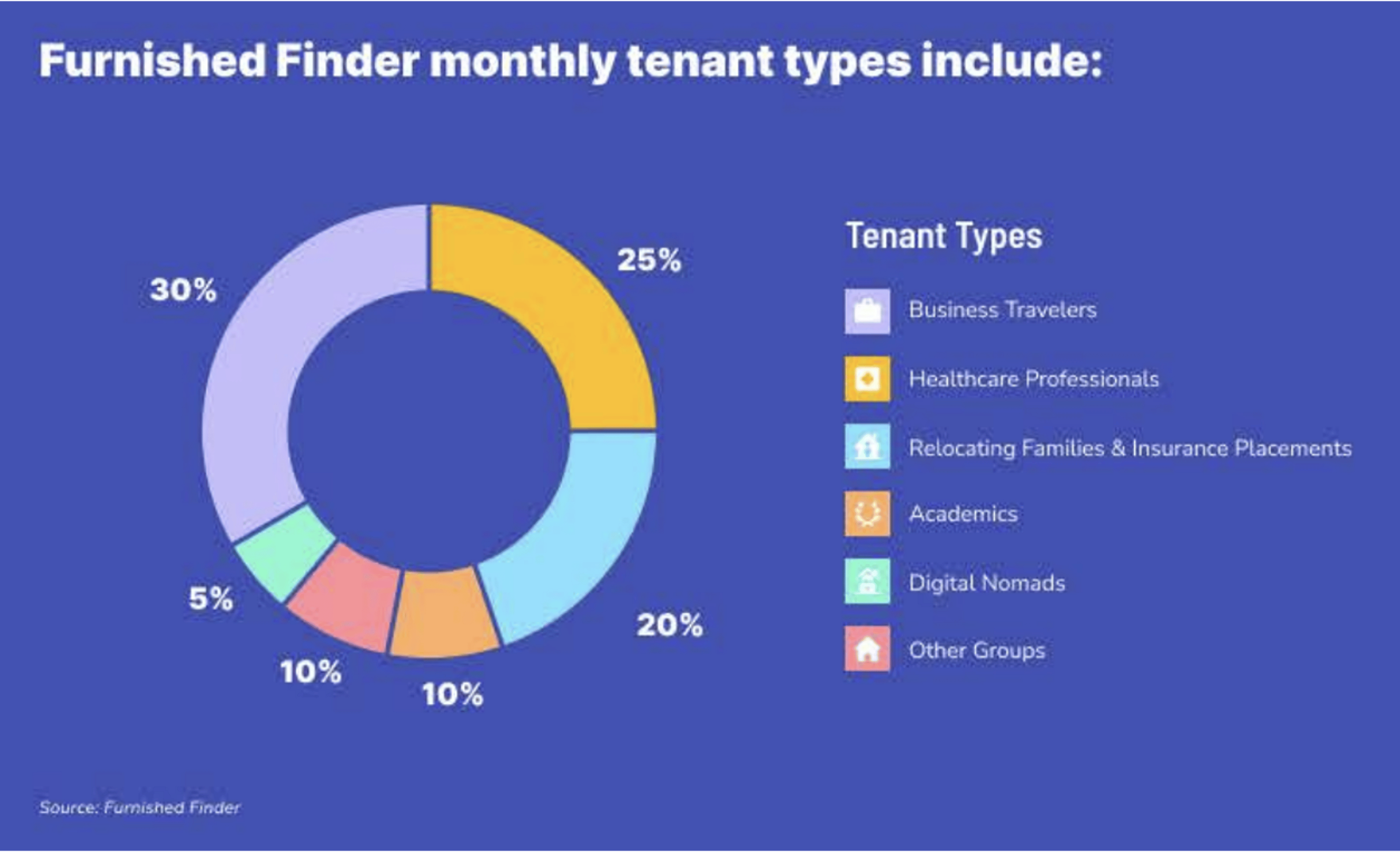
Figure: Monthly rental tenant breakdown by renter type.
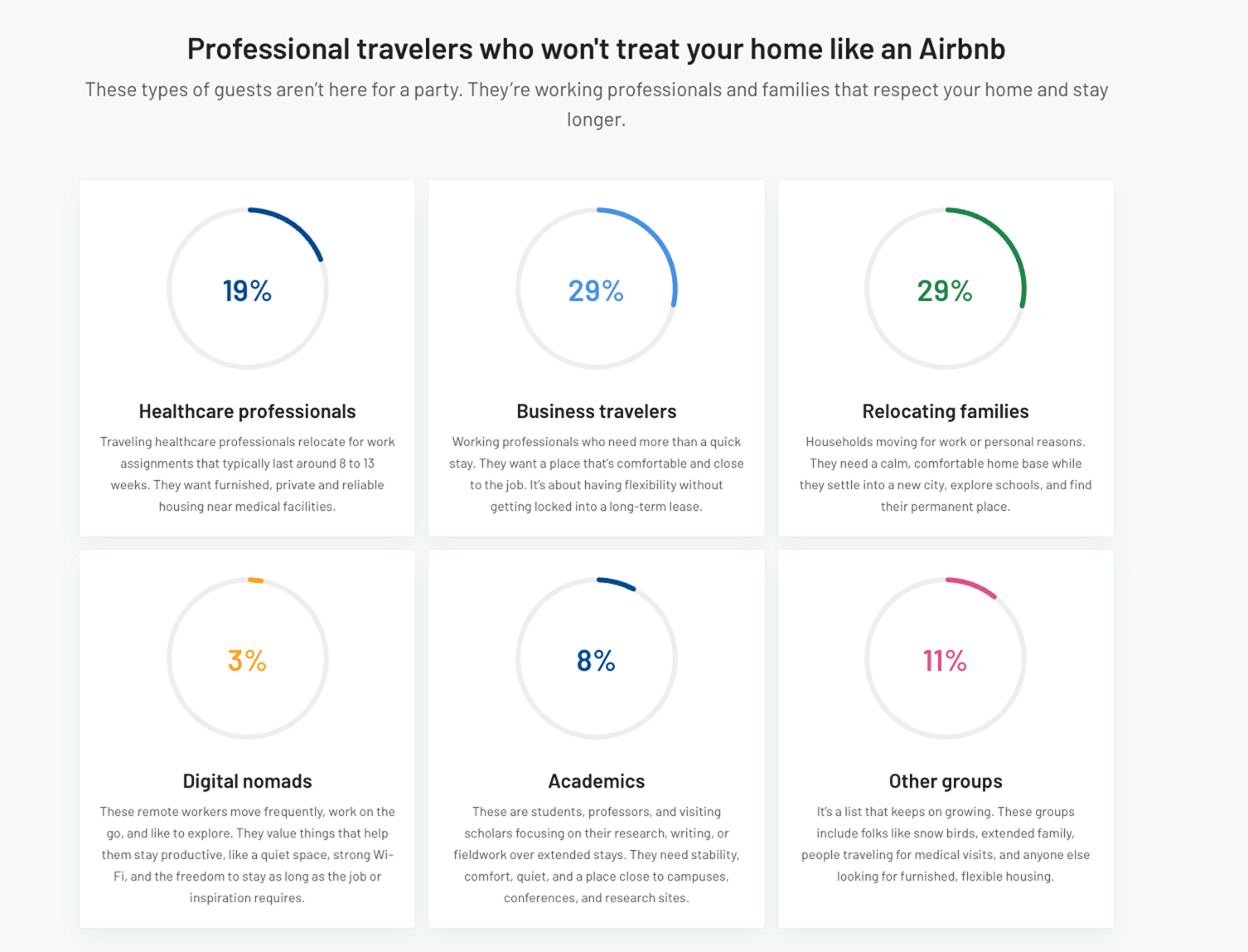
Business travelers make up the largest segment of monthly renters (around one-third of tenants), followed by traveling healthcare professionals at roughly one-quarter. The remaining share is a mix of relocating families (often including insurance placements for displaced homeowners), academic renters (students and visiting academics), and digital nomads, each contributing a significant slice of demand. The key takeaway is that there’s no single “typical” monthly renter – this housing niche serves a wide spectrum of people with purposes very different from vacationers.
Monthly rental tenant preferences
Knowing who these tenants are is only half the story – what do monthly renters want in a rental?
The Furnished Finder report breaks down preferences by tenant type, revealing how each group has its own priorities. Below we expand on these findings with some color commentary:
Business Travelers: Often corporate professionals on temporary assignment, they comprise about 35% of monthly renters. Business travelers value convenience and comfort – a clean, well-furnished place near work hubs, with reliable Wi-Fi and a hassle-free check-in. Their booking patterns are steady and their stays fairly consistent in length, making them predictable, low-drama tenants.
Healthcare Professionals: Travel nurses and medical staff account for roughly 26% of monthly tenants. This group is a reliable, recurring source of demand as hospitals hire on rotation, year-round. They often seek rentals near hospitals or clinics, in safe neighborhoods, and appreciate flexible start dates (to align with assignment schedules). Many travel solo, so a small one-bedroom or studio with essentials suits them well.
Relocating Families & Insurance Placements: This is the fastest-growing tenant category. These are folks in life transition. For example, a family relocating for a new job, or people displaced from their home due to renovations or an insurance-covered event. They often travel with others or pets, so they gravitate toward rentals offering more space (extra bedrooms, a fenced yard) and pet-friendly policies. They may prefer a house or larger apartment where they can feel “at home” during their interim stay.
Digital Nomads: Remote workers and freelancers who move from place to place are a smaller segment of monthly renters, but notably they tend to have the highest budgets. Digital nomads are willing to pay for rentals that enable their lifestyle: they prioritize quiet workspaces and fast internet, and often seek pet-friendly homes so their furry companions can join their travels. Location-wise, they might choose vibrant neighborhoods or cities that offer a mix of work and leisure opportunities, but their rental must above all support day-to-day living and remote work.
Academic Travelers: This group includes university students, visiting professors, and academic interns. They typically seek budget-friendly options and short-term housing around the academic calendar. In fact, academics are the least likely to travel with pets and are often content renting a room in a house or a no-frills studio to keep costs down. Proximity to campus or research facilities is a plus, and a quiet, study-conducive environment is important for them.
Despite their varying circumstances, monthly renters share some common preferences across the board. Affordability is a key theme: over 55% of all Furnished Finder renters search for housing priced at $2,500 per month or less.
The vast majority also focus on smaller units – about 85% of property views are for two bedrooms or fewer – indicating that a functional, right-sized space often beats a large, costly one.
Certain amenities consistently top their wish lists: pet-friendly accommodations, utilities included in the rent, in-unit laundry, and a reliable workspace rank among the most sought-after features.
In short, monthly renters are looking for a comfortable home base that makes their day-to-day life easy and affordable. Fancy extras (like hot tubs or concierge service) matter far less than a well-equipped kitchen, laundry, good Wi-Fi, and a safe, convenient location.
Monthly renters stay longer and book differently
One of the biggest differences between monthly renters and short-term vacation guests is how long they stay and how they plan their trips. Monthly renters tend to stay dramatically longer than typical tourists – often on the order of months, not days.
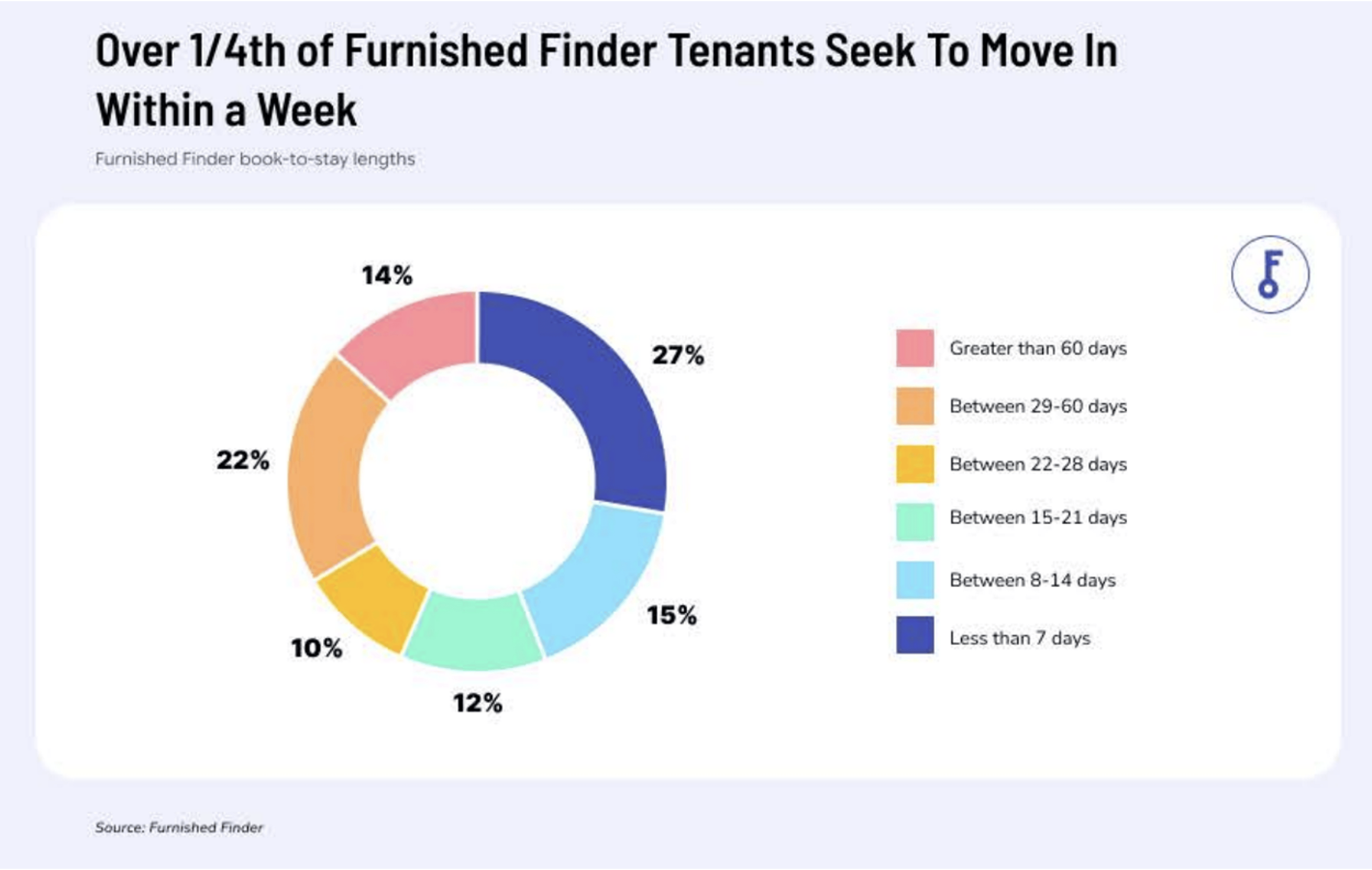
According to the report, the average monthly rental stay is around 93 to 96 days (roughly three months). That’s easily 3× longer (or more) than the average short-term rental booking, which means far less turnover for landlords. Instead of flipping the unit every week, a landlord might have the same tenant for a quarter of the year. For owners, that kind of stay length provides much more stable occupancy and fewer gaps between bookings.
At the same time, monthly renters tend to book on shorter notice compared to leisure travelers. Vacations might be planned months in advance, but many monthly tenants are responding to sudden life events – a last-minute job relocation, an unexpected work contract, etc. In fact, over 40% of monthly renters secure housing within just two weeks of their move-in date.
This compressed lead time is a hallmark of the mid-term rental market. The report data shows an interesting split: certain groups do plan ahead (for example, digital nomads and academics often search a month or more before their start date, especially if tied to a school term or a long-term remote work plan). Whereas relocation tenants, traveling healthcare pros, and business travelers usually book only a few weeks out. The latter often get notified of their assignment or project on short notice, so they need housing fast. For landlords, this means being responsive and ready is crucial – if you can accommodate a quick turnaround, you’re more likely to capture those tenants who need a place now.
Another way monthly rental bookings differ is the booking process itself. Mid-term renters behave less like guests and more like temporary residents. They typically expect a more traditional landlord-tenant interaction: direct communication with the property owner, a clear lease agreement (covering a month-to-month or fixed-term stay), monthly payment schedules instead of nightly rates, and the flexibility to extend the stay if needed.
In essence, these renters are looking for a home and a hassle-free living arrangement, not a vacation booking. This more relationship-driven approach often leads to better understanding on both sides and can translate into longer tenancies, fewer turnovers, and more predictable income for the owner.
Monthly rental demand is highly geographic
While monthly renters share similar motivations nationwide, demand looks very different market to market.
Monthly rental demand tends to concentrate in:
Healthcare corridors with large hospital systems
Corporate employment centers
University cities
Military and government assignment regions
Fast-growing metros experiencing population relocation
Areas impacted by insurance-displacement events
Unlike vacation demand, which follows beaches, ski resorts, and attractions, monthly rental demand follows jobs, infrastructure, and life transitions.
In some markets, healthcare professionals dominate inquiries. In others, relocating families drive demand. A college town may skew academic, while a fast-growth Sunbelt metro may see higher corporate and relocation activity.
Understanding your local renter mix is critical to pricing, furnishing, and marketing effectively.
See who is driving demand in your market
National trends tell part of the story. Local data tells the rest.
Furnished Finder’s Market Insights (opens in new tab) allows property owners to analyze their specific metro and understand:
The breakdown of renter types in their area
Average stay lengths
Pricing benchmarks
Seasonality patterns
Supply and demand dynamics
Which professional segments are most active locally
In many large hospital markets, healthcare professionals represent a substantial share of inquiries. In high-growth metros, relocating families may be expanding rapidly. In university towns, academic demand may spike predictably each semester.
Rather than guessing who might book your property, Market Insights allows you to see exactly who is searching in your area, and position your listing accordingly.
Monthly rentals support life transitions, not trips
Monthly rentals are best understood as temporary housing for life transitions, not travel. Furnished Finder’s data shows these stays function as a short-term home during periods of change, whether someone is relocating for work, starting a new assignment, attending school, or navigating an unexpected disruption. Demand reflects that reality. It’s strongest in employment centers, healthcare hubs, and university markets, not resort towns. These renters need housing that supports everyday living, and they care far more about practical essentials than vacation-style amenities.
For owners and landlords, this shift creates a clear opportunity. Monthly renters stay longer, book year-round, and treat properties like a home. That means less turnover, fewer vacancies, and more predictable income. By listing on Furnished Finder (opens in new tab), you connect directly with traveling professionals, healthcare workers, and relocating families who are actively searching for furnished housing. If you’re looking for stability instead of seasonality, now is the time to tap into the growing monthly rental market with Furnished Finder.